
In the Age of the Polycrisis
How Complex Crises Arise and How We Can Address Them
In recent years, the world has experienced a variety of crisis situations that can be understood as a complex system of parallel, overlapping, and interconnected crises. These polycrises have the potential to cause the failure of social and political systems, but have so far received insufficient scientific attention—both conceptually and in terms of their effects. This interdisciplinary project aims to examine the tension between complex crises and the necessary sociopolitical reduction of this complexity. For it is precisely this reduction of complexity that carries the risk of causing crisis communication to fail or of polarizing societal discourses.
To date, there has been no theory-driven conceptual examination of the term “polycrisis” in the social sciences. Its application to empirical observations to date has not been sufficiently theorized; consequently, it remains analytically unclear how a polycrisis can be identified and which individual crises, in what form, constitute a complex system of systemic risks. We therefore see the social-scientific conceptualization of polycrises as a means of reducing complexity. Furthermore, there have been hardly any empirical analyses to date regarding the course, management, and consequences of polycrises for societies and states. This is due, on the one hand, to the fact that the academic community has not yet reached a consensus on an adequate conceptualization of polycrises. On the other hand, however, the few empirical studies that exist demonstrate that the analysis of polycrises and the reduction of their complexity pose methodological challenges.
This research project aims to conceptualize the emergence, development, and progression of polycrises, as well as to examine their impact on social and political discourses and, consequently, on crisis management, in order to provide insights into how these novel crises can be addressed. To this end, we aim to answer two questions in this research project:
- How can the dynamics (origin, development, progression) of polycrises be described and conceptualized more effectively?
- How do global polycrises influence social and political discourses regarding crisis management and the reduction of complexity?
To address the complex topic of polycrises and their effects, theoretical approaches and research methods from International Relations and American Studies will be combined, including, for example, complexity theory, the theory of ontological security, and methods from corpus-based discourse analysis.
As a first step in the work plan for this research project, theoretical assumptions will be developed based on the literature in International Relations, polycentrism, sociology, and complexity research, which address the question of how polycentric crises can be conceptualized and what potential impacts various polycrises may have on nation-states and their societies. Although IR research has dealt extensively with the concept of crisis, the discipline has so far lacked a systematic understanding of what “polycrisis” means and encompasses. Against this backdrop, this research project begins by integrating approaches to concept formation in order to develop a thorough conceptualization of the polycrisis. This is intended to help understand the widespread uncertainty and complexity that have become characteristic features of today’s international politics.
In a second step, we will then apply the developed concept of polycrisis and, using a mixed-methods approach, examine specifically how social and political discourses take shape in the context of global polycrises. The first case study addresses the polycrisis of global climate change and natural disasters, as well as the social, societal, and political factors that exacerbate their impacts. The second case examines the polycrisis of the war in Ukraine and the associated economic, food supply, and energy crises. Due to their complexity and multifaceted nature, both cases represent ideal types of a polycrisis, but they potentially vary in terms of their diffusion and nonlinearity.
Due to their diffuse complexity within societies, polycrises are often perceived differently, leading to dissent over whether a crisis situation exists at all, who or what caused the crisis, and how it can be overcome. Due to their complexity and seemingly never-ending uncertainty, polycrises have the potential to polarize crisis discourses, which in turn can influence crisis management. Through a methodological approach combining quantitative and qualitative discourse analysis, the project aims to explore the concept of the polycrisis and thereby provide insights into state action in these crisis situations and the perceptions of such action. The United States, as a global superpower, continues to play a decisive role in this regard. However, the project also aims to draw comparisons with other political systems, such as Germany. Here, we are interested in the role that discourse patterns and actors play in the perception and addressing of complex crises, and whether these contribute to the effective management of polycrises (reduction of complexity). Due to their particular complexity, polycrises create a high degree of uncertainty regarding the expected material and immaterial costs to society and the state. Consequently, governments, societies, and individuals strive to reduce the enormous complexity of today’s polycrises in order to legitimize public engagement and acceptance of crisis management in the first place.
The WIN Kolleg offers attractive conditions for interdisciplinary collaboration and networking for our research project. When examining perception and communication in crisis situations, the project can benefit from collaboration with other disciplines—for example, in addressing how crisis communication unfolds not only at the national and societal levels but also how it is processed by individuals on a personal, psychological level. This allows for a holistic understanding of the societal impacts of polycrises and also enables us to examine individual vulnerability to and resilience in the face of crises.
 HAdW/Schwerdt
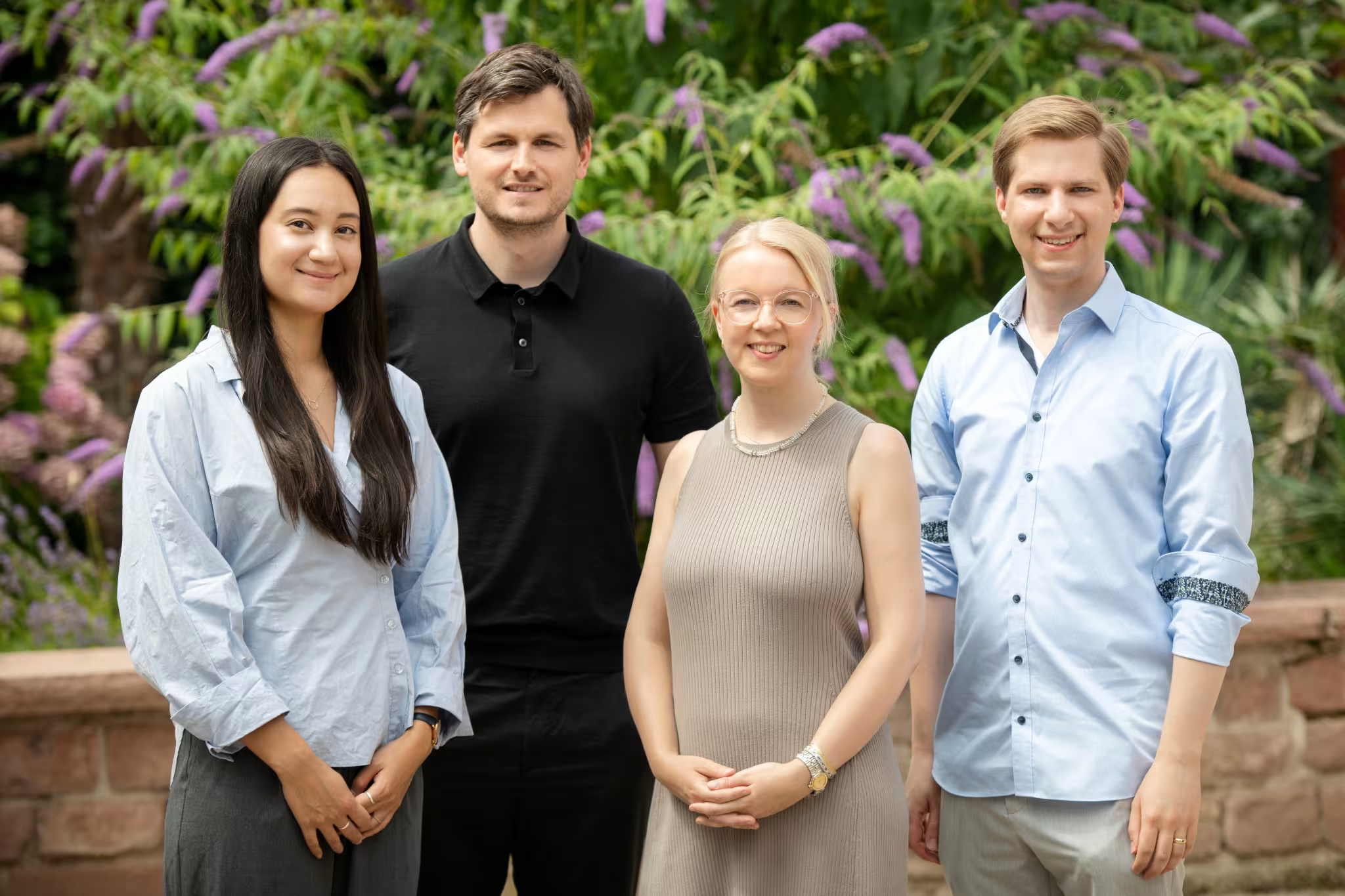
Polycrisis Team
WIN Fellows
Dr. Gordon M. Friedrichs
Gordon Friedrichs is a Senior Research Fellow in the MAGGI Research Group at the Max Planck Institute for Comparative Public Law and International Law in Heidelberg. Previously, he was a Fulbright Schuman Fellow at the Kellogg Institute for International Studies at the University of Notre Dame and a postdoctoral researcher at the Department of Political Science at the University of Freiburg.
His research focuses on international relations and comparative foreign policy analysis. In particular, his research examines (1) the effects of polarization and populism on the foreign policy of democracies, with a focus on the United States; (2) the resilience and transformation of global governance institutions; and (3) interstate relations in East Asia and the Asia-Pacific region. More broadly, he is interested in how the interplay between domestic and foreign policy influences the role of states in the areas of security, trade, and the rule of law.
He has published three books: U.S. Global Leadership Role and Domestic Polarization: A Role Theory Approach (Routledge, 2020), The Politics of Resilience and Transatlantic Order (co-authored with Sebastian Harnisch & Cameron Thies, Routledge, 2019), and National Role Conceptions in a New Millennium: Defining a Place in a Changing World (co-edited with Michael Grossman and Francis Shortgen, Routledge, 2022). His research has also been published in International Studies Review, Foreign Policy Analysis, International Politics, Journal of Global Security Studies, International Relations, and the Journal of International Relations, among others.
Further information about Gordon Friedrichs can be found here.

Dr. Natalie Rauscher
Natalie Rauscher is a postdoctoral researcher at the Heidelberg Center for American Studies (HCA) at Heidelberg University. Her research focuses on public and political discourses regarding the future of work and the platform economy in the United States. Her other research focuses include topics such as social movements, social media, U.S. philanthropy and think tanks, as well as natural disasters in the United States.
In her postdoctoral project, Natalie Rauscher examines U.S. philanthropy in the 21st century and, in particular, how new actors and new approaches to giving within (mega)philanthropy might affect public trust in this sector.
In 2021, her dissertation was published by Springer under the title The Future of Work in the United States - Discourses on Automation and the Platform Economy in the series Contributions to Economics. She has also published in journals such as Zeitschrift für Politikberatung, Zeitschrift für Politikwissenschaft, and Politische Vierteljahresschrift.

Members of the research team
Stella Kim
Stella Kim is a research associate at the Heidelberg Academy of Sciences and Humanities and is pursuing her Ph.D. on how complex crises—particularly climate change, pandemics, and strategic rivalries—impact armed conflicts in the evolving multipolar order of the 21st century. She earned her master’s degree in Security, Intelligence, and Strategic Studies in 2022 from the University of Glasgow, the University of Trento, and Charles University in Prague. She holds a bachelor’s degree in political science from Goethe University Frankfurt, during which time she also studied at Ewha Womans University in Seoul.
Previously, she worked for various European think tanks, where she published papers primarily on defense strategies in the Indo-Pacific, as well as at the Federal Ministry of Defense and the European External Action Service, which combined her research interests in security, defense, conflict analysis, and diplomacy in the Euro-Atlantic and Asia-Pacific regions.
 HAdW/Schwerdt
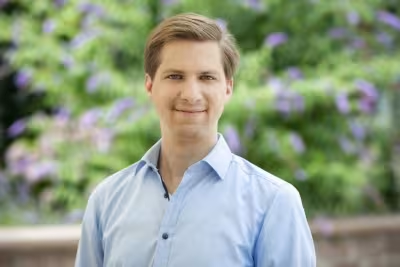
Steven Schwarz
Steven Schwarz is a research associate at the Heidelberg Academy of Sciences and Humanities. As part of his doctoral research, he is examining the role of domestic sectors and economic actors in the formulation and implementation of foreign and security policy in international relations in the age of polycrisis, using the examples of the Federal Republic of Germany and Japan.
Steven Schwarz earned his Master of Arts in Political Science at Ruprecht Karls University of Heidelberg, where he also completed related coursework at the Faculty of Law. During a one-year study abroad program at the Institut d’études politiques de Lille (Sciences Po Lille), he also earned a Certificat d’Études Politiques. Prior to that, he earned a Joint Bachelor of Arts in History and Political Science from the Technical University of Darmstadt. During his bachelor’s program, he also spent a semester studying at the Department of International Politics at Aberystwyth University in Wales. His master’s studies were supported by a scholarship from the Friedrich Naumann Foundation for Freedom.
In October and November 2025, Schwarz undertook two research stays in Tokyo as a visiting researcher at Sophia University and the University of Tokyo.
 HAdW/Schwerdt
Svenja Wiederroth
Svenja Wiederroth has been working as a student assistant on the “In the Age of the Polycrisis” project at the Heidelberg Academy of Sciences and Humanities since May 2025. She is currently pursuing a Master of Arts in Political Science and Geography at Heidelberg University. She completed her bachelor’s degree with a minor in Public Law; during that time, she spent a semester abroad at the University of Galway. She previously gained professional experience through her work as a trained patent attorney’s assistant, as well as through practical experience acquired during her studies—including at Department 3 of the City of Karlsruhe, the Heidelberg Center for the Environment, and the Heidelberg Institute for International Conflict Research e.V.
Anthologies

Articles in academic journals
- Friedrichs, Gordon M. and Jule Sommer. “Ontological Security Crisis and Role Conception Change: The Impact of the Russian Invasion of Ukraine on the European Union's Role Conceptions” (2024). The European Journal of International Relations (forthcoming).
- Friedrichs, Gordon M. and Natalie Rauscher. “Icon of Freedom? American Society and the U.S.’s Leadership Role in the (Poly)Crisis” (2024). Athene Magazine of the Heidelberg Academy of Sciences and Humanities.