
“Farm | Music | City” Research Center
On January 1, 2021, the “Hof | Musik | Stadt” Research Center began its work under the direction of Prof. Dr. Christiane Wiesenfeldt (Heidelberg) and Prof. Dr. Panja Mücke (Mannheim). As a collaboration between the Heidelberg Academy of Sciences and Humanities, the Mannheim State University of Music and Performing Arts (external link) and the Department of Musicology at Heidelberg University (external link), it is the successor to the research project “Southwest German Court Music” (internal link) at the Heidelberg Academy of Sciences and Humanities.
The Idea
The research center, located in Schwetzingen, is dedicated to teaching, public outreach and music education, research and publication, as well as project planning and grant applications. Dr. Rüdiger Thomsen-Fürst serves as the research center’s full-time staff member.
From the late Middle Ages through 1918, the court was a major driving force behind musical life in southwestern Germany. Within the borders of the state of Baden-Württemberg, there are numerous residences of varying sizes where not only did the modern orchestra as an ensemble take shape, but where the development of court music also evolved from a means of princely representation into city and state orchestras with an educational mission. Although commendable research on southwestern German court music has been conducted in recent decades, there remain gaps in our knowledge, particularly at the intersection of court and city.
Research Projects
In the field of research, the expertise of staff member Dr. Thomsen-Fürst and the two directors Prof. Panja Mücke (external link), who specializes in 18th-century court music research, and Prof. Christiane Wiesenfeldt (external link), who specializes in research on bourgeois, Romantic music culture, have formed a constructive partnership. The project examines the period of upheaval in the broadly defined decades around 1800, exploring both discontinuities and continuities in the transition from a court-based to an urban musical culture in southwestern Germany. To date, research has more or less assumed separate spheres of activity—music at court and music in a bourgeois city—which, tied to a narrative of progress initiated by Enlightenment studies, were believed to have inevitably succeeded one another. The fact that this is by no means the case—that courtly and urban musical cultures influenced one another in various ways, and that numerous structures originally associated with the court (concerts, theater) persisted even after the loss of a royal residence—represents, in its dynamics, one of the as-yet unexplored areas of research concerning the period around 1800.
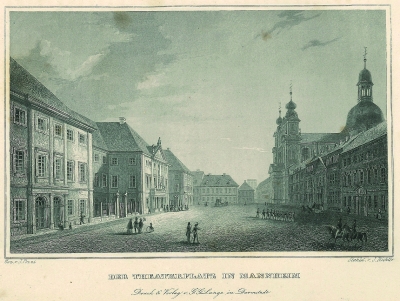 Hof Research Center, Music, City
Theaterplatz in Mannheim, steel engraving by Johann Carl August Richter, after Giacomo Pozzi, circa 1840.
University Education Programs
The Research Center’s high level of expertise—which is unique in the context of court music in southwestern Germany—will be reflected first and foremost, and on a regular basis, in the teaching activities of the bachelor’s and master’s degree programs at Heidelberg University and the Mannheim State University of Music and Performing Arts. The teaching will focus in particular on digital edition, one of the most important future fields in the discipline of musicology. In addition, a summer school for international students and doctoral candidates is planned; it will take place every two years and give young international researchers the opportunity to become familiar with the Southwest German repertoire and the venues where these events took place.
Public Relations
The connection to musical practice and the public is essential to the research center. Its responsibilities therefore include advising musicians and ensembles as well as lending out performance materials. The long-standing collaboration with the Schwetzingen SWR Festival (external link) is to be continued in an intensive manner. Two high-profile academic conferences accompanied by concerts are firmly scheduled for the duration of the Research Center (on topics such as “The Southwest German Region and Court Culture in the 19th Century” or “The Loss of Royal Residences in the Southwest around 1800”), which will also help the directors invite international experts to Schwetzingen.