Ericson's Sticks
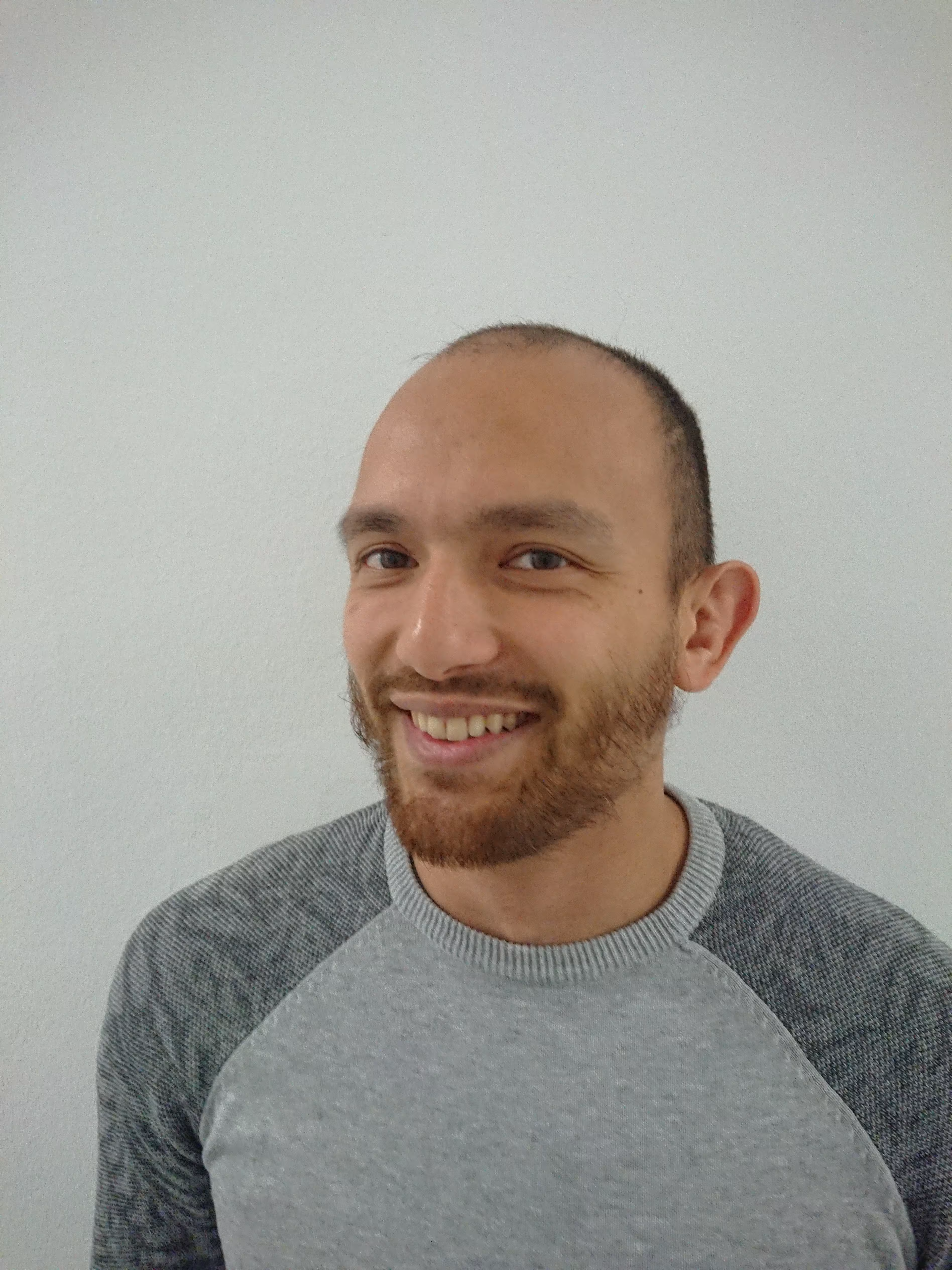
Curriculum Vitae
Doctoral student
My work focuses on hominin dispersal and the processes involved. Hominin dispersal is driven not only by changes in the environment but also by a series of active decisions. Agent-based modeling is best suited for modeling the interaction between a population and its environment, which we believe is a driving factor in hominin dispersal. A prominent example is “Out of Africa.” There are currently four possible routes for human dispersal out of Africa: via the Bab al-Mandab Route, along the Levantine Corridor, the Sicily Route, and/or the Gibraltar Route. Several hypotheses may play a role in hominin dispersal, such as ecological variations, demographic pressure, climatic changes, biological and social organization, the dispersal of megafauna, competition with carnivores, vegetation, and sea-level changes. Using agent-based modeling, we can develop, test, and compare different scenarios that incorporate all of the aforementioned hypotheses.
Since January 2015, research fellow in agent-based modeling and simulation
August 2013 – December 2014: Research fellow responsible for maintaining and completing the “Roceeh Out of Africa Database” (ROAD) and agent-based modeling
October 2012 – July 2013: Research fellow in 3D modeling and 3D scan processing of primate molars at the Department of Paleoanthropology and Messel Research, Section on Tertiary Mammals, Senckenberg
2013 Diploma in Bioinformatics. Thesis title: “Simulation of the functional-morphological evolution of developmental stages in bunodont primate molars” (Goethe University, Frankfurt).
July 2020: ROCEEH Conference 2020 “Human Origins – Digital Future” in Frankfurt, Germany
September 2019: PaleoMaps Workshop 2019 “Modeling and Mapping Paleoenvironments,” Germany
July 2019 International Union for Quaternary Research (INQUA) 2019, Ireland
April 2019: Computer Applications and Quantitative Methods in Archaeology (CAA) 2019, Poland
November 2018 METHOD IFG Workshop “We boldly went”: Advances and Progress in Modeling the Mid-Pleistocene Revolution, Spain
April 2018: METHOD IFG Training Lab on Agent-Based Modeling, Germany
March 2018: Computer Applications and Quantitative Methods in Archaeology (CAA) 2018, Germany
April 2017 METHOD IFG Workshop “Keep calm and boldly go” – Which environmental factors drove early human expansion and influenced their settlements?, Germany
March 2017: Computer Applications and Quantitative Methods in Archaeology (CAA) 2017, USA
September 2016 METHOD IFG Training Lab: Data Availability, Management, and Storage—Working with Databases, Italy
May 2016 Royal Anthropological Institute – Anthropology, Weather, and Climate Change 2016, United Kingdom
03/2016 Computer Applications and Quantitative Methods in Archaeology (CAA) 2016, Italy
07/2015 Expansions 2015, Germany
06/2015 International Interdisciplinary Summer School “Origins of Human Cooperation” with Michael Tomasello, Germany
03/2015 – 04/2015 Computer Applications and Quantitative Methods in Archaeology (CAA) 2015, Italy
09/2014 Union International de Sciences Préhistoriques et Protohistoriques (UISPP), Spain
Selected publications and lectures
Hölzchen, E., Hertler, C., Mateos, A., Rodríguez, J., Jan Ole Berndt & Timm, I. (2021): Discovering the opposite shore: How did hominins cross sea straits?. PLOS ONE. DOI: 10.1371/journal.pone.0252885
Willmes, C., Niedziólka, K., Serbe, B., Grimm, S.B., Groß, D., Miebach, A., Märker, M., Henselowsky, F., Gamisch, A., Rostami, M., Mateos, A., Rodríguez, J., Limberg, H., Schmidt, I., Müller, M., Hölzchen, E., Holthausen, M., Klein, K., Wegener, C., Weninger, B., Kellberg Nielsen, T., Otto, T., Weniger, G.C., Bubenzer, O., & Bareth, G. (2020): State of the Art in Paleoenvironment Mapping for Modeling Applications in Archaeology—Summary, Conclusions, and Future Directions from the PaleoMaps Workshop. Quaternary 3 (2), p. 13. DOI: 10.3390/quat3020013
Volmer, R., Hölzchen, E., Wurster, A., Ferreras, M.R., & Hertler, C. (2017): Did leopards (Panthera pardus) become extinct because of competition for prey? Modeling interspecific competition within the Late Pleistocene carnivore guild of the Padang Highlands, Sumatra. Palaeogeography, Palaeoclimatology, Palaeoecology 487, 175–186. DOI: 10.1016/j.palaeo.2017.08.032
Timm, I., Lorig, F., Hölzchen, E., & Hertler, C. (2016): Multi-scale Agent-Based Simulation of Long-Term Dispersal Processes: Towards a Sophisticated Simulation Model of Hominin Dispersal. In: J.A. Barceló & F. Del Castillo (eds.) Simulating Prehistoric and Ancient Worlds. Computational Social Sciences. Springer, Cham, pp. 141–157.
Hölzchen, E., Hertler, C., Timm, I., & Lorig, F. (2016): Evaluation of Out-of-Africa hypotheses using agent-based modeling. Quaternary International 413, Part B, 78–90.
Timm, I., Lorig, F., Hölzchen, E., & Hertler, C. (2014): Multi-Scale Agent-Based Simulation of Long-Term Dispersal Processes: Challenges in Modeling Hominin Biogeography and Expansion, 1–3.
Kubi, M., Schäfer, M., & Hölzchen, E. (2010): Salt-tolerant Plants and Algae. Report on the marine biology field trip organized by the Zoological Institute of the University of Frankfurt to Rovinj, Croatia, 17–20.
Free text
- Hominid dispersal
- Agent-based simulation