
Goethe Dictionary
Goethe Dictionary
The Goethe Dictionary is a context-specific dictionary of meanings that presents Goethe’s entire vocabulary—approximately 90,000 headwords—in alphabetical order, with entries systematically organized according to usage. It takes equal account of everyday language, diverse technical terminology, and the distinctive features of Goethe’s poetic language. This reference work, which has become indispensable not only for analyzing Goethe’s poetry but also as an aid to understanding all texts from the Classical to the Romantic periods, has already reached the final third of the alphabet.
Anyone who wants to know how people spoke about “humanity” and the “nation,” the “public” and the “private,” “politics” and the “police”—and, not least, about “the majesty of the mob” and “the theory of the rabble”—during the Rococo and Biedermeier periods will find what they’re looking for here. Clearly structured entries provide comprehensive information on the sometimes quite surprising aspects of meaning in the cradle of modern German; the findings are illustrated in a way that is both vivid and entertaining with original quotations, including some from the fringes of Goethe’s oeuvre.
The Goethe Dictionary is an inter-academic project. In addition to Tübingen, research centers have been established since the project’s inception in Leipzig—under the auspices of the Berlin-Brandenburg Academy of Sciences and Humanities—and in Hamburg—under the auspices of the Lower Saxony Academy of Sciences and Humanities Göttingen.
Goethe on Dictionaries
"The riding horses were nowhere to be seen; the large kitchen wagon, drawn by six sturdy horses, passed me by. I climbed aboard; it wasn’t entirely empty of provisions, but the kitchen maid was standing in the corner looking very glum. I turned my attention to my studies. I had taken the third volume of Fischer’s Physical Lexicon out of my suitcase; in such cases, a dictionary is the most welcome companion, where interruptions occur at any moment, and then it provides the best distraction by leading us from one topic to another."
(Campaign in France. 1792)
program
In the beginning was the Word —in our case: a text, specifically a “memorandum” by the Berlin classical philologist Wolfgang Schadewaldt. With his programmatic memorandum, he succeeded Academy of Sciences and Humanities late 1946 Academy of Sciences and Humanities the German Academy of Sciences and Humanities to dedicate a biographical dictionary to Germany’s most famous poet, just as such works had long been a matter of course for the leading figures of other national literatures.
Schadewaldt had specifically approached one of the academies of sciences, as he viewed them as the “cathedral workshops” of research—the only institutions he believed had the staying power required for such a project. Following the establishment of the research centers in Berlin and Hamburg ( 1947), the Tübingen center was founded in 1951 at Schadewaldt’s new chair. About three decades later, the Goethe Dictionary project was incorporated into the Academies' Programme for long-term projects.
Structure of the articles
A longer entry in the Goethe Dictionary is typically divided into eight sections:
Keyword, introductory note, definition, quotations, source references, information on usage, information on word formation, information on synonyms.
The introductory note may include, among other things:
- an outline of the article,
- Information on spelling, pronunciation, word form, case,
- Information on frequency and distribution across text groups or meanings,
- Information about the lexical field context,
- Information on the history of words or terms,
- Information on any distinctive features or notable aspects of Goethe's use of the term.
The main body is organized hierarchically using alphanumeric section markers (I, A, 1, a, α) and may include, among other things:
- Information about lexical meanings, usually in the form of definitions, synonyms, or paraphrases,
- Information on antonyms,
- Information regarding meaning modifications, connotations, evaluations, perspectives, and references that are specific to an individual, a work, a character, or a context,
- Information on poetic features, such as imagery, symbolism, ambiguity, and associativity,
- Information on the use of terms and terminology.
Information on areas of usage (e.g., anatomical, architectural, mining), stylistic patterns (e.g., letter style, official style), and stylistic qualities (e.g., humorous, coarse) usually appears in conjunction with the definitions.
The quotations serve to substantiate the respective meaning and, at the same time, convey an idea of the variety of possible uses in different contexts. Illustrative quotations can also replace the explanation of meaning. Quotations and source references can often only be provided in a strictly limited selection.
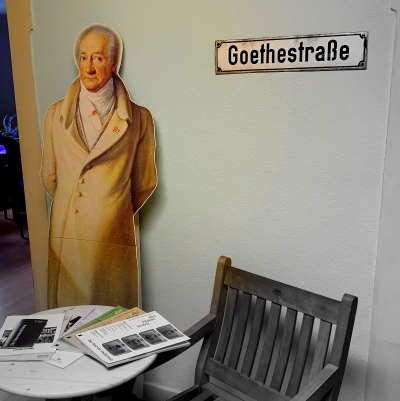
Job in Tübingen

Goethe Dictionary, Tübingen

Entrance to the workplace
Goethe Dictionary Online
Volumes I through VII were made available online with support from the DFG at the Trier Center of Excellence for Electronic Publishing.
You can also find the Goethe Dictionary on Mastodon!
Newly added words: Supplement list, as of 2026
Goethe Dictionary, Tübingen
Tübingen Office Management
- Sofia Frys, M.A.
Employees
- Moritz Bareiß, M.A.
- Dr. Volker Hartmann
- Sontje Schulenburg, M.A.
- Kornelia Wegenast(Secretariat and Archives)
Research Assistants
- Annika Hermann
- Malie Johanning
Former department heads
- 1961–1972 Prof. Dr. Wolfgang Schadewaldt
- 1972–1982 Dr. Wolfgang Herwig
- 1982–1998 Dr. Rose Unterberger
- 1998–2020 Dr. Rüdiger Welter
- 2020–2024 Jutta Heinz, Ph.D. (Habil.)
- 2024–2025 Dr. Martina Eicheldinger
Members of the Interacademic Commission
- Prof. Dr. Achim Aurnhammer (Freiburg), Chair
- Prof. Dr. Barbara Beßlich (Heidelberg)
- Prof. Dr. Andreas Gardt (Kassel)
- Prof. Dr. Thomas Gloning (Giessen)
- Prof. Dr. Ulrike Haß (Duisburg-Essen)
- Prof. Dr. Ernst Osterkamp (Berlin)

Photo from the early days of the Tübingen office, founded in 1951. On the right is the project’s initiator, Wolfgang Schadewaldt.
Published Volumes
(Kohlhammer Publishing, Stuttgart)
Volume 1: A – azurn (1978)
Volume 2: B – Orientation (1989)
Volume 3: Object – Whisper (1998)
Volume 4: Business – Imprisonment (2004)
Volume 5: Contents – Medical Expenses (2011)
Volume 6: Medical Edition – Promenade (2018)
Volume 7: Promenade Day - (2)she (2023)
Volume 8: Issue 1: Sieb – sollen (2024)
Ex. 2: (1) Söller – reflection (2024)
Lfg. 3: Mirror Plate – Steadfast (2025)
Section 4: Steadfastness – Star (2025)
Track 5: Sternall – Striving (2025)
Book 6: Companion in the Quest – Substance (2025)

Links
- About the Berlin/Leipzig Office
- About the Hamburg Office
- Go to the Goethe Dictionary online (Competence Center Trier)
- Goethe's Quote of the Week on X
- Goethe's Quote of the Week on Mastodon
- To the Goethe Lexicon of Philosophical Concepts
- About Propylaeum: Goethe's Biography
- Faust Digital
- Go to the Goethe Era Portal
- About the Goethe Society in Weimar
- About the Weimar Classical Foundation
- On the Controversy Surrounding Goethe's 'Theory of Colors'
- About the " Classic Vocabulary" Project
- About the Jacobi Dictionary Project
- About the ZBK Project (Key Concepts of the Classical-Romantic “Art Period” (1760–1840). A Dictionary of Literary and Artistic Reflection in the Goethe Era)
Job in Tübingen
Heidelberg Academy of Sciences and Humanities
Goethe Dictionary Project
Frischlinstraße 7 | 72074 Tübingen
Phone: +49 (0) 7071 / 29 72145
Fax: +49 (0) 7071 / 25 4002
Email: gwbsekretariat[at]oe.uni-tuebingen.de
