
Karl-Jaspers-Gesamtausgabe (KJG)
Karl Jaspers (1883-1969) was one of the most important German-speaking philosophers of the 20th century. With a doctorate in medicine and a habilitation in psychology, he was a full professor of philosophy in Heidelberg until his dismissal by the Nazi regime in 1937. In 1948, Jaspers accepted an academic call to the University of Basel, where he taught until his retirement in 1961.
‘Truth is what unites us‘ is one of Jaspers’ key sentences, whose thinking – following the humanist tradition of the great philosophers – is dedicated to the attempt to find orientation in a world that has become questionable and prone to ideology. As a metaphysician, Jaspers was also a co-founder of existential philosophy – and a prominent critic of post-war German politics.
The Karl Jaspers Complete Edition (ger. Karl-Jaspers-Gesamtausgabe, abbr. KJG) presents his multi-layered œuvre as a whole for the first time. In three sections – Works, Estate, Letters – all of Jaspers’ latest published writings, relevant posthumous publications, and a selection of further, previously unpublished estate texts and correspondence are being printed. An additional focus of the editorial work, in co-operation with the Karl Jaspers Foundation in Basel, is the systematic indexing of the Jaspers estate held in the German Literature Archive.
The KJG is a joint project of the Heidelberg Academy of Sciences and Humanities with a research centre in Heidelberg and the Lower Saxony Academy of Sciences and Humanities in Göttingen (external link) with a research centre in Oldenburg.
The Author
Karl Jaspers is one of the most important thinkers of the 20th century and one of the most widely translated German-speaking philosophers in the world. For him, the truth of philosophy is philosophising itself, as both a radical way of existence and illumination of existence. Jaspers' entire thinking is therefore dedicated to the attempt to find orientation in a world that has become deeply questionable. As a metaphysician and philosopher of history, Jaspers furthermore serves as a co-founder of existential philosophy, as well as one of the most prominent critics of post-war German politics.
Jaspers was born in Oldenburg in 1883. After studying medicine, he began working at the psychiatric clinic in Heidelberg, starting in 1909. His habilitation thesis, which was first published in 1913 under the title General Psychopathology and subsequently appeared in repeated editions with some major revisions, is still one of the classic texts in the field today. Jaspers did not switch to philosophy until 1922, the year in which he was appointed to a chair of philosophy at Heidelberg University on the basis of his Psychology of Worldviews; published in 1919, the book can be regarded as the founding text of modern existential philosophy. Jaspers' main programmatic work, Philosophy in three volumes, was published in 1932, followed by the first volume of his Philosophical Logic (On Truth) in 1947 and finally The Great Philosophers in 1957 - titles that refer to the thinker's most comprehensive, if not necessarily most influential, works. In 1937, the National Socialists forced Jaspers into early retirement because he did not want to separate from his Jewish wife. Nevertheless, they both remained in Germany despite facing the imminent possibility of arrest and deportation to a concentration camp at any time, and Jaspers was also banned from publishing from 1938 onwards. The couple left Germany only after the war, mainly because they were deeply disappointed by the way Germany dealt with the recent past following the war’s end. In 1948, Jaspers and his wife moved to Basel, where he held a professorship in philosophy until 1961; he died there in 1969.
Jaspers' sphere of influence extended far beyond philosophy: in addition to philosophers, his students - and this roster represents the enormous range of his work - included doctors, historians, literary scholars, filmmakers and writers; his interlocutors and correspondents were not only scientists from other disciplines, but also politicians, publishers, judges and statesmen. As a political writer, a role he increasingly adopted on the basis of philosophical and philosophical-historical themes, he made a significant contribution to the social debates of the newly founded Federal Republic of Germany with his topical writings, and this alone made him a formative figure in cultural and political history.
The Work
Initially, the debates surrounding Jaspers’ work focused primarily on psychopathology and psychology, followed by existential philosophy and the logical foundation of the philosophy of reason.
Jaspers' thinking was increasingly dominated by a global approach to philosophy that went beyond the Eurocentric frame of reference and yet was always historically based. In its openness to history, this approach sought to offer more than traditional or even adopted metaphysics, namely a new metaphysics that could open up a space of its own for transcendence and could therefore be the ultimate goal of all religion. However, the matters of philosophical faith, the world history of philosophy, world philosophy and the philosophical illumination of world politics that increasingly emerged as questions in his work after 1945 were neither seen as an idea nor recognised as the far-reaching task of the age, not least because of their sometimes-fragmentary manner of publication - despite the fact that Jaspers used a readily graspable terminology (e.g. the concept of ‘axis time’) and was prepared to utilise a wide-ranging framework of thought (from ancient transcendental metaphysics to Indian logic). This disregard for Jaspers' late work is also a particular shortcoming because in it he offers possible answers to current cultural, metaphysical and religious philosophical questions. It is fair to say that this late work in particular has remained unrecognised and misunderstood to this day - a situation that can only be remedied by making his extensive estate as comprehensively accessible as possible.
Jaspers is a radical thinker in the best sense of the word - not in a political sense, but in his unwavering will to honesty. He expects philosophy to provide answers to fundamental, existential questions of life - and this documents his closeness to Sören Kierkegaard, whom he held in high esteem, and to the early Martin Heidegger. According to Jaspers, philosophy should turn to factual life; it must interpret existence, make it speak, as Jaspers says: “illuminate”. Consequently, if philosophy wants to earn its name, it must transform itself into existential philosophy; it must pose the question of existence and analyse human existence without falsely defining it in inappropriate concreteness, as the sciences do, or objectifying it in imagined generality. For the sake of existential truthfulness, it must renounce an objective or even absolute truth and distance itself from it. This is why, strictly speaking, philosophy does not lead to any objectifiable result; its possibility and significance lie in existential reasoning and appeal. Following Jaspers, the only truth that can still be meaningfully spoken of, namely that of human existence, reveals itself primarily in so-called ‘borderline situations’ such as suffering, illness, death, struggle or guilt. For it is in these exceptional constellations that man reaches his limits, that he directly experiences meaninglessness and loneliness, that all certainty is lost except for one: the certainty of his own existence. Borderline situations reveal who a person is and what they are capable of enduring or even achieving. In these situations, people must face the possibilities of (their) actual selfhood - and thus inevitably also come to terms with their freedom and responsibility. In this way, borderline situations mark the actual origin of philosophy for Jaspers, not least because they are closely linked to the experience of transcendence. Of course, this experience is only possible as a problematic one, in the form of signs that can never be fully deciphered - Jaspers calls them ‘ciphers’. According to Jaspers, all great philosophers have thought and spoken in such ciphers because truth and the absolute cannot be represented, communicated or experienced together in any other way.
For Jaspers, existence is therefore always directed towards the other, i.e. it is only possible as a collective practice. Only in the community is there such a thing as freedom, because only therein are reason, truth and philosophy possible at all. The individual is only free to the extent that other people are. This close link between communication, freedom and philosophy is probably the real and decisive reason for Jaspers' political commitment, which - though not only beginning after 1945 - steadily increased from 1958 (with his Peace Prize speech) and continued to intensify until his death. Jaspers saw clearly that - and this had always been highly controversial in Germany, disputed by Heidegger throughout his life - philosophy must necessarily become political and that the philosopher must position himself on political issues. As a representative of the ‘other Germany’, Jaspers thus quickly became a moral authority. His greatest concern was the preservation of freedom, which he saw as being threatened primarily by totalitarian systems, the nuclear armament of the two world powers and their bloc policy, but also by dangerous developments in his own country, such as the repression of the crimes of the National Socialists or the emergence of oligarchic government structures, which he criticised. Jaspers always saw democracy as a path to freedom, not as a state of already achieved freedom. Those who want to preserve and improve democracy – so he believed – must be able to control and criticise it, to demand and promote its potential for change. Jaspers did both.
The Edition
If the wide-ranging context of Jaspers' thought, as it emerges from the larger and smaller printed works, the estate material and the numerous correspondence, has not yet been adequately worked out and appreciated, it is because there is still no authoritative edition of his work based on standardised criteria that places all the relevant texts accessible in their context and makes them available as a systematically networked whole.
In cooperation with the Karl Jaspers Foundation (Basel) (external link), a complete edition (= Karl Jaspers Complete Edition [KJG]) of Jaspers' already published works as well as a selection of his partly unedited works and correspondence will now be produced at the research centre of the Heidelberg Academy of Sciences and Humanities, which is jointly run by the Philosophical Seminar and the Centre for Psychosocial Medicine at the University of Heidelberg. The edition will also include detailed commentaries and collections of documents summarising what has already been achieved in this field to date while further posing new research questions.


"Wir forschen. Für Sie." I: Die Arbeitsmoral und Max Weber. Zur Aktualität eines Klassikers
In der Vortragsreihe "Wir forschen. Für Sie." kommen Wissenschaftlerinnen und Wissenschaftler aus den acht Landesakademien der Wissenschaften zu Wort, um Einblicke in ihre Forschungsarbeit zu geben.
Termin: 10. Juni 2026
Ort: Heidelberger Akademie der Wissenschaften, Karlstraße 4, 69117 Heidelberg
Beginn: 18:15 Uhr
Referentin: Dr. Edith Hanke (Bayerische Akademie der Wissenschaften)
Pessimistische Wirtschaftsprognosen, Abwanderung von Industrieunternehmen, bedrohte Arbeitsplätze. Ist das europäische Wirtschaftssystem am Ende? Der Soziologe Max Weber (1864-1920) hat sich vorrangig mit der Entstehungsphase des modernen Kapitalismus beschäftigt. Im Gegensatz zum Geschichtsmaterialismus machte er nicht nur technischen Fortschritt für den wirtschaftlichen Take-off verantwortlich, sondern eine religiös fundierte Berufsethik. Viele Gelehrte anderer Kulturkreise fragten, ob es Äquivalente zu dieser Arbeitsethik gibt.
Als Kranker stand Max Weber plötzlich außerhalb der bürgerlichen Berufswelt. In seinen späten Reden bekennt er sich zu einem Berufsethos, das Beruf als Berufung versteht. Klein und beliebig wirkt dagegen das heutige Reden vom „Job“. Die Text- und Briefedition der Max Weber-Gesamtausgabe macht es möglich, wissenschaftliches Werk und Biographie auf neue Weise zu lesen. Die neue digitale Edition schafft einen schnellen und direkten Zugriff.
Zur Person: Dr. Edith Hanke ist promovierte Politikwissenschaftlerin und seit 1990 Mitarbeiterin der Bayerischen Akademie der Wissenschaften in München. Als Generalredaktorin hat sie den Abschluss der Max Weber-Gesamtausgabe 2020 mit 47 Bänden begleitet und selber die sog. Herrschaftssoziologie ediert. Seit 2021 arbeitet sie an dem Projekt „MWG digital“.
Zur Vortragsreihe: Seit nunmehr über 20 Jahren findet diese öffentliche Vortragsreihe statt, bei der Wissenschaftlerinnen und Wissenschaftler der Heidelberger Akademie der Wissenschaften sowie auch aus den sieben Schwesterakademien zu Wort kommen. Die Vorträge richten sich an ein breites Publikum, um Einblicke in die Forschungsarbeiten zu geben. Im Anschluss besteht die Möglichkeit, im Hofgarten der Akademie bei Brezel und Wein mit den Wissenschaftlerinnen und Wissenschaftlern ins Gespräch zu kommen.
Neues Video
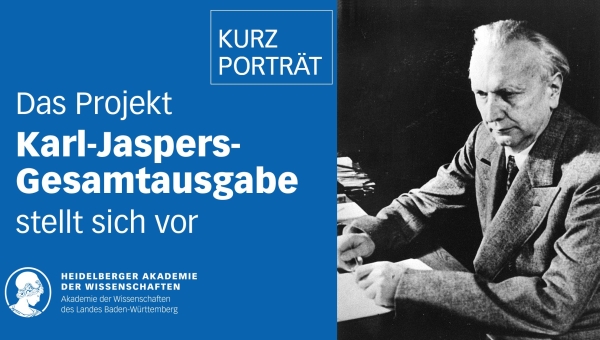
Kurzporträt | Das Projekt „Karl-Jaspers-Gesamtausgabe“ stellt sich vor
Link zum Video (YouTube): https://youtu.be/rWQckqmkUwU?si=BwvVk8SiAtiKYV9h
Projekt des Monats
Das Akademieprojekt „Karl-Jaspers-Gesamtausgabe“ wurde von der Union der deutschen Akademien der Wissenschaften zum Projekt des Monats Februar 2025 gewählt. Die Vorstellung auf den Websites des Bundesministerium für Forschung, Technologie und Raumfahrt und der Union der deutschen Akademien der Wissenschaften gibt einen Einblick in die Arbeit der Forschungsstelle:
Bundesministerium für Forschung, Technologie und Raumfahrt
Einblicke ins Akademienprogramm:
Karl Jaspers: Ein Denker für die Gegenwart (externer Link)
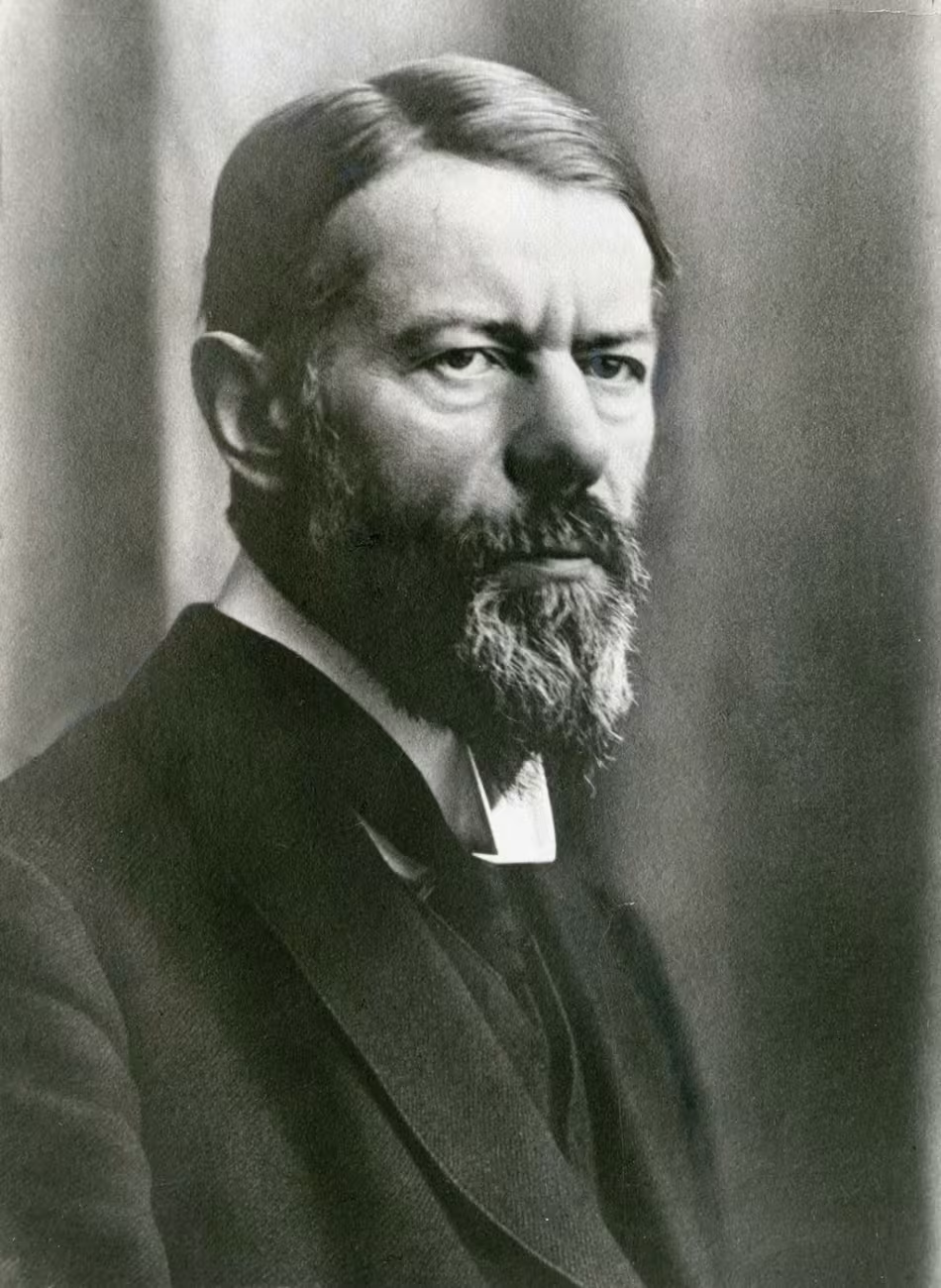 Foto: Ernst Gottmann
Max Weber 1918