
Academy publications

Most of the publications areprovidedin cooperation with Heidelberg University Library ( external link). The common theme is the free and sustainable provision of documents and research results. This means that current research projects and their results can be made available to a wide audience through open access.

Through the Heidelberg Academic Library, the Heidelberg Academy of Sciences and Humanities aims to create Academy of Sciences and Humanities forum where the Academy’s members can introduce themselves to the interested public in a new way. [...] The idea is that each member should leave a scholarly calling card here. And through the sum of these contributions, the cosmos of the sciences—as it is Academy of Sciences and Humanities in the Heidelberg Academy of Sciences and Humanities —should become visible, with all its diversity of topics, questions, and methods.

[Foreword by the editors Peter Graf Kielmansegg and Bernhard Zimmermann]

Easily recognizable by its colorful book covers, the series has been in publication since 2020. More than 15 volumes have been published since then, and more are in the works.

New Release

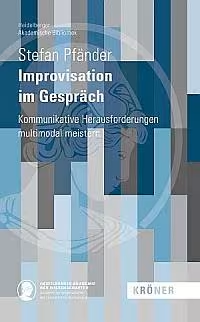
Stefan Pfänder

Improvisation in Conversation: Overcoming Communicative Challenges Through Multimodal Approaches

Heidelberg Academic Library
, Stuttgart: Alfred Kröner Verlag, 2026
Current volumes
  • Albrecht Winnacker: Silicon Isn’t Everything. On the Material Challenges of Modern Electronics, 2025
  • Michael Erler: Why Read Old Texts? Reading as Collaboration with the Text, 2025
  • Ronald G. Asch: A Republican Experiment in the 17th Century. The Commonwealth and the Protectorate in England, 1649–59/60, 2024
  • Hans-Joachim Gehrke: Civil Wars and Ephebes. Principles and Practices of Bourgeois Socialization in Ancient Greece, 2024


You can find a complete list of all volumes on the Kröner Verlag website.

The Proceedings of Academy of Sciences and Humanities Heidelberg Academy of Sciences and Humanities scholarly lectures, studies, and research findings from the Academy’s two divisions. As a series of publications, they ensure that academic work remains permanently accessible to the scholarly community. These publication series have not been published continuously since the 1990s. However, lectures and similar materials can be found in the Academy’s yearbooks.

Proceedings of the Heidelberg Academy of Sciences and Humanities, Philosophical-Historical Class (from the years 1910–1995)

Proceedings of the Heidelberg Academy of Sciences and Humanities, Mathematical and Natural Sciences Section (from 1909–1995)

Proceedings of the Heidelberg Academy of Sciences and Humanities, Mathematical and Natural Sciences Section: Division A, Mathematical and Physical Sciences (from the years 1911–1924)

Proceedings of the Heidelberg Academy of Sciences and Humanities, Mathematical and Natural Sciences Section: Division B, Biological Sciences (from the years 1911–1924)


The following publications explore the rich history of the Heidelberg Academy of Sciences and Humanities selection):

  • Udo Wennemuth, Scientific Organization and Research Funding in Baden: The Heidelberg Academy of Sciences and Humanities (Heidelberg, 1994).
  • Udo Wennemuth, “The Heidelberg Academy of Sciences and Humanities Third Reich,” in *Acta historica Leopoldina* No. 22 (1995), pp. 113–132.
  • Volker Sellin (ed.), The Europe of Academies (Heidelberg 2010).
  • Heidelberg Academy of Sciences and Humanities ed.), Members of the Heidelberg Academy of Sciences and Humanities Who Were Deprived of Their Rights and Expelled During the Third Reich Academy of Sciences and Humanities Heidelberg 2009).
  • Volker Sellin and Sebastian Zwies (eds.), The Heidelberg Academy of Sciences and Humanities Reflected in Its Inaugural Addresses, 1944–2008 (Heidelberg, 2009), including a list of full members, 1909–2008.
  • Volker Sellin, Eike Wolgast, and Sebastian Zwies (eds.), Research Projects of the Heidelberg Academy of Sciences and Humanities Heidelberg, 2009).
  • Ditte Bandini and Ulrich Kronauer (eds.), *Fruits from the Tree of Knowledge: A Festschrift by the Research Associates* (Heidelberg, 2009).
  • Herbert von Bose, “The Heidelberg Academy of Sciences and Humanities,” in Jörg Kreutz, Wilhelm Kreutz, and Hermann Wiegand (eds.), *In omnibus veritas: 250 Years Academy of Sciences and Humanities Electoral Palatinate Academy of Sciences and Humanities Mannheim (1763–1806)*, Mannheim 2014, pp. 221–231.
  • Tonio Hölscher, “Athena as the Emblem of the Heidelberg Academy of Sciences and Humanities,” *Athena* 1-2021, 6–9.
  • Uta Hüttig and Hans-Georg Kräusslich (eds.), The Heidelberg Academy of Sciences and Humanities Reflected in Its Inaugural Addresses, 2009–2023 (Heidelberg, 2024), including a list of full members from 2009 to 2023.
  • Matthias Ohm, “The Medals of the Heidelberg Academy of Sciences and Humanities,” Athene 2-2024, pp. 35–37.
  • Matthias Ohm, “Academia in Nummis: Medals of the Mannheim and Heidelberg Academy of Sciences and Humanities,” in: Numismatisches Nachrichtenblatt, Issue 11/2024, pp. 413–420.

Proceedings of the Theodoro-Palatinae Academy 

The page linked here provides an overview of the Kurpfälzische Academy of Sciences and Humanities its legacy. It includes references to key publications, historical series, and members of the Academy who shaped its scholarly work in the 18th century. 

The *Zentralblatt Mathematik und ihre Grenzgebiete*(zbMATH) is one of the most important journals in mathematics, founded in 1931. The Heidelberg Academy of Sciences and Humanities one of two publishers since 1965 and one of three since 1999. In addition to the Academy, the FIZ-Karlsruhe(external link), part of the Leibniz Association, and the European Mathematical Society(external link) are now also involved. Until recently, Springer Verlag handled the printing. Originally founded as a departmental journal, zbMATH is today the world’s most comprehensive and longest-running abstract and review service in pure and applied mathematics.

Its current functionality goes far beyond that of a departmental journal. It is now completely digital and offers a wide range of meta-information on the publications discussed. In 2019, full funding for zbMATH was secured from the Federal Ministry of Education and Research, meaning that zbMATH will be managed as zbMATH OPEN in open access in the future.

For more information about zbMATH and its history,click here.(external link)

➟ to the portal  zbMATH OPEN (external link)