
Financial and Business Research from a Long-Term Perspective
Analyzing the long-term evolution of the financial system helps us better understand current and future economic and social challenges. However, there is a lack of consistent, long-term data series, particularly regarding the corporate sector and its interaction with the financial system and society. Previous long-term financial and corporate research has relied primarily on data from the United States. Applying these findings to other systems and structures, such as those in continental European countries, carries the risk of drawing erroneous conclusions, as institutions and cultures differ fundamentally.
The goal of the project is therefore to compile structured and interconnected research data, including corporate information and financial metrics for German real and financial sector companies over a long period of time (beginning in 1871), to preserve this data as part of our cultural heritage, and to make it available for financial research up to the present day.
Based on this data, a research program is being conducted that focuses on a wide range of topics in financial history and those examined from a long-term perspective. Given the unique characteristics of Germany’s development during the period under review—including fundamental changes in the financial system, hyperinflation, and crises—the data offers valuable insights into the challenges facing the financial system and economic policy measures.
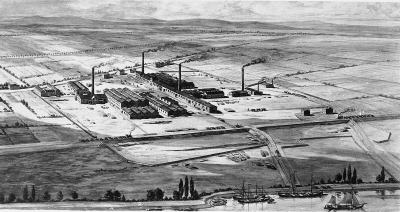
BASF plant in Ludwigshafen, 1865, Wikimedia Commons, public domain