
Heike Hawicks
__________________________________
Dr. Heike Hawicks
Heidelberg Academy of Sciences and Humanities
- German Legal Dictionary -
Karlstraße 4
69117 Heidelberg
hadw
Curriculum Vitae
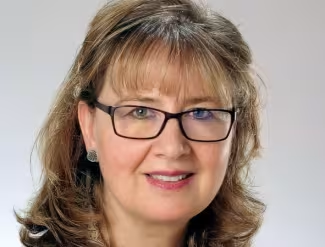
Heike Hawicks is a research associate at the German Legal Dictionary and a lecturer in medieval history, regional and university history, and basic historical sciences at Heidelberg University. She has also taught at the universities of Duisburg, Essen, and Mannheim. There, her work focused on late medieval urban language, early medieval names, high medieval female rulers, as well as the history of the Lower Rhineland and urban history. She contributed to the DFG projects “Language History of the Lower Rhineland” and “Nomen et gens. Personal Names as Indicators of Linguistic, Ethnic, Social, and Cultural Group Affiliation of Their Bearers,” as well as on the historical section of the “Reallexikon der Germanischen Altertumskunde (RGA)” at the Academy of Sciences and Humanities Göttingen. She earned her doctorate with a dissertation on “Xanten in the Late Middle Ages: The Abbey and the City Caught Between Cologne and Kleve.” This was followed by publications in the form of monographs, edited volumes, essays, and articles on urban and regional history, church and university history, as well as on materiality and legal history.
Academic Awards:
2004 Prize Henning Kaufmann Foundation for the Promotion of German Onomastics Based on Historical Linguistics, for contributions to the DFG project “Nomen et gens. Personal Names as Indicators of Linguistic, Ethnic, Social, and Cultural Group Affiliation of Their Bearers.”
2007 Sparkasse Essen Science Prize for the best thesis (dissertation/habilitation) in the Department of Humanities at the University of Duisburg-Essen.
Memberships (selection):
Working Group for Regional History in the Upper Rhine Region
Friends of the Heidelberg University Archives and Museum (Chair since 2015)
Society for University and Science History
Goethe Society of Heidelberg
Heidelberg Historical Society
Heidelberg Society for Legal History
Institute for Lower Rhine Cultural History and Regional Development at the University of Duisburg-Essen
State Committee on Science and Research of the CDU Baden-Württemberg
Scientific Commission of the Xanten Cathedral Building Association
Conference, October 10–11, 2023:
Municipal Sovereignty in the Late Middle Ages and Early Modern Period
Conference Report: https://www.hsozkult.de/conferencereport/id/fdkn-140429
Conference proceedings:https://doi.org/10.5771/9783748967545
Selected publications and lectures
Monographs:
- Studies on situational variation in late medieval written languages. Illustrated by the vowel usage of the Duisburg town scribe Jacob Ludger, Duisburg 1994 (URL: https://doi.org/10.17185/duepublico/70733) [as part of the DFG project “Language History of the Lower Rhine,” text volume 200 pp., edition/source volume 313 pp.].
- Medieval Jurisprudence in Xanten. The Neuss Lay Judges’ Rulings in the Book of Privileges of the City of Xanten (Xanten Lectures on the History of the Lower Rhine, Issue No. 42), Duisburg 2004 [54 pp., reprinted in: Xanten Lectures on the History of the Lower Rhine 2004, ed. by Dieter Geuenich, Duisburg 2004, pp. 181–229].
- Xanten in the Late Middle Ages: The Abbey and the City Caught Between Cologne and Kleve (Rheinisches Archiv 150), Cologne / Weimar / Vienna 2007 [669 pp., Dissertation, Duisburg-Essen 2005; also published as Volume 3 of the special edition “History of the City of Xanten”].
- In collaboration with Harald Berger: Marsilius of Inghen and the Lower Rhineland. On the 625th anniversary of the death of the founding rector of Heidelberg University (Contributions to the History of the Electoral Palatinate and Heidelberg University 1), Heidelberg 2021 [169 pp.].
- In collaboration with Jolanta Wiendlocha: The Work of the Jesuits in Heidelberg. Facsimile, translation, and commentary on the *Fata Collegii Heidelbergensis Societatis Jesu* (1622–1712) (Latin Literature in Southwest Germany 4), Heidelberg 2022 [165 pp.].
- Heinrich Buschmann – Rigo dal Bosco. The Lower Rhineland “Buschmann Miracle” on the Upper Rhine and in Northern Italy. Transcription, translation, and commentary, with contributions by Jule Meyer, Katharina Grünke, and Stefania Cattaneo, Heidelberg [in preparation].
- The Daughters of the Palatinate Wittelsbachs [in preparation].
Publishers:
- In collaboration with Ingo Runde: The Old Auditorium of Heidelberg University, Heidelberg 2016 [110 pp., online edition: https://heiup.uni-heidelberg.de/catalog/book/122].
- In collaboration with Ingo Runde: Popes – Electors – Professors – Reformers. Heidelberg and the Holy See from the Medieval Reform Councils to the Reformation. Catalog accompanying the exhibition at the Kurpfälzisches Museum from May 21 to October 22, 2017, published by the Historical Society for the Promotion of International Calvinist Research e.V. / Kurpfälzisches Museum Heidelberg / Heidelberg University Archives, Heidelberg / Neustadt a.d.W. / Ubstadt-Weiher / Basel 2017 [120 pp., revised online edition 2018: http://www.uni-heidelberg.de/md/uniarchiv/heidelberg_und_der_heilige_stuhl_web.pdf].
- Co-authored with Ingo Runde: University Registers in Southwest Germany. Collections, Cataloging, and Digital Presentation. Papers from the conference held on May 16 and 17, 2019, at the Heidelberg University Archives (Heidelberger Schriften zur Universitätsgeschichte 9), Heidelberg 2020 [434 pp.].
- In collaboration with Ingo Runde: Max Weber in Heidelberg. Contributions to the digital lecture series at Heidelberg University during the summer semester of 2020, marking the 100th anniversary of his death on June 14, 2020 (Heidelberger Schriften zur Universitätsgeschichte 11), Heidelberg 2022 [417 pp.].
- Sovereignty – Condominium – Community: Shared Urban Sovereignty in the Late Middle Ages and Early Modern Period. Proceedings of the Conference Held on October 10 and 11, 2023, at the Heidelberg Academy of Sciences and Humanities Legal History Studies 11), Baden-Baden 2026 [456 pp., DOI: https://doi.org/10.5771/9783748967545].
Series Editor: Contributions to the History of the Electoral Palatinate and the University of Heidelberg, Universitätsverlag Winter.
https://www.winter-verlag.de/de/programm/buchreihen/geschichte/reihe172/Beitraege_zur_Geschichte_der_Kurpfalz_und_der_Universitaet_Heidelberg/alle/
Essays:
- The Name and Language of the Franks, in: Clovis and the “Battle of Zülpich” – History and Myth 496–1996. Companion volume to the exhibition in Zülpich from August 30 to October 26, 1996, published by the Association of History and Local History Enthusiasts of the District of Euskirchen, Inc., in cooperation with the Zülpich Historical Society, ed. Dieter Geuenich / Thomas Grünewald / Reinhold Weitz, Euskirchen 1996, pp. 40–47.
- Sanctos – Xantum – Troia. On the Influence of Ottonian-Byzantine Relations on Toponymy in the Xanten Region, in: The Middle Ages on the Rhine and Meuse. Essays on the History of the Lower Rhine. Dieter Geuenich on the Occasion of His 60th Birthday (Studies on the History and Culture of Northwestern Europe, Vol. 8), ed. by Uwe Ludwig / Thomas Schilp, Münster / New York / Munich / Berlin 2004, pp. 27–41.
- On the Economic Significance of the Veneration of Saints for the Construction of Gothic Religious Buildings in the Lower Rhine Region. The example of the Viktortracht and Viktordom in Xanten in the context of procession and church construction in Rees and Cologne, in: The Veneration of Saints and Pilgrimages in the Lower Rhine Region (Publications of the Lower Rhine Academy, Vol. 6), ed. by Dieter Geuenich, Essen 2004, pp. 50–70.
- Johannes Corputius’s 1566 Map of Duisburg: From an Early Modern “Promotional Brochure” to a Modern Multimedia CD-ROM, in: Duisburger Forschungen 51, 2004, pp. 225–234.
- In collaboration with Ingo Runde: The sample entry *guda-friþu-z (Gotefrid) as an example of the methodology for the interdisciplinary compilation of name and personal commentaries in the DFG project “Nomen et gens,” in: Name and Society in the Early Middle Ages. Personal Names as Indicators of the Linguistic, Ethnic, Social, and Cultural Group Affiliations of Their Bearers (German Name Research on a Linguistic-Historical Basis 2), ed. by Dieter Geuenich / Ingo Runde, Hildesheim 2006, pp. 353–378.
- With Dieter Geuenich: Problems of Lemmatization of Early Medieval Personal Names in the Interdisciplinary Project “Nomen et gens,” in: Proceedings of the 21st International Congress of Onomastic Sciences (ICOS), August 19–24, 2002, Uppsala, Volume 4, edited by Eva Brylla and Mats Wahlberg, Uppsala 2008, pp. 81–90.
- Theophanu, in: The Empresses of the Middle Ages, ed. by Amalie Fößel, Regensburg 2011, pp. 62–79.
- The Fürstenberg (Martinsberg, Varusberg) – On the Naming of a Modest Hill, in: Caelius and Beyond? History and Future of the Fürstenberg and Bislicher Island near Xanten: Table Ronde in Xanten, June 18–19, 2009 (Materials on Archaeological Heritage Preservation in the Rhineland 23), ed. by Jürgen Kunow, Treis-Karden 2011, pp. 59–66.
- Archaic Toponyms in the Rhineland during the Time of Archbishop Gero of Cologne (969–976), in: I nomi nel tempo e nello spazio. Proceedings of the 22nd International Congress of Onomastic Sciences V, Pisa, Aug. 28–Sept. 4, 2005 (Nominatio: Miscellanea Series), ed. Maria Giovanna Arcamone / Donatella Bremer / Davide De Camilli / Bruno Porcelli, Pisa 2012, pp. 231–242.
- “Like the Three Young Men in the Fiery Furnace” – Xanten and the Cologne-Kleve Feuds of the 14th and 15th Centuries Against the Background of the Great Western Schism, in: Rheinische Vierteljahrsblätter 76, 2012, pp. 91–122.
- Co-authored with Stefan Böttcher and Rita Hartel: Name Lemmatization in the Web Database of Medieval and Early Modern University Registers, in: Els noms en la vida quotidiana. Proceedings of the 24th International ICOS Congress on Onomastic Sciences, Barcelona, September 5–9, 2011 (Biblioteca Tècnica de Política Lingüística 11), ed. Joan Tort i Donada / Montserrat Montagut i Montagut, Barcelona 2014, Annex, pp. 283–293.
- The Situational Use of Parchment and Paper in the Late Middle Ages. A case study based on the holdings of the Duisburg City Archives and the Heidelberg University Archives, in: Paper in Medieval Europe. Production and Use (Materiale Textkulturen 7), ed. by Carla Meyer / Bernd Schneidmüller / Sandra Schultz, Berlin / New York 2014, pp. 217–250.
- Theophanu, in: Women in Saxony-Anhalt: A Biographical and Bibliographical Dictionary from the Middle Ages to the 18th Century, ed. by Eva Labovie, Cologne / Weimar / Vienna 2016, pp. 358–364.
- On the Function and Use of the Old Auditorium Through the Ages, in: The Old Auditorium of Heidelberg University. Conference held on March 13, 2015, in the Old Auditorium on the occasion of the 300th anniversary of its first mention in 1715, ed. by Heike Hawicks / Ingo Runde, Heidelberg 2016, pp. 11–32.
- Co-authored with Ingo Runde: War-related losses of cultural property and their partial restitution, illustrated by the example of two papal documents from 1387 and 1816 from the Heidelberg University Archives, in: Homo heidelbergensis. Festschrift for Klaus-Peter Schroeder on his 70th birthday (Foundation for the Promotion of Palatinate Historical Research, Series B: Treatises on the History of the Palatinate, Vol. 18), ed. by Pirmin Spieß / Christian Hattenhauer / Michael Hettinger, Neustadt an der Weinstraße 2017, pp. 333–354.
- In collaboration with Ingo Runde: Dispargum – Duisburg. Current Status and Challenges in Research, in: Dispargum. Annual Reports of the Duisburg City Archaeology Department 1, Duisburg 2017, pp. 9–21.
- Co-authored with Ingo Runde: “Heidelberg and the Holy See – from the Late Medieval Reform Councils to the Reformation in the Electoral Palatinate,” in: 1517. Universities and the Protestant Reformation. Studies and Research on the Fifth Anniversary of Luther’s Theses (Studies and Research on the University), ed. Simona Negruzzo, Bologna 2018, pp. 33–54.
- Monasteries, Chancellors, Curators. The Ecclesiastical Context of Heidelberg University from the Late Middle Ages to the Early Modern Period, in: Universities and Their Context. The Southwest and the Empire in the Middle Ages and Early Modern Period. Contributions to the Conference at the Heidelberg University Archives on October 6 and 7, 2016 (Heidelberg Papers on University History 7), edited by Benjamin Müsegades / Ingo Runde, Heidelberg 2019, pp. 165–199.
- Heidelberg and Hussitism: Professors as Envoys, Experts, and Inquisitors, in: *Acta Universitatis Carolinae – Historia Universitatis Carolinae Pragensis* 60/1, 2020, pp. 245–256 (URL: https://www.ceeol.com/search/article-detail?id=935806).
- In collaboration with Ingo Runde: “The Student Register Database of the Old University of Duisburg,” in: University Registers in Southwest Germany: Collections, Cataloging, and Digital Presentation (Heidelberg Papers on University History 9), edited by Heike Hawicks and Ingo Runde, Heidelberg 2020, pp. 309–327.
- Lemmatization and Encoding – On the Possibilities and Problems of Structuring Medieval and Early Modern Names in Web Databases, in: University Registers in Southwest Germany [as No. 20], pp. 367–384.
- Municipal Law Relations in the Lower Rhine Region, the Duisburg Municipal Charter of 1518, and the Standardization of Law by the Sovereign in the 16th Century, in: Municipal Charters and Municipal Law Reforms (Series of the German Legal Dictionary / Academy Conferences 32), ed. by Andreas Deutsch, Heidelberg 2021, pp. 357–398.
- The University and Princely Politics: The Founding, Establishment, and Formative Influence of the University of Heidelberg during the Western Schism and the Councils, in: Higher Education and Politics – The Politicization of Universities (Publications of the Society for the History of Universities and Science, GUW), edited by Martin Kintzinger / Wolfgang Eric Wagner / Ingo Runde, Basel 2022, pp. 39–63.
- Woe salmen nv dit halden… On the Relationship Between Orality and Writing in Pre-Modern Municipal Law: The Xanten Legal Consultations at the Oberhof in Neuss and the Development of Duisburg’s Municipal Law, in: Feder und Recht. Written Records and the Judicial System in the Pre-Modern Era (Bibliothek Altes Reich 39), ed. by Josef Bongartz et al., Berlin / Boston 2023, pp. 155–176.
- The Palatinate Count’s Residence in Heidelberg in the 17th and 18th Centuries until Its Relocation to Mannheim in Light of the *Fata Collegii Heidelbergensis Societatis Jesu*, in: *Residenzstädte in der Transformation. Competition, Loss of Residency, and Cultural Heritage as a Challenge. Proceedings of the 60th Annual Conference of the Southwest German Working Group for Urban History Research (Stadt in der Geschichte 48), ed. by Wolfgang Dobras / Matthias Müller, Göttingen 2024, pp. 133–162.
- In collaboration with Ingo Runde, “University Matriculation Records as Material Testimonies of the Initiation Culture at Universities.” A comparative study based on the example of the Heidelberg matriculation records, in: Inscribing Initiation. Written Artefacts in Rites of Passage (Hamburger Studien zu Gesellschaften und Kulturen der Vormoderne 30), ed. by Jochen Hermann Vennebusch, Stuttgart 2024, pp. 15–44.
- The Final Decade of Ludwig III of the Palatinate’s Life: The Background and Consequences of His Journey to Jerusalem, Illness, Deposition, and Death, in: Ludwig III of the Palatinate (1378–1436). Elector – Council Protector – Sovereign (Foundation for the Promotion of Palatinate Historical Research. Series B, Treatises on the History of the Palatinate 24), ed. by Franz Fuchs / Pirmin Spieß / Ellen Widder, Neustadt an der Weinstraße 2025, pp. 375–430.
- The Joint Rule of the Archbishop of Cologne and the Counts of Kleve over Xanten, in: Joint Rule – Condominium – Community: Shared Municipal Rule in the Late Middle Ages and Early Modern Period. Proceedings of the conference held on October 10 and 11, 2023, at the Heidelberg Academy of Sciences and Humanities Legal History Research 11), edited by Heike Hawicks, Baden-Baden 2026, pp. 289–325.
- The St. Magdalene Flood and the Black Death in the Lower Rhine Region. Crises, Disasters, Diseases, and Their Economic Consequences in the 14th Century, in: Life and Survival in the Lower Rhine Region. Economy, Crises, and Poverty in the Late Middle Ages and Early Modern Period (Publications of the Heresbach Foundation Kalkar 18), edited by Monika Gussone / Hiram Kümper [in press].
- Marsilius of Inghen and the Lower Rhineland, in: Mapping the Via Marsiliana. Marsilius of Inghen and his legacy, conference at Radboud University Nijmegen, July 1–2, 2022, edited by Graziana Ciola [in press].
- In collaboration with Ingo Runde, *Duisburgum doctum* – Duisburg as an Old and New University City in the Context of Denominational and Educational Policy Developments, in: *Continuity or a New Beginning? Closure and Reopening in German University History from the 18th to the 20th Century, Conference June 6–8, 2024, at the University of Mainz, ed. by Nina Gallion / Christian George [in press].
- Women of the House of Wittelsbach during the Interregnum, in: The Interregnum 1250–1273 – with Special Reference to the Palatinate (Foundation for the Promotion of Historical Research in the Palatinate. Series B, Treatises on the History of the Palatinate), edited by Jörg Schwarz and Pirmin Spieß, Neustadt an der Weinstraße [in press].
- In collaboration with Ingo Runde, Statutes and 'Student Wars' - Norms and Potential for Conflict in Student Life at the Medieval and Early Modern University of Heidelberg, in: Deviance, Crime, and Discipline in the Academic Sphere of the Middle Ages and Early Modern Period, Conference June 12–13, 2025, at Charles University in Prague, ed. by Martin Holý [in press].
- Together with Ingo Runde, “Dismissal” and “Apology”: Kuno Fischer’s Revocation of His Teaching License at the University of Heidelberg and the Media Fallout in 1853/54,” in: Kuno Fischer. A 19th-Century Heidelberg Professor, Conference October 24–25, 2024, at the Heidelberg University Archives, ed. by Peter König [in preparation].
- The Medieval Origins of Heidelberg in the Context of Imperial and Regional History, in: The Origins of Heidelberg in the Middle Ages – On the Documentary Record of the City (Contributions to the History of the Electoral Palatinate and the University of Heidelberg), edited by Jörg Peltzer and Ingo Runde, Heidelberg [in preparation].
Articles and reports:
- Ze Santen – Xanten. Studies on the History of the City and Its Relations with the Abbey in the Late Middle Ages, in: 10 Years of Partnership between the City of Xanten, the Provost Parish of St. Viktor in Xanten, and Gerhard Mercator University Duisburg, in collaboration with the Association for the Preservation of Xanten Cathedral (Verein zur Erhaltung des Xantener Domes e.V.) for the Study of the History of the Abbey and the City of Xanten. An Inventory (Xanten Lectures on the History of the Lower Rhine, Issue 33), ed. by Dieter Geuenich, Duisburg 2000, pp. 15–18.
- In collaboration with Ingo Runde: Historical Research on the “Genius Loci,” in: Forum Forschung 2000. Research Magazine of Gerhard Mercator University Duisburg, Duisburg 2000, p. 20.
- Summary of the concluding discussion, in: Reader for the expert discussion on the planning of a “Nibelungen Museum” in Xanten, November 6–7, 2003, at the Regionalmuseum Xanten, commissioned by the University of Duisburg-Essen and edited by Dieter Geuenich, [Duisburg 2004], p. 81ff.
- In collaboration with Christa Jochum-Godglück and Ingo Runde: Name entry no. 6, “Gotefrid,” in the essay by Hans-Werner Goetz and Wolfgang Haubrich, *Personal Names in Language and Society*. On the linguistic and historical analysis of early medieval name evidence based on a database (Part 2), in: Beiträge zur Namenforschung (BNF) 40, 2005, pp. 155–163.
- Source article Q08, “700 (706/7) Duke Gotefrid of Alemannia for St. Gallen,” in: BNF 40 [as in No. 4], 2005, pp. 193ff.
- Source article Q16, “Annales Nazariani,” in: BNF 40 [as in no. 4], 2005, p. 196.
- Source article Q17, “Annales Sangallenses Breves,” in: BNF 40 [as in No. 4], 2005, p. 196.
- Source article Q34, “Reichenau Fraternity Register, p. 83, Constance List,” in: BNF 40 [as in No. 4], 2005, p. 202.
- Art. “Xanten, Onomastics,” in: Reallexikon der germanischen Altertumskunde 34, Berlin / New York 2007, p. 363 ff.
- Object description B 1.02, “Heidelberg University Register,” in: The Wittelsbachs on the Rhine. The Electoral Palatinate and Europe, Catalog Volume 2: Modern Era (Publications of the Reiss-Engelhorn Museums Mannheim 60), edited by Alfried Wieczorek / Bernd Schneidmüller / Alexander Schubert / Stefan Weinfurter, Regensburg 2013, p. 165ff.
- Toponymic note in Clive Bridger’s article, “A Previously Unknown Constantinian-Valentinian Riverside Fort in the District of Wesel?”, in: The Limes in Raetia and the Germanic Provinces in the 1st–4th Centuries (Contributions to the Limes World Heritage Site 8), Limes Colloquium Aalen 2013, pp. 172–185 (specifically pp. 181–182).
- Co-authored with Ingo Runde: “Zum Roten Ochsen,” a student pub, in: Heidelberg: Yearbook of the City’s History 18, 2014, pp. 30–33.
- In collaboration with Ingo Runde: Discovery, Repatriation, and Historical Background of a Bull by Pope Urban VI dated August 2, 1387 (Friends of the Heidelberg University Archives and Museum, Inc., New Year’s Bulletin 2015), [Heidelberg 2015].
- In collaboration with Ingo Runde: May 16, 1816. Pope Pius VII informs Heidelberg University of the completion of the return of part of the Bibliotheca Palatina (Friends of the Heidelberg University Archives and Museum, 2017 New Year’s Bulletin), [Heidelberg 2017].
- In collaboration with Ingo Runde: Editors’ Foreword, in: Popes – Electors – Professors – Reformers. Heidelberg and the Holy See from the Medieval Reform Councils to the Reformation. Catalog accompanying the exhibition at the Kurpfälzisches Museum from May 21 to October 22, 2017, published by the Heidelberg University Archives (edited by Heike Hawicks and Ingo Runde), the Historical Society for the Promotion of International Calvinist Research, and the Kurpfälzisches Museum Heidelberg, Heidelberg / Neustadt a.d.W. / Ubstadt-Weiher / Basel 2017, p. 7ff.
- In collaboration with Ingo Runde: “The Great Western Schism and the Founding of the University of Heidelberg,” in *Heidelberg and the Holy See* [as in No. 15], p. 9.
- Church Property and the University Before and After the Reformation, in: Heidelberg and the Holy See [as in No. 15], p. 23.
- Church Reforms and Heresy Trials at the Council of Constance, a) The Council and the Imprisoned Pope in Heidelberg, in: Heidelberg and the Holy See [as in No. 15], p. 39.
- Church Reforms and Heresy Trials at the Council of Constance, b) Heresy Trials During and After the Council of Constance, in: Heidelberg and the Holy See [as in No. 15], p. 49.
- Heidelberg and Geneva, a) Family ties to the antipopes of Savoy, in: Heidelberg and the Holy See [as in no. 15], p. 54.
- Heidelberg and Geneva, b) Oswald von Wolkenstein and his odes to Heidelberg and Ludwig III, in: Heidelberg and the Holy See [as in No. 15], p. 59.
- Jewish Quarter and university buildings in the city, in: Heidelberg and the Holy See [as in No. 15], p. 66ff.
- Luther in Heidelberg – The Disputation and Its Impact on the Pre-Reformation Period, in: Heidelberg and the Holy See [as in No. 15], p. 84.
- The Reformation and the Reformed Confession: Heidelberg as the “German Geneva,” in: Heidelberg and the Holy See [as in No. 15], p. 89.
- Consequences and Counter-Movements – Disciplinarians, Erastians, and Antitrinitarians, in: Heidelberg and the Holy See [as in No. 15], p. 93.
- “Controversial Times” – Protestant Resistance to the Gregorian Calendar Reform, in: Heidelberg and the Holy See [as in No. 15], p. 95.
- Cat. No. 2.02: Pope Boniface IX grants twelve canonries to the university, in: Heidelberg and the Holy See [as in No. 15], p. 32.
- Cat. No. 2.03 Pope Boniface IX appoints the abbot of Schönau and the deans of Neustadt and St. Viktor near Mainz as executors of his bull of December 1, 1398, in: Heidelberg and the Holy See [as in No. 15], p. 33.
- Cat. No. 2.04: At the request of the Count Palatine and the University, Pope Boniface IX lifts the ban on the incorporation of benefices imposed on December 22, 1402; in: Heidelberg and the Holy See [as in No. 15], p. 34.
- Cat. No. 2.05 Pope Boniface IX grants the Church of the Holy Spirit in Heidelberg four canonries from the church in Neustadt (on the Wine Route), in: Heidelberg and the Holy See [as in No. 15], p. 35.
- Cat. No. 2.08 The deceased St. Philip of Zell rises from his bier in a gesture of blessing, in: Heidelberg and the Holy See [as in No. 15], p. 38.
- Cat. No. 3.01 “How Pope John Lay in the Snow on the Arlenberg and Cursed,” in: Heidelberg and the Holy See [as No. 15], p. 40.
- Cat. No. 3.02 Council session in Constance Cathedral, in: Heidelberg and the Holy See [as in No. 15], p. 41.
- Cat. No. 3.08 Job Vener as an expert, in: Heidelberg and the Holy See [as in No. 15], p. 47.
- Cat. No. 3.09 Procession of the Universities with Scepters, in: Heidelberg and the Holy See [as in No. 15], p. 48
- Cat. No. 3.10 The burning of John Hus at the Council of Constance on July 6, 1415, in: Heidelberg and the Holy See [as in No. 15], p. 50.
- Cat. No. 3.11 The burning of the former Heidelberg master Hieronymus of Prague at the Council of Constance on May 30, 1416, in: Heidelberg and the Holy See [as in No. 15], p. 51.
- Cat. No. 4.01: Duke Amadeus VIII of Savoy rides into Bern following his election as pope on June 18, 1440, in: Heidelberg and the Holy See [as in No. 15], p. 55.
- Cat. No. 4.04 The Miraculous Draught of Fishes – Outer panel of an altar in St. Peter’s Cathedral in Geneva, in: Heidelberg and the Holy See [as No. 15], p. 58.
- Cat. No. 4.07: Oswald von Wolkenstein’s Odes to Heidelberg and Elector Ludwig III, in: Heidelberg and the Holy See [as in No. 15], p. 62ff.
- Cat. No. 4.08 Selected portraits of the Counts Palatine and their wives on the Amberg family tree (Ruprecht I, II, III, and Ludwig III, IV), in: Heidelberg and the Holy See [as in No. 15], p. 64ff.
- Citation: “The Reform of University Statutes under Elector Ludwig VI,” in: Core Areas of the Reformation: The Southwest and Europe, exhibition catalog, ed. by Alfried Wieczorek, Christoph Strohm, and Stefan Weinfurter, Regensburg 2017, pp. 213ff.
- Conference proceedings: “Urban Sovereignty in the Late Middle Ages and Early Modern Period,” in: Heidelberg Academy of Sciences and Humanities. Yearbook 2023, Heidelberg 2023, p. 363 ff.
- "Deadly Deception" – on the attempted assassination of King Ruprecht on April 20, 1401, in: Athene – Journal of the Heidelberg Academy of Sciences and Humanities , p. 29ff.
- Report on the lecture "Here is what brings joy, indeed the seat of the Muses – The Double Jubilee of Elector Karl Theodor (1724–1799) and His Relationship to the Old Heidelberg Residence," in: Heidelberg Academy of Sciences and Humanities. Yearbook 2024, Heidelberg 2024 [in press]
Since 2022, authoring articles for the "German Legal Dictionary"; contributor starting with Volume XIV, Issue 9/10, "Right of Way."
Multimedia and Databases:
- “Nomen et gens” database, an Access database developed as part of the DFG project “Nomen et gens” at the universities of Bremen, Duisburg, Hamburg, Paderborn, Regensburg, and Saarbrücken, 2000–2007 (contributed to the lemmatization of names and the editing of the Alemannic corpus; URL: http://www.neg.uni-tuebingen.de/?q=de/datenbank).
- Johannes Corputius’s 1566 Map of Duisburg on CD-ROM. A multimedia project by the Gerhard Mercator Society in cooperation with the Duisburg Museum of Culture and City History, the Duisburg City Archives, and the Gerhard Mercator University of Duisburg, Duisburg 2002 (editing and structure).
- Online database of the student registers of the Old University of Duisburg (1655–1818), University Archives of Duisburg-Essen, 2007–2009 (contributed to the development; URL: http://matrikeldb.ub.uni-due.de/depa/personenbeleg.jsp).
Editorial board of the series "Contributions to the History of the Electoral Palatinate and the University of Heidelberg" published by Universitätsverlag Winter:
- Heike Hawicks / Harald Berger: Marsilius of Inghen and the Lower Rhineland. On the 625th anniversary of the death of the founding rector of Heidelberg University, Heidelberg 2021.
- Carsten Dutt: Gadamer’s Philosophical Hermeneutics Today: A Retrospective and Outlook. On the Occasion of Hans-Georg Gadamer’s 125th Birthday [in press].
- Manfred Komorowski: Heidelberg Students of the Late 17th Century. An Assessment of an Attempt to Reconstruct the Lost Student Register (1663–1693), Heidelberg 2025 [in preparation for publication].
- Heike Jöns: Networking in Europe. Regional Cooperation, Academic Travel, and Research Cultures at the University of Heidelberg, 1700–1815 [in preparation].
Selection of presentations:
- June 11, 2002 “The Historical Development and Economic Significance of the Xanten Viktor Costumes” on the occasion of the 125th anniversary celebration of the Niederrheinischer Altertumsverein Xanten e.V.
- February 13, 2003 “Sanctos – Xantum – Troia. On the Influence of Ottonian-Byzantine Relations on Toponymy in the Xanten Region” at the colloquium “Research on the History of the Lower Rhine in the Middle Ages” on the occasion of the 60th birthday of Prof. Dr. D. Geuenich at Gerhard Mercator University Duisburg
- March 13, 2003: “Johannes Corputius’s 1566 Map of Duisburg as a Multimedia CD-ROM” at the Annual General Meeting of the Mercator Society at the Museum of Culture and City History in Duisburg
- July 8, 2003: “Medieval Jurisprudence in Xanten: The Neuss Lay Judges’ Verdicts in the Book of Privileges of the City of Xanten,” as part of the anniversary lecture series “750 Years of the City of Xanten”
- October 24, 2003: “The Economic Significance of the Veneration of Saints for the Construction of Religious Buildings in the Lower Rhine Region” at the academic colloquium “The Veneration of Saints and Pilgrimages in the Lower Rhine Region” in Kevelaer
- September 26, 2004 “On the Sample Article ‘Gotefrid’ – *guda-friþu-z. An Example of the Approach to the Interdisciplinary Compilation of Name and Personal Commentaries in the DFG Project Nomen et gens” (co-authored with Ingo Runde) at the interdisciplinary colloquium “Names and Society in the Early Middle Ages. Personal Names as Indicators of the Linguistic, Ethnic, Social, and Cultural Group Affiliation of Their Bearers” at the Catholic Academy “Die Wolfsburg” (Mülheim/Ruhr)
- June 28, 2005: “Kalkar and the Founding of Medieval Towns in the Lower Rhine Region” at the “Alte Mühle” in Kalkar
- September 1, 2005: “Bonn-Verona, Xanten-Troia: Antiquized Toponyms in the Rhineland during the Reign of Archbishop Gero of Cologne (969–976)” at the XXII International Congress of Onomastic Sciences (ICOS) in Pisa
- November 3, 2005: “Emmerich and the Founding of Medieval Towns in the Lower Rhine Region” at the Rheinmuseum Emmerich
- October 23, 2007: “Xanten in the Late Middle Ages” at Xanten City Hall on the occasion of the book launch for the dissertation
- February 6, 2008: “Interdisciplinary Research Project on Regional Characteristics of Naming Practices and European Networks of Individuals and Groups in the Early Middle Ages” at the farewell colloquium for Prof. Dr. Dieter Geuenich in Essen
- June 19, 2009: “The Fürstenberg (Martinsberg, Varusberg) – On the Naming of a Modest Mountain” at the conference “Caelius and Beyond? The History and Future of the Fürstenberg and Bislicher Island near Xanten,” organized by the Rhineland Regional Council in Xanten
- May 8, 2010: “'Like the Three Young Men in the Fiery Furnace' – Xanten in the Cologne-Kleve Feuds of the 14th and 15th Centuries” at the Annual General Meeting of the Association for Regional History of the Rhineland in Xanten
- June 21, 2010 “People on the Move. Culture and Knowledge in Motion” at the Global Young Faculty Midterm Meeting at the Philharmonie Essen
- September 8, 2011: “Lemmatization of Names in the Web Database of Medieval and Early Modern University Registers” at the XXIV International Congress of Onomastic Sciences (ICOS) in Barcelona (the presentation text was prepared in collaboration with Prof. Dr. Stefan Böttcher and Dr. Rita Hartel).
- March 13, 2015 “The Function and Use of the Alte Aula Through the Ages” on the occasion of the 300th anniversary of the Alte Aula, held in the Alte Aula at Heidelberg University
- October 7, 2016: “Monasteries, Chancellors, Curators: The Ecclesiastical Context of Heidelberg University from the Late Middle Ages to the Early Modern Period” at the conference “Universities and Their Context: The Southwest and the Empire in the Middle Ages and Early Modern Period,” organized by the University Archives and the FPI, held at the University Archives
- June 28, 2017 “I Praise You, Heidelberg: Oswald von Wolkenstein and the Music of the Minstrel Tradition” as part of the “Art in the Salon” series (with an introduction by Frieder Hepp and Sigrid Haselmann on the harp) at the Kurpfälzisches Museum in Heidelberg
- December 6, 2017: “The Counts Palatine of the Rhine and Their Connections to the Northwest of the Empire—Networks and Politics in the Middle Ages” at the research colloquium “400–1500: The Middle Ages” at the University of Münster
- November 13, 2018: “Social Networks Along the Rhine and Their Impact on the Church, Politics, and Scholarship in the Late Middle Ages and Early Modern Period” at the University of Mainz
- April 4, 2019: “Medieval Families of Municipal Charters in the Lower Rhine Region and the Standardization of Law as a Challenge for the Sovereign in the 16th Century” at the conference “Municipal Charters and Reforms of Municipal Law” at the Academy of Sciences and Humanities
- May 17, 2019: “Lemmatization and Coding—On the Possibilities and Problems of Structuring Medieval and Early Modern Names in Web Databases” and (co-authored with Ingo Runde) “The Matriculation Database of the Old University of Duisburg” at the conference “University Registers in Southwest Germany: Collections, Cataloging, and Digital Presentation” at the Heidelberg University Archives
- June 11, 2019: “Heidelberg and Hussitism: Professors as Envoys, Experts, and Inquisitors” at the international conference “University Professors in (Central) Europe from the Late Middle Ages to the Early Modern Period (15th–18th Centuries)” at Charles University in Prague
- September 20, 2019“Woe salmen nv dit halden… On the Relationship Between Orality and Writing in Pre-Modern Municipal Law: The Xanten Legal Consultations at the Oberhof in Neuss and the Development of Duisburg’s Municipal Law” at the 17th Young Scholars’ Conference of the Network on Imperial Jurisdiction on the topic “Pen and Law. Written Records and the Judicial System in the Pre-Modern Era” in Mühlhausen
- March 16, 2021 “Franconian-Palatinate Relations in the Late Middle Ages and Early Modern Period from a University History Perspective” online lecture at the University of Erlangen-Nuremberg
- July 20, 2021 “Marsilius of Inghen and the Lower Rhineland: Marking the 625th Anniversary of the Death of the Founding Rector of Heidelberg University,” an online lecture organized in cooperation with Heidelberg Alumni International and the Friends of the University of Heidelberg Archives and Museum
- November 13, 2021 “The Palatinate Count’s Residence in Heidelberg in the 17th and 18th Centuries until Its Relocation to Mannheim, as Reflected in the *Fata Collegii Heidelbergensis Societatis Jesu*” at the conference of the Southwest German Working Group for Urban History Research on “Residence Cities in Transition: Competition, Loss of Residency, and Cultural Heritage as a Challenge” at the Landesmuseum Mainz
- December 10, 2021: “The St. Magdalene Flood and the Black Death in the Lower Rhine Region: Crises, Disasters, Diseases, and Their Economic Consequences in the 14th Century” at the conference “Life and Survival in the Lower Rhine Region in the Late Middle Ages and Early Modern Period” in the Kalkar Town Hall
- April 29, 2022: “An Introduction to Practical Lexicography Using the Example of a Craftsman’s Title: The Tüncher” at the Workshop on Historical Lexicography in Trier
- July 2, 2022: “Marsilius of Inghen and the Lower Rhineland” at the conference “Mapping the Via Marsiliana: Marsilius of Inghen and His Legacy,” Radboud University Nijmegen
- January 19, 2023 "University matriculation records as material evidence of initiation culture at universities," keynote presentation co-delivered with Ingo Runde at the workshop "Inscribing Initiation: Written Artefacts in Rites of Passage" organized by the Cluster of Excellence "Understanding Written Artefacts" at the University of Hamburg
- March 24, 2023: "Background, Course, and Consequences of Ludwig’s Journey to Jerusalem" at the conference "Count Palatine Ludwig III of the Rhine: Elector – Protector of the Council – Sovereign" in Neustadt an der Weinstraße
- June 15, 2023: "University Registers – Cataloging, Digitization, Publication, and Analysis" (co-presented with Ingo Runde) in the advanced seminar "New Research on Medieval History and Thuringian Regional History" at the University of Jena
- October 11, 2023: "The Joint Rule of the Archbishop of Cologne and the Counts of Kleve over Xanten" at the conference "Municipal Joint Rule in the
: The Late Middle Ages and Early Modern Period" at the Heidelberg Academy of Sciences and Humanities - December 1, 2023: "Eberhard von Künßberg’s ‘Rechtswortgeographie’ and the Cartographic Recording of Language Use a Century Ago – Inventory and Perspectives of his Academic Legacy" at the MICOLL workshop "Law, Language, and Geography: Charting the History of Commercial Terms" at Goethe University Frankfurt am Main
- March 4, 2024: "The Daughters of the Palatinate Wittelsbachs: 13th to 16th Centuries" at the conference "Wittelsbach Women Abroad II" at Banz Abbey
- May 8, 2024: "University Matriculation Registers as a Source for Historical Research and a Historical Database" (co-authored with Ingo Runde) as part of the online lecture series organized by the HistGeogUni research network (historical geographies of the university) on the topic of "History of Universities"
- June 6, 2024:“Duisburgum doctum – Duisburg as an Old and New University City in the Context of Denominational and Educational Policy Developments” (co-authored with Ingo Runde) at the conference “Continuity or a New Beginning? Closures and Reopenings in German University History from the 18th to the 20th Century” at the University of Mainz
- June 20, 2024: "Franconian-Palatinate Relations in the Late Middle Ages: Cooperation and Confrontation in the Context of Rivalries between Bavaria, Bohemia, and the Palatinate" at the University of Würzburg
- October 25, 2024: “’Dismissal’ and ‘Apology’: The Revocation of Kuno Fischer’s Teaching License at Heidelberg University and the Subsequent Media Coverage in 1853–54” (co-authored with Ingo Runde) at the conference “Kuno Fischer: A 19th-Century Heidelberg Professor” at the Heidelberg University Archives
- December 18, 2024 "Here is what brings joy, indeed the very seat of the Muses —The Double Jubilee of Elector Carl Theodor (1724–1799) and His Connection to the Old Heidelberg Residence" Lecture in the series "Wir forschen. Für Sie." at the Heidelberg Academy of Sciences and Humanities
- April 15, 2025: "The Daughters of the Palatinate Wittelsbachs" at the Medieval Research Colloquium of the Department of History at Heidelberg University
- May 10, 2025 "On 'Ober-/Übermänner,' 'Ungehorsam(en),' and 'Verräter.' On the Problem of Headword Selection in Modern High German for Compound Forms Derived from Frisian, Low German, and High German" at the Workshop on Historical Lexicography at Springiersbach Abbey
- May 23, 2025: "Contradictory, Arbitrary, or Deliberate? Expansion and Divisions of the Bavarian and Palatinate Wittelsbachs in the Late Middle Ages" at LMU Munich
- June 12, 2025: "Statutes and 'Student Wars'—Norms and Sources of Conflict in Student Life at the Medieval and Early Modern University of Heidelberg" (co-authored with Ingo Runde) at the conference "Deviance, Crime, and Discipline in the Academic Sphere of the Middle Ages and Early Modern Period" at Charles University in Prague
- January 15, 2026: "The First Mention of Heidelberg as a City in 1225 in the Context of Imperial and Regional History" at the short conference organized by the FPI and the University Archives, "On the Documentary Record of the City of Heidelberg in the Middle Ages," held at the Heidelberg University Archives
- January 19, 2026 "Just a Title and a Name? Women of the House of Wittelsbach Between Self-Determination and Family Interests in the Late Middle Ages" at the University of Tübingen
- March 6, 2026 "Low German – Latin – Ripuarian – Thuringian – Italian: On the History of Transmission and Translation of a Theological Text from the Mid-15th to the Mid-16th Century" at the conference "Multilingualism and Translation in the History of German Academic and Scholarly Languages" at the Heidelberg University Archives
- April 21, 2026: "A Man of Refined Sensibilities or a Perfidious Murderer? The Background and Consequences of the Attempted Murder of King Ruprecht and His Family by the Electoral Palatinate’s Personal Physician, Hermann von Poll, in 1401" at the Heidelberg Society for Legal History
- May 8, 2026: "The Medieval Origins of the City of Heidelberg in the Context of Imperial and Regional History" at the Working Group on Regional History of the Upper Rhine at the General State Archives in Karlsruhe
- May 27, 2026: "The Dictionary of Historical German Legal Terms: A Case Study of Early Crowdsourcing and Its Digital Transformation" at the ICARUS Convention #36: "Highlighting Heritage, Empowering Knowledge - From Archivists to Everyone" at The National Archives of Estonia in Tallinn