Melanchthon Correspondence (MBW)
-
- Node
- Melanchthon Correspondence (MBW)
The humanist Philipp Melanchthon (1497–1560) was a colleague of Martin Luther’s as a professor in Wittenberg and became his most important and closest collaborator in the introduction of the Reformation. In addition to his teaching at the university, he authored numerous textbooks, commentaries on ancient writings and biblical books, as well as works on the natural sciences, history, and theology; he served in university administration and was called upon from outside the university to advise on the establishment of schools and universities. The enormous scholarly breadth of his writings and his contribution to the development of the Christian-humanist educational system are the reasons why he was called“Praeceptor Germaniae,”or “Teacher of Germany.” As an advisor to the Saxon electors and a participant in Imperial Diets and religious dialogues, he played a decisive role in shaping the Reformation.
The mission and goal of the Melanchthon Research Center is to produce a critical and annotated complete edition of Philipp Melanchthon’s correspondence, which comprises approximately 9,800 letters. This edition is one of the fundamental source compilations for research into German and European history of the early modern period. It documents Melanchthon’s extensive correspondence for the first time in a philologically critical manner and with precise chronology. This highlights Melanchthon’s preeminent position in Reformation theology and church history, as well as the central significance of his universal humanism for the history of European education.
About the History of the Research Center
In connection with the 400th anniversary of Philipp Melanchthon’s birth in 1897, a decision was made to undertake a critical new edition of his correspondence, and work began. However, a series of adverse circumstances regarding personnel—and not least the two world wars—subsequently caused the plan to fail. It was not until 1960, the 400th anniversary of Melanchthon’s death, that the project was revived: After extensive research and a thorough collection of the material (9,722 letters), Heinz Scheible drafted a detailed plan for carrying out the project. Accordingly, the critical and annotated complete edition of Melanchthon’s correspondence will be realized in two parts and thus in two phases: the catalog of letters and the critical text edition. The first, foundational phase of the project was funded by the Baden Regional Church and the Fritz Thyssen Foundation.
In 1963, Heinz Scheible founded a Melanchthon Research Center in Heidelberg on behalf of his teacher, Heinrich Bornkamm; in 1965, at Heinrich Bornkamm’s request, the center was incorporated into the research projects of the Heidelberg “ Academy of Sciences and Humanities .” The center was gradually developed into a fully functional specialized institute, with since —two in 1969, since —three in 1985, and a three-quarters position for administration and research support, supplemented by student assistants, a carefully curated specialized library, and a computer network.
In 1997, on the 500th anniversary of Melanchthon’s birth, the Melanchthon Research Center was able to present the eight-volume catalog of his correspondence, the first two volumes of the textual edition, and numerous individual publications on humanism and the Reformation. With the publication of the addenda and concordances, the place index, and the name index, the catalog of correspondence is now complete. since Text volumes were published in 1991. Work on the critical edition is now the Research Center’s primary task and is being pursued continuously and expeditiously.
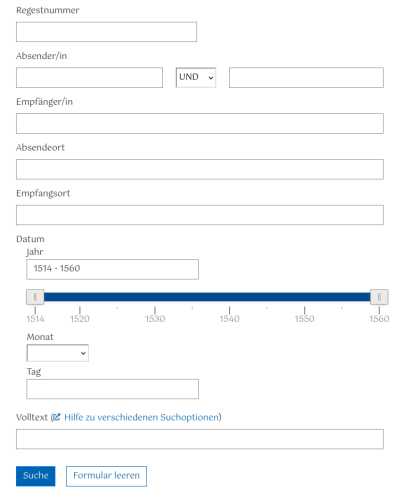
In 2010, the year marking the 450th anniversary of Melanchthon’s death, the project made the transition to the Internet; the regesta, which had previously been published in print, were made available online in a database with various search options and are accessible to users free of charge.
The edition *Melanchthon's Correspondence*
The Regestae
The catalog of documents, including indexes and a list of manuscripts. The catalog entries are German summaries; they provide an initial analysis through explanatory notes and precise dating. Letters, expert opinions, prefaces, and related documents from the years 1514 to 1560 are analyzed in terms of content, annotated, and their connections highlighted (Vol. 1–9). Separate index volumes cover the places (Vol. 10) and individuals (Vols. 11–16) mentioned in the correspondence. This series of *Melanchthon’s Correspondence* is now complete.
The Edition
The critical edition of the letters aims to present the predominantly Latin—but also German and Greek—texts in a reader-friendly manner and without distracting embellishments, while still ensuring that every addition is clearly identifiable. Logical (rather than historical) punctuation is intended to facilitate understanding of the texts. However, the editor’s task is not merely to present the texts, but also to comprehensively list and characterize the manuscript and printed traditions, as well as to prepare the texts for textual criticism in three sets of critical apparatus:
- a system for identifying variants in the text while preserving the autograph;
- one for textual criticism in the narrower sense, particularly of texts that have been transmitted only through copies;
- a framework for the history of reception in cases where earlier editors have provided a distorted but widely accepted text.
The “Apparatus” section documents the history of the text’s origins, textual criticism, and reception history, and provides references to sources, quotations, and literary allusions. To date, 24 volumes containing texts from 1514 through March 1555 are available. A particular focus is also placed on documenting quotations and literary allusions in a fourth appendix, which is another part of the commentary. The sources documented here are indexed at the end of each volume.
The typesetting of the edition, including the aforementioned line-based apparatus and registers, is carried out by the scholarly editors themselves using TUSTEP (the Tübingen System of Text Processing Programs). The encoded file, which serves as the print template, is created during the course of the scholarly editing process. This ensures the consistency of the edited text while also reducing the amount of proofreading required and lowering printing costs.
Examples of Editions
The presentation of a document in MBW follows a fixed format. The title line—including the number, sender, recipient, place, and date—is taken from the regesta. The introductory section that follows lists the complete manuscript and printed traditions of the text. Before the text of the actual letter begins, the so-called “Text from” line indicates the source from which the edition is derived.
The most common cases are described here:
If the autograph or a copy of a letter has been preserved, the edition is, of course, based on that. Corrections and changes in the original are recorded in the so-called historical-critical apparatus (E).
If a copy serves as the source, important variants from other copies are listed in the textual-critical apparatus (T). A historical-reception apparatus (W) documents textual changes in 16th-century editions of the letters and in the “textus receptus.” Quotations, allusions, and documents mentioned in the text are identified whenever possible and listed in the source apparatus (Q).
The edited text of the letter also follows the paragraph division of the register.

Autograph

Letter Text

Edited text with markings
A special group of autographs consists of Melanchthon’s letters to his lifelong friend Joachim Camerarius, which are preserved in the Bibliotheca Vaticana (Rome, Biblioteca Apostolica Vaticana, Cod. Chis. J VIII 293 and 294).
Nikolaus Müller (1857–1912), who later became a professor of church history in Berlin, had carefully collated the manuscript volume during his time as a fellow at the German Archaeological Institute. He had a copy of the edition of Melanchthon’s letters, edited by Joachim Camerarius in 1569, cut apart and a blank page inserted after every sheet. In this copy, he then meticulously recorded, in a special shorthand, all the discrepancies he discovered when comparing the printed text with the autographs. He was able to decipher nearly all of the deletions made by Melanchthon in the original and record them in this personal copy. By examining the ink, he could distinguish whether a deletion had been made by Melanchthon himself or by Camerarius. This personal copy is still preserved at the research center today and is consulted during the editing of the Camerarius letters.


Sample pages from Müller's copy
Edition of a Preface
287 pieces in the *MBW* are prefaces, the vast majority of which were written by Melanchthon. He wrote some prefaces for others, but most were published under his own name. Since the first edition is, in effect, the original, it serves as the basis for this edition. The title page of the first edition is reproduced diplomatically, and the text is established according to the rules that apply to the MBW in general. The increasing digitization of early modern prints greatly facilitates access to the copies.
References:
Melanchthon’s Correspondence. A Critical and Annotated Complete Edition, published on behalf of the Heidelberg Society for the Study of the Reformation ( Academy of Sciences and Humanities ) by Heinz Scheible and Christine Mundhenk. Stuttgart-Bad Cannstatt: Frommann-Holzboog, 1977 ff.
Walter Thüringer, “The Melanchthon Research Center in Heidelberg: Founding, Development, Achievements,” in: Dona Melanchthoniana: Festschrift for Heinz Scheible on His 70th Birthday, ed. by Johanna Loehr, Stuttgart-Bad Cannstatt: Frommann-Holzboog, 2001, pp. 521–536.
Christine Mundhenk, “Melanchthon’s Correspondence.” In: Volker Sellin, Eike Wolgast, and Sebastian Zwies (eds.), *Research Projects of the Heidelberg “ Academy of Sciences and Humanities ” 1909–2009*. Heidelberg: Universitätsverlag Winter, 2009, pp. 155–161.
The Catalog of Manuscripts
As part of the cataloging process, the texts first had to be arranged chronologically. To this end, the content of even the encrypted private letters had to be understood and placed in the context of known events in contemporary history. The individuals, who were often referred to only by their first names, had to be identified. Based on all this information, the paraphrased and annotated summaries (regesta) were then compiled according to established rules (see the introduction to Volume 1 [1977]). This phase of the project is now complete; the entire correspondence has been documented in a 9-volume collection of regesta.
Another task involves compiling indexes of places and people based on the regesta. These indexes also serve a commentary function: In the place index (Vol. 10), the 1,475 places are identified by both their political affiliations at the time and their current ones. The index of persons (Vol. 11–16) provides biographical data on the approximately 7,000 individuals mentioned in Melanchthon’s correspondence, along with further reading suggestions. since As of 2010, the regesta are also available online as a database.
Melanchthon's Autographs
As part of numerous digitization projects, many large and smaller libraries and archives are making manuscript materials available on their websites, thereby making them accessible not only to scholars but to anyone interested. Among these digitized manuscripts is a substantial number of original letters by Philipp Melanchthon, some of which have been preserved as individual items, while others are compiled into entire volumes.
To serve as a link between our edition and the manuscripts, we have compiled a list of the digitized versions of Melanchthon’s letters that are known to us and provided links to facilitate easy access to these manuscripts. Only Melanchthon’s autographs were included; copies or letters addressed to Melanchthon were not included.
MelLit Bibliography
The “MelLit” bibliography was compiled as part of the edition of Melanchthon’s correspondence at the Heidelberg “ Academy of Sciences and Humanities .” It provides access to the research articles on Philipp Melanchthon (1497–1560) published in the * since * in 1991 and supplements the existing bibliographic resources on the life, work, and influence of the humanist and reformer. In addition to monographs and anthologies, the bibliography also lists articles and other short works. The bibliography is continuously updated.
The Camerarius Edition of Letters
Liber Continens Continva: A Series of Letters Written by Philipp Melanchthon in the Year 1538 to Ioach. Camerar, Bishop of Pabep.
The correspondence between Philipp Melanchthon and his lifelong best friend, the Greek scholar Joachim Camerarius (1500–1574), comprises approximately 670 surviving letters from the years 1522–1560, making it an exceptionally extensive and well-preserved collection of private correspondence. Camerarius himself was primarily responsible for preserving these letters: he carefully collected Melanchthon’s letters addressed to him and published them nine years after the reformer’s death. His edition, published in Leipzig in 1569, contains no fewer than 591 letters from Melanchthon addressed to him. The fact that only nine additional letters from Melanchthon addressed to Camerarius have survived elsewhere impressively highlights the significance of the 1569 edition in the history of textual transmission: For centuries, it served as the textus receptus of this correspondence and still forms the basis for the first ten volumes of the *Corpus Reformatorum* (including the *Melanthonis Epistolae*), published between 1834 and 1842. In Melanchthon’s correspondence, it is designated as *CamD*.
When, in the 1870s, the autographs of Melanchthon’s letters to Camerarius were discovered in two volumes of manuscripts at the Biblioteca Apostolica Vaticana (Cod. Chis. J VIII 293 and 294)—which had come into the possession of the Roman noble family Chigi in the 17th century—the autographs of Melanchthon’s letters to Camerarius were discovered and made available, it turned out that Camerarius had altered these letters to a not insignificant degree for his edition: In doing so, he not only made formal, orthographic, or stylistic changes, but also frequently modified the wording by replacing proper names in the letters with pseudonyms, toning down Melanchthon’s critical remarks, or generalizing specific statements. At times, he also omitted passages or interpolated individual phrases or entire sentences.
The philologist and church historian Nikolaus Müller (1857–1912), who resided in Rome from 1883 to 1885, carefully compared the Camerarius text with Melanchthon’s autographs in the Chigi Library on site. For this purpose, he had his personal copy of the 1569 edition interleaved with blank pages and rebound. In the copy prepared in this manner, Müller meticulously recorded all deviations of the printed edition from the autographs, documenting not only the changes made by Camerarius—most of which had already been corrected into the respective autograph—but also Melanchthon’s own deletions and corrections, the occasional use of red ink, alternative spellings, changes in capitalization, and even such marginal details as the original spelling of “et” instead of the ligature “&” used in the printed text. This last detail alone (“et” instead of “&”) is noted thousands of times in Müller’s collation! Just how meticulously he worked is also evident in his 1901 standalone edition of Melanchthon’s famous Greek letter dated June 16, 1525 (MBW 408), through which Camerarius was informed of Luther’s marriage.
Müller’s unique personal copy, which found its way from his estate to the Melanchthon Research Center in Heidelberg via several intermediaries (see MBW, Vol. 1, p. 23), with its delicate entries in Sütterlin script—further condensed by numerous abbreviations and written mostly in red or black ink, though occasionally in pencil—has always been an important working tool for the editors in Heidelberg since . In the MBW text volumes, the preface to Melanchthon’s letters to Camerarius explicitly refers to this copy. At the initiative of the Research Center, it was digitized in 2017 as part of a collaboration with the Heidelberg University Library and made freely available to the general public.
Literature
Nikolaus Müller: “Melanchthon’s Letter to Joachim Camerarius of June 16, 1525, Concerning Luther’s Marriage,” in: Zeitschrift für Kirchengeschichte 21 (1901), pp. 595–598.
Heinz Scheible: “The Transmission and Editions of Melanchthon’s Letters,” in: Heidelberger Jahrbücher 12 (1968), pp. 139–142.
Christine Mundhenk: “Letters,” in Günter Frank (ed.), Philipp Melanchthon: The Reformer Between Faith and Knowledge—A Handbook (2017), pp. 306–308.
Matthias Dall’Asta: “Melanchthon’s Letters to Joachim Camerarius—A Reinterpretation in Light of Their New Edition,” in Thomas Baier (ed.), *Camerarius Polyhistor: The Transmission of Knowledge in German Humanism* (2017), pp. 301–322.
To the Camerarius Edition

Additions, Supplements, and Corrections to the Volumes of “Melanchthon’s Correspondence” (MBW.T)
Research Director
- Dr. Christine Mundhenk
Employees
- Dr. Matthias Dall'Asta
- Heidi Hein
- Tobias Gilcher, M.A. (Secretariat)
Members of the commission accompanying the project
- Prof. Dr. Anthony Ho (Heidelberg)
- Prof. Dr. Andreas Holzem (Tübingen)
- Prof. Dr. Gerlinde Huber-Rebenich (Bern)
- Prof. Dr. Kai Johnsson (Heidelberg)
- Prof. Dr. Nicole Kuropka (Wuppertal)
- Prof. Dr. Thomas Maissen (Heidelberg)
- Prof. Dr. Irmgard Männlein (Tübingen)
- Prof. Dr. Christoph Strohm (Heidelberg), Chair
- Prof. Dr. Dirk Werle (Heidelberg)
- Prof. Dr. Eike Wolgast (Heidelberg)
Published Volumes
Bibliographic Information
Melanchthon’s Correspondence. A Critical and Annotated Complete Edition, published on behalf of the Heidelberg Society for the Study of the Reformation ( Academy of Sciences and Humanities ) by Heinz Scheible and since , Volume T 11 by Christine Mundhenk. Stuttgart-Bad Cannstatt, Frommann-Holzboog Publishers.
The volumes are published in two series, the regesta and the text volumes.
Catalog Entries and Indexes
Volume 1: Regesta 1–1109 (1514–1530).
Edited by Heinz Scheible. 1977. 456 pp.
Notable topics in the records from these years include the Wittenberg Movement of 1521–22, the first ecclesiastical visitation of 1527–29, the Pack Affair of 1528, the Second Diet of Speyer, the Marburg Religious Colloquy of 1529, and the Diet of Augsburg in 1530. Correspondents include Reuchlin, Erasmus, Pirckheimer, Luther, Spalatin, and Camerarius.
Volume 2: Regesta 1110–2335 (1531–1539).
Edited by Heinz Scheible. 1978. 487 pp.
It covers the origins of the Schmalkaldic League, the right to resistance, the League’s alliance negotiations with England and France, the Papal Council and its consequences within Protestantism, the resolution of the Eucharistic Controversy through the Wittenberg Concord of 1536, and the Schmalkaldic Diet of 1537 with its confessional documents, and finally, the Frankfurt Agreement of 1539.
Volume 3: Regesta 2336–3420 (1540–1543).
Edited by Heinz Scheible. 1979. 466 pp.
The religious division in Germany proved insurmountable. In accordance with the Frankfurt Agreement of 1539, a futile attempt was made to preserve the spiritual and religious unity of the Empire through religious discussions. Melanchthon served as the spokesperson for the Protestants and as an interpreter and defender of Reformation theology.
Volume 4: Regesta 3421–4529 (1544–1546).
Edited by Heinz Scheible, with contributions from Walter Thüringer. 1983. 477 pp.
The correspondence offers insights into Melanchthon’s daily life. His good relationship with Luther survives one final dramatic ordeal. Melanchthon was bound by genuine friendship to J. Camerarius in Leipzig, V. Dietrich and H. Baumgartner in Nuremberg, and also to the Protestant Bishop Georg von Anhalt in Merseburg, while criticism of his own sovereign grew. The Imperial Diets of Speyer and Worms, the Council of Trent, and the Schmalkaldic War are all reflected in the correspondence.
Volume 5: Regesta 4530–5707 (1547–1549).
Edited by Heinz Scheible, with contributions by Walter Thüringer. 1987. 551 pp.
The vicissitudes of the Schmalkaldic War—including Melanchthon’s flight to Zerbst and Nordhausen, his return to reopen the University of Wittenberg under the new sovereign Moritz of Saxony, and his subsequent role as a church policy advisor on the Augsburg Interim and its implications for Electoral Saxony—are the most significant events of the years 1547 through 1549. Numerous documents and letters have been precisely dated for the first time.
Volume 6: Regesta 5708–6690 (1550–1552).
Edited by Heinz Scheible and Walter Thüringer. 1988. 400 pp.
Daily life at the university and at home: academic publications and the marriages of his two surviving children are the main topics. The deliberations surrounding the Council of Trent call Melanchthon back into high politics. The war, which had never truly subsided in neighboring Magdeburg and Lower Saxony, catches up with Melanchthon in Nuremberg and prevents him from continuing his journey to Trent. Theological disputes also need to be resolved, particularly the issues of justification and Christology raised by Andreas Osiander and Francesco Stancaro.
Volume 7: Regesta 6691–8071 (1553–1556).
Edited by Heinz Scheible and Walter Thüringer. 1993. 529 pp.
This volume paints a vivid picture of the multitude of affairs and the flood of news that assailed Melanchthon on a daily basis. Together with Camerarius, Melanchthon had to inspect the princely schools and examine scholarship recipients, as well as interrogate recalcitrant preachers, for the dispute over the adiaphora was still not over. For Prussia, Pomerania, and the imperial city of Nuremberg, the Osiandrian controversy over the correct doctrine of justification had to be assessed. The Electorate of Brandenburg demanded clarification on Christological issues, which led to the creation of Melanchthon’s most subtle theological treatise after months of work. In Augsburg, there was a demand for clarity regarding Schwenckfeld’s teachings—a laborious and unresolved task for Melanchthon. With Petrus Canisius, the first Jesuits came into his field of vision. His correspondence with the Danish king remained unclouded. His close relationship with the neighboring princes of Anhalt suffered a bitter loss due to Georg’s untimely death.
Volume 8: Regesta 8072–9301 (1557–1560).
Edited by Heinz Scheible and Walter Thüringer. 1995. 470 pp.
This final volume of the Regesten, covering the period up to Melanchthon’s death, begins with an attempt to settle the dispute between the Flacians and Melanchthon and the Wittenbergers. The aim was to enable the Protestants to present a united front at the Second Diet of Worms in 1557. Both efforts failed. The documents and letters concerning this matter constitute the largest body of material from these final years. In addition, the dispute over the Lord’s Supper had flared up again. Melanchthon advised his friend Hardenberg in Bremen, and he wrote his expert opinion for Elector Frederick III of the Palatinate, which ultimately led the latter to Calvinism. The Counter-Reformation visitation—or inquisition—in Bavaria inspired Melanchthon to make a final reckoning with Roman doctrine, to which he himself attached testamentary significance.
Volume 9: Addenda and Concordances.
Edited by Heinz Scheible and Walter Thüringer. 1998. 403 pp.
Now that Volume 8 has presented the dated and datable letters up to Melanchthon’s death in the form of regesta, Volume 9 marks the beginning of the cataloging volumes. The first part of this volume presents the regesta that are undated or cannot be precisely dated in sequential order, followed by the dated supplements with subnumbers, and finally additions and corrections to the regesta in Volumes 1–8. The second part consists of concordances that make it easy to locate the letters from earlier editions in *Melanchthon’s Correspondence*; the “Corpus Reformatorum” and the editions by Bindseil, Krause, *Supplementa Melanchthoniana*, *Selected Works of Melanchthon*, and finally the pieces of Melanchthon’s correspondence contained in the letter volumes of the Weimar Luther Edition are all taken into account.
Volume 10: Places A–Z and Itinerary.
Edited by Heinz Scheible. 1998. 725 pp.
The alphabetical index of places mentioned in Melanchthon’s correspondence identifies these locations—as an integral part of the commentary—according to their political affiliations at the time and today. The chronological arrangement of Melanchthon’s places of residence forms his itinerary, which has been supplemented using sources outside the correspondence and through cross-referencing.
Volume 11: People A–E.
Edited by Heinz Scheible, with the collaboration of Corinna Schneider. 2003. 426 pp.
The biographical index to the regesta is another part of the commentary on Melanchthon’s correspondence. The selection of individuals is based on their appearance in Regesta volumes 1–9. This list is intended to be exhaustive. The biographical information is primarily intended to aid in understanding Melanchthon’s correspondence. The interconnections within this corpus—particularly family relationships—are listed in full; relatives not mentioned in the MBW are included only if they contribute to a better understanding of the person in question, such as their social background. The bibliography following each biographical entry is intended to facilitate further study of the biography and documents the degree of prominence of the person in question. For individuals mentioned only sporadically in the MBW, a very brief characterization is provided before the date of birth to aid quick orientation. For well-known figures who are covered in many encyclopedias, the biographical entry is kept brief and limited to the key dates of their life. Works are cited only if they are significant to the author’s entry in the MBW. The exact references can be found in the bibliography of the text volumes.
Reviews of this volume:
- Herbergen der Christenheit 27 (2003), pp. 187–189 (Günther Wartenberg)
- Actualidad Bibliográfica de Filosofia y Teologia 82 (2004), p. 263 (Josep Boada)
- Dansk teologisk Tidsskrift 67 (2004), p. 239ff (Martin Schwarz Lausten)
- Dialogo Filosofico (2004, No. 60), p. 560
- Revue d'Histoire et de Philosophie religieuses 84 (2004), pp. 360ff (Matthieu Arnold)
- Rhein-Neckar-Zeitung (2004, No. 92), p. 11 (Johannes Schnurr)
- Journal of Bavarian Church History 73 (2004), p. 190ff (Rudolf Keller)
- Journal of the History of the Upper Rhine 152 (2004), pp. 572ff (Hermann Ehmer)
- Bibliothèque d'Humanisme et Renaissance 67 (2005), pp. 523ff (Reinhard Bodenmann)
- Journal of Palatinate Church History and Religious Folklore 72 (2005), pp. 427–430 (Gustav Adolf Benrath)
- Germanistik 46 (2005), p. 795ff (Herbert Jaumann)
- Rottenburg Yearbook of Church History 24 (2005), p. 251 (Helmut Feld)
- Theology and Faith 95 (2005), p. 268 et seq.
- Vigiliae Christianae 59 (2005), p. 477 (Johannes van Oort)
- Wolfenbüttel Renaissance Bulletin 29 (2005), p. 180ff (Heribert Smolinsky)
- Neue Zürcher Zeitung (2006) (Isabelle Deflers) (online)
- The Sixteenth Century Journal 37 (2006), pp. 206ff (Timothy Wengert)
- Theologische Literaturzeitung 131 (2006), cols. 181–183 (Michael Beyer)
- Revue d'histoire ecclésiastique 102 (2007), pp. 251–253 (Joseph Vercruysse)
- Lutheran Quarterly 37 (2023), pp. 466 ff. (Timothy J. Wengert)
Volume 12: People F–K.
Edited by Heinz Scheible, with contributions from Corinna Schneider. 2005. 479 pp.
Reviews of this volume:
- Actualidad Bibliográfica (2005), p. 277 ff. (Antoni Borràs)
- Journal of Palatinate Church History and Religious Folklore 72 (2005), pp. 427–430 (Gustav Adolf Benrath)
- Dansk teologisk Tidsskrift 68 (2005), p. 240 (Martin Schwarz Lausten)
- Germanistik 46 (2005), p. 795ff (Herbert Jaumann)
- Luther 76 (2005), p. 170ff (Karl-Heinz zur Mühlen)
- Luther Yearbook 72 (2005), p. 192ff (Helmar Junghans)
- Positions luthériennes 53 (2005), pp. 341ff (Matthieu Arnold)
- Revue d'Histoire et de Philosophie religieuses 85 (2005), p. 588 (Matthieu Arnold)
- Vigiliae Christianae 59 (2005), p. 477 (Johannes van Oort)
- Journal of Bavarian Church History 74 (2005), p. 257 ff. (Rudolf Keller)
- Bibliothèque d'Humanisme et Renaissance 67 (2006), pp. 651 ff. (Reinhard Bodenmann)
- Neue Zürcher Zeitung (2006) (Isabelle Deflers) (online)
- *Sixteenth Century Journal* 37 (2006), pp. 1147ff (Timothy Wengert)
- Theologische Literaturzeitung 131 (2006), cols. 181–183 (Michael Beyer)
- Journal of Catholic Theology 128 (2006), pp. 342ff (Lothar Lies)
- Church History and Religious Culture 87 (2007), pp. 248–250 (Sachiko Kusukawa)
- Rottenburg Yearbook of Church History 26 (2007), p. 373 (Helmut Feld)
- Lutheran Quarterly 37 (2023), pp. 466 ff. (Timothy J. Wengert)
Volume 13: People L–N.
Edited by Heinz Scheible. 2019. 582 pp.
Reviews of this volume:
- Journal of Bavarian Church History 88 (2019), pp. 242–244 (Rudolf Keller)
- Dansk Teologisk Tidsskrift 83 (2020), p. 160 (Martin Schwarz Lausten)
- Theologische Literaturzeitung 147 (2022), cols. 705–708 (Michael Beyer)
- Lutheran Quarterly 37 (2023), pp. 466 ff. (Timothy J. Wengert)
Volume 14: People O–R.
Edited by Heinz Scheible. 2020. 555 pp.
Reviews of this volume:
- Journal of Bavarian Church History 90 (2021), pp. 210–213 (Rudolf Keller)
- Theologische Literaturzeitung 147 (2022), cols. 705–708 (Michael Beyer)
- Lutheran Quarterly 37 (2023), pp. 466 ff. (Timothy J. Wengert)
Volume 15: People, p.
Edited by Heinz Scheible. 2021. 487 pp.
Reviews of this volume:
- Journal of Bavarian Church History 90 (2021), pp. 213–216 (Rudolf Keller)
- Lutheran Quarterly 37 (2023), pp. 466 ff. (Timothy J. Wengert)
- Theologische Literaturzeitung 149 (2024), pp. 1044–1048 (Michael Beyer)
Volume 16: People T–Z and Supplements.
Edited by Heinz Scheible. 2022. 420 pp.
Reviews of this volume:
- Luther Yearbook 89 (2022), pp. 276–278 (Johannes Schilling)
- Journal of Bavarian Church History 91 (2022), pp. 394–397 (Rudolf Keller)
- Lutheran Quarterly 37 (2023), pp. 466 ff. (Timothy J. Wengert)
- Theologische Literaturzeitung 149 (2024), pp. 1044–1048 (Michael Beyer)
Volumes of Prose
Volume 1: Texts 1–254 (1514–1522).
Edited by Richard Wetzel. 1991. 558 pp.
The first volume documents Melanchthon’s development from a seventeen-year-old Reuchlinist in Tübingen, through the tumultuous beginning of his tenure as a professor in Wittenberg, to the consolidation of the Reformation following Luther’s return from the Wartburg. The entire corpus of texts is cataloged, evaluated, and clearly presented. In the process, older editions such as the *Corpus Reformatorum* have been consistently improved; in the case of Luther’s Wartburg letters, previously overlooked readings have even been identified as correct. The quotations and allusions have been verified.
Volume 2: Texts 255–520 (1523–1526).
Edited by Richard Wetzel, with the collaboration of Helga Scheible. 1995. 563 pp.
This second volume addresses central issues in the history of the Reformation, such as the right to resist, the Peasants’ War, Luther’s dispute with Erasmus, and the founding of the Nuremberg school. As in the first volume, all sources are clearly presented and, where necessary, briefly described. This highlights the varying degrees of circulation among the individual texts. Some may be quite obscure, such as the original version of the Greek letter concerning Luther’s marriage, while others may have as many as 35 reprints, such as the prefaces to the edition of Terence or to the Proverbs of Solomon. The variants are presented in separate appendices, depending on whether they consist of autograph drafts, textual criticism, or the history of reception. The quotations and literary allusions have been carefully traced; they are documented in a fourth appendix.
Reviews of this volume:
- Journal of the History of the Upper Rhine 152 (2004), p. 571ff (Hermann Ehmer)
Volume 3: Texts 521–858 (1527–1529).
Edited by Richard Wetzel. 2000. 726 pp.
The central themes of the third volume are Melanchthon’s inspection tours—for which many new sources are provided—the relocation of the University of Wittenberg to Jena due to an epidemic, the Reformers’ dispute over the correct understanding of penance and the Lord’s Supper during the Marburg Religious Colloquy, the political affair known as the “Pack Controversy,” and the Diet of Speyer in 1529, at which Melanchthon’s original texts in some cases reveal views quite different from those transmitted by discreet editors.
Reviews of this volume:
- Wolfenbüttel Renaissance Reports 29 (2005), p. 181ff (Heribert Smolinsky)
Volume T 4: Texts 859–1109 (1530).
Edited by Johanna Loehr. 2007. 796 pages in two volumes.
A high point in the history of the Reformation—the Diet of Augsburg in 1530—features so prominently in Melanchthon’s correspondence that this topic fills the entire volume: Melanchthon, as an influential advisor, was at the center of events. As a result, in addition to the usual documents, expert opinions were produced in collaboration with other authors; the various drafts of these have been preserved in the official records and now present significant paleographic and editorial challenges. The correspondence with Luther at Coburg has always attracted considerable attention; its numerous copies and printed editions are being fully cataloged for the first time and edited according to the principles of methodical textual criticism.
Reviews of this volume:
- Germanistik 48 (2007), p. 770 (Herbert Jaumann)
- Bibliographic Updates in Philosophy and Theology (2008), p. 106 (Josep Boada)
- Archive for the History of the Reformation (Literature Review) 37 (2008), p. 31ff (Johannes Schilling)
- Journal of Palatinate Church History and Religious Folklore 75 (2008), pp. 425–428 (Kęstutis Daugirdas)
- "Fast Reviews of Books in Renaissance Intellectual History" (2008) (Manuela Kahle) (online)
- "Quick Reviews of Books in Renaissance Intellectual History" (2008) (Heinrich Kuhn) (online)
- Luther Yearbook 75 (2008), pp. 211–213 (Helmar Junghans)
- Positions Lutheriennes 56 (2008), pp. 415–417 (Matthieu Arnold)
- Renaissance Quarterly 61 (2008), pp. 282–284 (Markus Wriedt)
- Revue d'Histoire et de Philosophie religieuses 88 (2008), pp. 545ff (Matthieu Arnold)
- Vigiliae Christianae 62 (2008), p. 527 (Johannes van Oort)
- Journal of Bavarian Church History 77 (2008), p. 347ff (Rudolf Keller)
- Journal of Catholic Theology 130 (2008), p. 382 (Lothar Lies)
- Dansk teologisk Tidsskrift 72 (2009), pp. 74ff (Martin Schwarz Lausten)
- Luther 80 (2009), pp. 131–134 (Karl-Heinz zur Mühlen)
- Rottenburg Yearbook of Church History 28 (2009), pp. 271ff (Helmut Feld)
- Bibliothèque d'Humanisme et Renaissance 72 (2010), pp. 224–226 (Reinhard Bodenmann)
- Church History and Religious Culture 90 (2010), pp. 91–93 (Eugène Honée)
- Theologische Literaturzeitung 135 (2010), pp. 465–468 (Michael Beyer)
- Journal of Bavarian Regional History 73 (2010), p. 541 et seq. (Alois Schmid)
- Journal of the History of the Upper Rhine 161 (2013), pp. 569 ff. (Hermann Ehmer)
Volume T 5: Texts 1110–1394 (1531–1533).
Edited by Walter Thüringer, with contributions by Christine Mundhenk. 2003. 552 pp.
300 letters spanning three years document the diversity of Melanchthon’s activities and relationships. After a long absence from Wittenberg in the preceding years, he now devoted himself once again primarily to his teaching duties and published works on rhetoric and dialectic, Aristotelian politics, and mathematics. The edition of the correspondence includes the programmatic prefaces. First, the “Confessio Augustana” and its apology were to be published. The arduous struggle to formulate the doctrine of justification is reflected in the correspondence. Soon afterward, the commentary on the Epistle to the Romans was completed. The professor continued to be involved in political matters, primarily as an expert advisor. Notable expert opinions concern church property and bishoprics, the Council, the treatment of the Anabaptists, and the divorce of Henry VIII of England. After Zwingli’s death, thanks to Bucer’s initiative, the question of the Lord’s Supper was brought closer to a resolution. This substantial volume has been expanded by 14 new discoveries compared to the previous register. Of particular textual significance are the 35 letters to Camerarius, which are presented here for the first time in their original wording.
Reviews of this volume:
- Herbergen der Christenheit 27 (2003), pp. 187–189 (Günther Wartenberg)
- Dansk teologisk Tidsskrift 67 (2004), p. 240 (Martin Schwarz Lausten)
- Luther Yearbook 71 (2004), p. 296 ff. (Helmar Junghans)
- Positions Luthérienne 52 (2004), pp. 183 ff. (Matthieu Arnold)
- Revue d'Histoire et de Philosophie religieuses 84 (2004), pp. 359ff (Matthieu Arnold)
- Theology and Faith 94 (2004), p. 288
- Vigiliae Christianae 58 (2004), p. 361 (Johannes van Oort)
- Journal of Bavarian Church History 73 (2004), p. 189ff (Rudolf Keller)
- Bibliothèque d'Humanisme et Renaissance 67 (2005), pp. 524–526 (Reinhard Bodenmann)
- Journal of Palatinate Church History and Religious Folklore 72 (2005), pp. 427–430 (Gustav Adolf Benrath)
- Philosophy - Book Reviews 23 (2005) (N.A. Espinosa)
- Germanistik 46 (2005), p. 795ff (Herbert Jaumann)
- Luther 76 (2005), p. 169ff (Karl-Heinz zur Mühlen)
- Rottenburg Yearbook of Church History 24 (2005), p. 251 (Helmut Feld)
- theologie-online (2005) (Irene Dingel) (online)
- The Sixteenth Century Journal 36 (2005), pp. 888 ff. (Timothy Wengert)
- Wolfenbüttel Renaissance Bulletin 29 (2005), p. 179ff (Heribert Smolinsky)
- Neue Zürcher Zeitung (2006) (Isabelle Deflers) (online)
- Theologische Literaturzeitung 131 (2006), cols. 181–183 (Michael Beyer)
- Journal of the History of the Upper Rhine 161 (2013), p. 570ff (Hermann Ehmer)
Volume T 6: Texts 1395–1683 (1534–1535).
Edited by Christine Mundhenk, with contributions by Roxane Wartenberg and Richard Wetzel. 2005. 588 pp.
Melanchthon’s correspondence, which has been preserved in ever-greater detail, offers comprehensive insights into his public and private life. Of particular note are the negotiations between the Schmalkaldic League and England and France, in which Melanchthon played a key role as a theological advisor, and his independent initiative—criticized even at the time—to promote conservative church reform in France, which still merits ecumenical interest today.
Reviews of this volume:
- Actualidad Bibliográfica de Filosofia y Teologia 83 (2005), p. 88 (Antoni Borràs)
- Bibliothèque d'Humanisme et Renaissance 67 (2005), pp. 524–526 (Reinhard Bodenmann)
- Journal of Palatinate Church History and Religious Folklore 72 (2005), pp. 427–430 (Gustav Adolf Benrath)
- Dansk teologisk Tidsskrift 68 (2005), p. 237 (Martin Schwarz Lausten)
- Germanistik 46 (2005), p. 795ff (Herbert Jaumann)
- Luther 76 (2005), p. 169ff (Karl-Heinz zur Mühlen)
- Luther Yearbook 72 (2005), p. 193ff (Helmar Junghans)
- Positions Luthérienne 53 (2005), pp. 100–102 (Matthieu Arnold)
- Revue d'Histoire et de Philosophie religieuses 85 (2005), pp. 587ff (Matthieu Arnold)
- Rottenburg Yearbook of Church History 24 (2005), p. 304ff (Helmut Feld)
- Süddeutsche Zeitung 61 (2005, No. 89), p. 14 (Johan Schloemann)
- theologie-online (2005) (Irene Dingel) (online)
- Theology and Faith 95 (2005), p. 268 et seq.
- Vigiliae Christianae 59 (2005), p. 227 (Johannes van Oort)
- Journal of Bavarian Church History 74 (2005), pp. 256ff (Rudolf Keller)
- Neue Zürcher Zeitung (2006) (Isabelle Deflers) (online)
- Theological Contributions 37 (2006), p. 51ff (Christian Peters)
- Theologische Literaturzeitung 131 (2006), cols. 181–183 (Michael Beyer)
- Journal of Catholic Theology 128 (2006), pp. 342ff (Lothar Lies)
- Actualidad Bibliográfica de Filosofia y Teologia (2007), p. 224ff (Antoni Borràs)
- Revue d'histoire ecclésiastique 102 (2007), pp. 251–253 (Joseph Vercruysse)
- Revue Philosophique de la France et l'Etranger 197 (2007), pp. 98ff. (Yvon Brès)
- Journal of the History of the Upper Rhine 161 (2013), p. 572 et seq. (Hermann Ehmer)
Volume T 7: Texts 1684–1979 (1536–1537).
Edited by Christine Mundhenk, with contributions from Heidi Hein and Judith Steiniger. 2006. 613 pp.
The 311 letters included paint a clear picture of Melanchthon’s personal, reformational, and political involvement. Topics include, among others, his efforts to reach an understanding with the Upper German theologians—efforts reflected in the Wittenberg Concord and Luther’s Schmalkaldic Articles—the Schmalkaldic League’s negotiations with England and France, and the deliberations regarding the Council.
Reviews of this volume:
- Archive for Hessian History 64 (2006), p. 435ff (Johannes Friedrich Battenberg)
- Archive for the History of the Reformation (Literature Review) 36 (2007), p. 27ff (Johannes Schilling)
- Bulletin of the Society for the History of French Protestantism 153 (2007), pp. 289–292 (Bernard Roussel)
- Dansk Teologisk Tidsskrift 70 (2007), p. 356ff (Martin Schwarz Lausten)
- Germanistik 48 (2007/2008), p. 763 et seq. (Herbert Jaumann)
- Luther Yearbook 74 (2007), p. 202 ff. (Helmar Junghans)
- Revue d'Histoire et de la Philosophie religieuses 87 (2007), pp. 480ff (Matthieu Arnold)
- Bibliothèque d'Humanisme et Renaissance 70 (2008), p. 215ff (Reinhard Bodenmann)
- Positions Lutheriennes 56 (2008), pp. 415–417 (Matthieu Arnold)
- Rottenburg Yearbook of Church History 26 (2008), pp. 335ff (Helmut Feld)
- Journal of Catholic Theology 130 (2008). p. 255 (Lothar Lies)
- Luther 80 (2009), pp. 131–134 (Karl-Heinz zur Mühlen)
- Theologische Literaturzeitung 135 (2010), pp. 465–468 (Michael Beyer)
- Journal of the History of the Upper Rhine 161 (2013), p. 573ff (Hermann Ehmer)
Volume T 8: Texts 1980–2335 (1538–1539).
Edited by Christine Mundhenk, Heidi Hein, and Judith Steiniger. 2007. 701 pp.
This comprehensive volume contains over 370 letters from the years 1538 and 1539. They provide insight into the grueling daily life of the “Praeceptor Germaniae”: letters of recommendation for students and 10 prefaces to scholarly works document Melanchthon’s work as a professor at Wittenberg, while 17 letters to Joachim Camerarius in Tübingen and 29 letters to Veit Dietrich in Nuremberg reveal him as a loyal friend. As an advisor and expert, he supported the Reformation in Brandenburg planned by Elector Joachim II and was involved in the difficult introduction of the Reformation in the Duchy of Saxony under Duke Henry following the death of Duke George. He was also preoccupied with theological disputes concerning the doctrine of the Lord’s Supper and good works. But national and international concerns also come to the fore: Time and again, the letters address the expectations tied to the (postponed) Council, as well as concerns about peace in Germany due to the Turkish threat and the Schmalkaldic League’s strained relations with the Emperor, France, and England. In several letters to Henry VIII, Melanchthon attempted to win the king over to the Protestant side and persuaded him not to enforce the Heresy Act, enacted in June 1539, for the time being. An epidemic that raged in Wittenberg in 1539—which claimed the lives of several people close to him—along with his own health problems, prompted Melanchthon to write his will.
Reviews of this volume:
- "Brief Reviews of Books in Renaissance Intellectual History" (2007) (Manuela Kahle) (online)
- Germanistik 48 (2007), pp. 770ff (Herbert Jaumann)
- Bibliographic Updates in Philosophy and Theology (2008), p. 106ff (Josep Boada)
- Bibliothèque d'Humanisme et Renaissance 70 (2008), p. 215ff (Reinhard Bodenmann)
- Journal of Palatinate Church History and Religious Folklore 75 (2008), pp. 428–430 (Gustav Adolf Benrath)
- Dansk teologisk Tidsskrift 71 (2008), p. 223 (Martin Schwarz Lausten)
- Luther Yearbook 75 (2008), pp. 211–213 (Helmar Junghans)
- Positions Lutheriennes 56 (2008), pp. 415–417 (Matthieu Arnold)
- Renaissance Quarterly 61 (2008), pp. 574–576 (Markus Wriedt)
- Revue d'Histoire et de Philosophie religieuses 88 (2008), pp. 545ff (Matthieu Arnold)
- Journal of Bavarian Regional History 71 (2008), p. 871 et seq. (Alois Schmid)
- Luther 80 (2009), pp. 131–134 (Karl-Heinz zur Mühlen)
- Sixteenth Century Journal 40 (2009), p. 1271 et seq. (Timothy Wengert)
- Church History and Religious Culture 90 (2010), pp. 94–98 (Isabelle Deflers)
- Theologische Literaturzeitung 135 (2010), pp. 465–468 (Michael Beyer)
- Journal of the History of the Upper Rhine 162 (2014), pp. 538–740 (Hermann Ehmer)
Volume T 9: Texts 2336–2604 (1540).
Edited by Christine Mundhenk, with contributions from Marion Bechtold, Heidi Hein, Simone Kurz, and Judith Steiniger. 2008. 637 pp.
The thematic focus of this volume is the efforts to resolve the religious dispute. During the preparations for the religious conference announced by the emperor, Melanchthon and other theologians served as key advisors; among other things, they drafted expert opinions to serve as the basis for a unified position on the Protestant side. In the spring of 1540, Melanchthon attended the Diet of Schmalkalden. The summer was overshadowed by the double marriage of Landgrave Philip of Hesse, which made Melanchthon so ill that he was unable to travel to Hagenau for the negotiations. Beginning in October, Melanchthon stayed in Worms to participate in the religious colloquy.
Reviews of this volume:
- Actualidad Bibliográfica 95 (2009), p. 108 (Josep Boada)
- Archive for the History of the Reformation. Literature Review 38 (2009), p. 43ff ([Johannes] Schilling)
- Ebernburg-Hefte 43 (2009), pp. 81–83 = Blätter für pfälzische Kirchengeschichte 76 (2009), pp. 413–415 (Kęstutis Daugirdas)
- "Brief Reviews of Books in Renaissance Intellectual History" (2009) (Manuela Kahle) (online)
- Positions Lutheriennes 57 (2009), pp. 378 ff. (Matthieu Arnold)
- Yearbook 99 (2009), pp. 212–216 (Otfried Czaika)
- Church History and Religious Culture 90 (2010), pp. 94–98 (Isabelle Deflers)
- Germanistik 50 (2010), p. 751 et seq. (Herbert Jaumann)
- Luther 81 (2010), pp. 112 ff. (Karl-Heinz zur Mühlen)
- Revue d'histoire ecclésiastique 105 (2010), pp. 642ff (Joseph Vercruysse)
- Revue d'Histoire et de Philosophie religieuses 90 (2010), pp. 100ff (Matthieu Arnold)
- Sixteenth Century Journal 41 (2010), pp. 894 ff. (Timothy Wengert)
- Theologische Literaturzeitung 135 (2010), pp. 465–468 (Michael Beyer)
- Journal of Bavarian Church History 79 (2010), pp. 189–191 (Rudolf Keller)
- Journal of Upper Rhine History 162 (2014), p. 537 ff. (Hermann Ehmer)
Volume T 10: Texts 2605–2865 (1541).
Edited by Christine Mundhenk, Marion Bechtold, Matthias Dall’Asta, Heidi Hein, and Simone Kurz. 2009. 640 pp.
The year 1541 was also marked by negotiations between the Catholic and Protestant sides. Just six weeks after his return from Worms, Melanchthon traveled in mid-March to the Imperial Diet in Regensburg, which lasted until the end of July. When his carriage overturned, Melanchthon sustained a hand injury that left him with a lasting disability. During the religious discussions, Melanchthon wrote expert opinions, statements, letters, and reports. Melanchthon was overjoyed by the appointment of his friend Joachim Camerarius to the University of Leipzig that fall.
Reviews of this volume:
- Dansk teologiskt Tidsskrift 73 (2010), p. 249 (Martin Schwarz Lausten)
- Germanistik 50 (2010), p. 752 et seq. (Herbert Jaumann)
- Positions Lutheriennes 58 (2010), pp. 347–349 (Matthieu Arnold)
- Yearbook 100 (2010), pp. 237–243 (Otfried Czaika)
- Theologische Literaturzeitung 136 (2011), pp. 915–918 (Michael Beyer)
- Journal of Bavarian Church History 80 (2011), p. 510ff (Rudolf Keller)
Volume T 11: Texts 2866–3126 (1542).
Edited by Matthias Dall’Asta, Heidi Hein, Simone Kurz, and Christine Mundhenk. 2010. 414 pp.
After his travels in previous years to Imperial Diets and religious conferences, Melanchthon spent the year 1542 almost exclusively in Wittenberg. From there, he followed the Imperial Diets in Speyer and Nuremberg and exchanged information with his correspondents. He watched with anxious fear as the Turks stood in Hungary and Joachim of Brandenburg led his army against them. Many letters detailing Melanchthon’s daily life reveal just how great the professor’s influence was; in addition to numerous letters of recommendation, his involvement in filling several vacant school and parish positions and in the founding of the University of Königsberg is well documented.
Reviews of this volume:
- Dansk teologiskt Tidsskrift 73 (2010), p. 249 ff. (Martin Schwarz Lausten)
- Positions Lutheriennes 58 (2010), pp. 347–349 (Matthieu Arnold)
- Actualidad Bibliografica 96 (2011), p. 244 (M. P.)
- Germanistik 51 (2011), p. 262 et seq. (Herbert Jaumann)
- Bibliothèque d'Humanisme et Renaissance 73 (2011), pp. 722–726 (Reinhard Bodenmann)
- *Blätter für pfälzische Kirchengeschichte* 78 (2011), pp. 292–294 (Kęstutis Daugirdas)
- Luther 82 (2011), p. 135 ff. (Karl-Heinz zur Mühlen)
- Revue d'Histoire et de Philosophie religieuses 91 (2011), pp. 590ff (Matthieu Arnold)
- Theologische Literaturzeitung 136 (2011), pp. 915–918 (Michael Beyer)
- Yearbook Årsskrift 101 (2011), pp. 185–190 (Otfried Czaika)
- Journal of Bavarian Church History 80 (2011), pp. 511–514 (Rudolf Keller)
- *Sixteenth Century Journal* 43 (2012), pp. 823 ff. (Timothy Wengert)
- Church History and Religious Culture 93 (2013), pp. 127–131 (Isabelle Deflers)
Volume T 12: Texts 3127–3420a (1543).
Edited by Matthias Dall’Asta, Heidi Hein, and Christine Mundhenk. 2011. 533 pp.
The year 1543 began quietly for Melanchthon. He was glad that he could devote himself to teaching, far removed from political affairs. His commentary on the Book of Daniel was printed and sent to friends. But soon after, Hermann von Wied, Archbishop of Cologne, called upon him to lead the Reformation in the Archdiocese of Cologne. Reluctantly, Melanchthon accepted this call and traveled to Bonn from mid-April to mid-August. He reported on the progress of the work and the intrigues of his opponents. On the Rhine, he also witnessed firsthand the effects of the War of the Geldrian Succession. Many letters reveal his concern for the survival of the church in the face of current and impending wars.
Reviews of this volume:
- Actualidad Bibliográfica 96 (2011), p. 270 et seq. (M. P.)
- Journal of Bavarian Church History 80 (2011), pp. 514–516 (Rudolf Keller)
- Ebernburg-Hefte 46 (2012), p. 641ff (Christoph Galle)
- Germanistik 52 (2012), p. 234 (Herbert Jaumann)
- Positions Lutheriennes 60 (2012), pp. 412 ff. (Matthieu Arnold)
- Revue d'histoire ecclésiastique 107 (2012), pp. 1189ff (Joseph Vercruysse)
- Revue d'Histoire et de Philosophie religieuses 92 (2012), p. 672 ff. (Matthieu Arnold)
- Bibliothèque d'Humanisme et Renaissance 75 (2013), pp. 646–648 (Reinhard Bodenmann)
- Church History and Religious Culture 93 (2013), pp. 127–131 (Isabelle Deflers)
- Luther 84 (2013), p. 125ff (Nicole Kuropka)
- Luther Yearbook 80 (2013), pp. 326–328 (Johannes Schilling)
Volume 13: Texts 3421–3779 (1544).
Edited by Matthias Dall’Asta, Heidi Hein, and Christine Mundhenk. 2012. 631 pp.
From Wittenberg, Melanchthon follows the events of the Diet of Speyer. The Turks in Hungary and other trouble spots are sowing dangerous unrest throughout Europe and casting a shadow over the daily life of the Wittenberg professor. 369 letters and other documents chronicle Melanchthon’s wide-ranging activities, as he laments the heavy burden of his responsibilities. The newly reignited controversy over the Lord’s Supper and tensions with Luther lead him to consider leaving Wittenberg. On a personal level, his daughter Anna’s unhappy marriage causes him great sorrow; deeply concerned, he watches as her family moves to distant Königsberg.
Reviews of this volume:
- Positions Lutheriennes 60 (2012), pp. 412 ff. (Matthieu Arnold)
- Actualidad Bibliográfica 99 (2013), p. 125ff (Josep Boada)
- Church History and Religious Culture 93 (2013), pp. 127–131 (Isabelle Deflers)
- Dansk teologisk tidsskrift 76 (2013), p. 78ff (Martin Schwarz Lausten)
- Luther 84 (2013), p. 125ff (Nicole Kuropka)
- Revue d'histoire ecclésiastique 108 (2013), pp. 1223ff. (Joseph Vercruysse)
- Rottenburg Yearbook of Church History 32 (2013), pp. 328–330 (Stefan Michel)
- Bibliothèque d'Humanisme et Renaissance 76 (2014), pp. 655–658 (Reinhard Bodenmann)
Volume T 14: Texts 3780–4109 (1545).
Edited by Matthias Dall’Asta, Heidi Hein, and Christine Mundhenk. 2013. 624 pp.
The dominant theme of the year 1545 is religious policy. As early as January, Melanchthon knows that Pope Paul III has convened the Council of Trent—which had been announced as early a since —for April; however, its start is delayed until December. Melanchthon drafted several expert opinions for the Imperial Diet in Worms. In addition to his university duties, he played a role in numerous appointments and ordinations and championed the cause of young scholars through some 50 recommendations and letters of support.
Reviews of this volume:
- Bibliothèque d'Humanisme et Renaissance 76 (2014), pp. 655–658 (Reinhard Bodenmann)
- Ebernburg-Hefte 48 (2014), p. 323ff (Christoph Galle)
- Luther 85, Issue 3 (2014), p. 224 ff. (Nicole Kuropka)
- Positions Luthériennes 63 (2015), pp. 89–91 (Matthieu Arnold)
- Yearbook 105 (2015), pp. 134–139 (Otfried Czaika)
- Church History and Religious Culture 96 (2016), pp. 401–404 (Isabelle Deflers)
- Dansk Teologisk Tidsskrift 79 (2016), p. 79 (Martin Schwarz Lausten)
Volume T 15: Texts 4110–4529 (1546).
Edited by Matthias Dall’Asta, Heidi Hein, and Christine Mundhenk. 2014. 664 pp.
On February 18, 1546, Luther dies. The death of his longtime colleague and friend plunges Melanchthon into deep mourning and great concern for the unity of the Protestant camp. The Council of Trent is not recognized by the Protestant side, and the religious debate at the Imperial Diet of Regensburg ends without resolution. What had long been feared came to pass in July: Emperor Charles V declared war on the members of the Schmalkaldic League. Although many students left Wittenberg, classes at the university continued for the time being; however, in November, the Leucorea was closed, and Melanchthon retired to Zerbst.
Reviews of this volume:
- Germanistik 56 (2015), p. 177 (Herbert Jaumann)
- Positions Luthériennes 63 (2015), pp. 89–91 (Matthieu Arnold)
- Yearbook 105 (2015), pp. 139–142 (Otfried Czaika)
- Bibliothèque d'Humanisme et Renaissance (2016), pp. 760–766
- Church History and Religious Culture 96 (2016), pp. 401–404 (Isabelle Deflers)
- Dansk Teologisk Tidsskrift 79 (2016), p. 80 (Martin Schwarz Lausten)
- Ebernburg-Hefte 50 (2016), pp. 326ff. (Christoph Galle)
- Theologische Literaturzeitung 143 (2018), cols. 374–377 (Michael Beyer)
Volume 16: Texts 4530–4790 (January–June 1547).
Edited by Matthias Dall’Asta, Heidi Hein, and Christine Mundhenk. 2015. 409 pp.
From his exile in Zerbst, Melanchthon observed the horrors of the Schmalkaldic War, but remained confident that God would preserve the church and scholarship. He found comfort not only in the letters he received, but also in writing them himself: Of the 272 pieces included in the volume, a good 240 were written by Melanchthon. Especially amid the chaos of war, he felt that solidarity among scholars was particularly important. The news of the death of his daughter, Anna Sabinus, in Königsberg brought him additional sorrow. After the defeat of the Saxon Elector at the Battle of Mühlberg, Melanchthon flees with his family to Nordhausen. Several universities, cities, and princes offer him asylum and positions. Before Melanchthon makes a decision, rumors are already circulating about the reopening of the University of Wittenberg by the new ruler, Moritz of Saxony.
Reviews of this volume:
- Revue d’Histoire et de Philosophie religieuses 96 (2016), p. 481 ff. (Matthieu Arnold)
- Rottenburg Yearbook of Church History 35 (2016), pp. 287–289 (Stefan Michel)
- Theology and Faith 3/2016, p. 259 ff.
- Ebernburg-Hefte 51 (2017) (Christoph Galle)
- Church History and Religious Culture 98 (2018), pp. 159–162 (Charlotte Methuen)
- Dansk Teologisk Tidsskrift 81 (2018), p. 1ff. (Martin Schwarz Lausten)
- Theologische Literaturzeitung 143 (2018), cols. 374–377 (Michael Beyer)
Volume 17: Texts 4791–5010 (July–December 1547).
Edited by Matthias Dall’Asta, Heidi Hein, and Christine Mundhenk. 2016. 356 pp.
After the end of the Schmalkaldic War, the reorganization of the territories began. 233 letters reveal the many uncertainties brought about by the changed political situation, but also the state of mind of the scholar, who received many offers from outside his region yet considered his home to be wherever he could be with his friends. Melanchthon is a sought-after advisor in the planning of the university system. He is involved in negotiations regarding the founding of a university in Jena, but is then summoned to Wittenberg, where discussions are underway about reopening the university there. Without his friends, he feels lonely there, for he misses the collegial exchange; yet the pressure of his “dialectic” keeps him there. He looks anxiously toward the upcoming Imperial Diet in Augsburg. Melanchthon’s worries are so great that, even at the end of the year, he dreams that Elector Moritz intends to lay Wittenberg in ruins.
Reviews of this volume:
- Archive for Hessian History 75 (2017), p. 425 (J. Friedrich Battenberg)
- Seventeenth Century News 75 (2017), pp. 134–136 (William Weaver)
- Church History and Religious Culture 98 (2018), pp. 159–162 (Charlotte Methuen)
- Dansk Teologisk Tidsskrift 81 (2018), p. 1ff. (Martin Schwarz Lausten)
- Ebernburg-Hefte 52 (2018), p. 327ff. (Christoph Galle)
- Luther 89 (2018), pp. 130ff (Nicole Kuropka)
- Rottenburg Yearbook of Church History 36 (2018), 292ff (Stefan Michel)
- Theologische Literaturzeitung 143 (2018), cols. 374–377 (Michael Beyer)
- Journal of Bavarian Church History 87 (2018), p. 320ff (Rudolf Keller)
- Sixteenth Century Journal (2/2020), pp. 555–557 (Amy Nelson Burnett)
Volume T 18: Texts 5011–5343 (January–October 1548).
Edited by Matthias Dall’Asta, Heidi Hein, and Christine Mundhenk. 2018. 650 pp.
While progress is being made on the reestablishment of the University of Wittenberg, the political situation in the Empire is by no means calming down. Following his victory over the Schmalkaldic League, Emperor Charles V seeks to enforce his religious and political objectives. With the “Interim,” enacted in June 1548 at the Diet of Augsburg, he aims to reverse the Reformation in Germany. Elector Moritz of Saxony informs Melanchthon of the negotiations at an early stage. In numerous expert opinions, he recommends rejecting the Interim. When asked for advice by many pastors, he urges them to clearly separate their decisions regarding Christian doctrine from the considerations of politicians. Melanchthon’s infamous letter to the Saxon diplomat Christoph von Carlowitz is being critically edited for the first time. A remark in the letter about Luther had already caused a stir at the Diet of Augsburg; this controversial nature likely made the document the reformer’s most widely circulated letter.
Reviews of this volume:
- Dansk Teologisk Tidsskrift 81 (2018), p. 321ff (Martin Schwarz Lausten)
- Germanistik 59 (2018), 788, No. 6048 (Herbert Jaumann)
- Positions luthériennes 66 (2018), pp. 403ff. (Matthieu Arnold)
- Church History and Religious Culture 99 (2019), pp. 89–91 (Timothy J. Wengert)
- Revue d'Histoire et de Philosophie religieuses 99 (2019), pp. 293–295 (Matthieu Arnold)
- Rottenburg Yearbook of Church History 38 (2019), pp. 336ff (Stefan Michel)
- Journal of Bavarian Church History 88 (2019), pp. 239–242 (Rudolf Keller)
- Archive of Hessian History 78 (2020), p. 259ff (J. Friedrich Battenberg)
- Revue d’histoire ecclésiastique (1/2020), pp. 379–383 (Martin H. Jung)
- Journal of the History of the Upper Rhine 168 (2020), p. 659ff (Hermann Ehmer)
- Luther 92 (2021), p. 75 et seq. (Nicole Kuropka)
- Luther Yearbook 88 (2021), pp. 323–327 (Johannes Schilling)
- Theologische Literaturzeitung 146 (2021), cols. 189–192 (Michael Beyer)
Volume T 19: Texts 5344–5642 (November 1548 – September 1549).
Edited by Matthias Dall’Asta, Heidi Hein, and Christine Mundhenk. 2019. 621 pp.
The Interim, issued by Emperor Charles V in 1549, continued to cause considerable unrest. Melanchthon is willing to make concessions on matters of adiaphora in order to preserve the purity of doctrine and avert the threat of war. In light of the expulsion of Protestant pastors from Strasbourg and Swabia, there is great uncertainty: How many concessions are acceptable without betraying one’s own religious convictions? Melanchthon is sought out for advice from many quarters. Yet he also faces fierce hostility from former friends such as Nikolaus von Amsdorf and Matthias Flacius, who flatly reject the Interim and will not tolerate any compromises. Concern for the survival and unity of Protestant doctrine takes a toll on Melanchthon’s health. Yet he finds comfort in the fact that the unaltered doctrine continues to be taught at the University of Wittenberg.
Reviews of this volume:
- Germanistik 60 (2019), p. 835ff, No. 6304 (Herbert Jaumann)
- Positions luthériennes 67 (2019), pp. 370–372 (Matthieu Arnold)
- Archive of Hessian History 78 (2020), p. 259ff (J. Friedrich Battenberg)
- Dansk Teologisk Tidsskrift 83 (2020), pp. 153–155 (Martin Schwarz Lausten)
- Revue d'Histoire et de Philosophie religieuses 100 (2020), pp. 421–424 (Matthieu Arnold)
- Journal of Bavarian Church History 89 (2020), pp. 128–130 (Rudolf Keller)
- Journal of the History of the Upper Rhine 168 (2020), p. 659ff (Hermann Ehmer)
- Luther 92 (2021), p. 75 et seq. (Nicole Kuropka)
- Luther Yearbook 88 (2021), pp. 323–327 (Johannes Schilling)
- Theologische Literaturzeitung 146 (2021), cols. 189–192 (Michael Beyer)
Volume T 20: Texts 5643–5969 (October 1549 – December 1550).
Edited by Matthias Dall’Asta, Heidi Hein, and Christine Mundhenk. 2019. 494 pp.
Even in 1550, tensions among Protestants showed no signs of abating. Due to Matthias Flacius Illyricus’s persistent polemics in the dispute over the adiaphora, Melanchthon felt unjustly attacked and defended himself; with two open letters, their conflict took on a public dimension. Melanchthon received encouragement and comfort from many quarters. Despite repeated invitations, going to England to escape the disputes and the threat from the emperor was out of the question for him. But theological disputes were breaking out elsewhere as well: In the Hamburg controversy over Christ’s descent into hell, Melanchthon and the Wittenberg theologians are called upon as experts; and in distant Königsberg, the Osiandrian Controversy begins to simmer, centering on the central doctrine of justification. Melanchthon finds distraction in family life; the weddings of his two children, Philipp and Magdalena, are particularly joyful occasions.
Reviews of this volume:
- Germanistik 60 (2019), p. 836, No. 6305 (Herbert Jaumann)
- Archive of Hessian History 78 (2020), p. 259ff (J. Friedrich Battenberg)
- Dansk Teologisk Tidsskrift 83 (2020), p. 155ff. (Martin Schwarz Lausten)
- Revue d'Histoire et de Philosophie religieuses 100 (2020), pp. 421–424 (Matthieu Arnold)
- Journal of Bavarian Church History 89 (2020), pp. 130–132 (Rudolf Keller)
- Journal of the History of the Upper Rhine 168 (2020), p. 660 et seq. (Hermann Ehmer)
- Luther 92 (2021), 214ff (Nicole Kuropka)
- Luther Yearbook 88 (2021), pp. 323–327 (Johannes Schilling)
- Theologische Literaturzeitung 146 (2021), cols. 189–192 (Michael Beyer)
Volume T 21: Texts 5970–6291 (1551).
Edited by Matthias Dall’Asta, Heidi Hein, and Christine Mundhenk. 2020. 484 pp.
At the beginning of 1551, Melanchthon expressed a desire to spend his later years in greater peace; however, this wish was not fulfilled. Throughout the year, he was preoccupied with the dispute over justification with Andreas Osiander, whose polemics he felt were a personal affront. To avoid acting alone, he sought the approval of other theologians before drafting his own treatise. Melanchthon’s theological authority also came to the fore with regard to the Council: in May, for the reopened Council of Trent, he composed the “Confessio Saxonica,” a concise and succinct restatement of the Augsburg Confession of 1530, which was endorsed by the leading theologians of Electoral Saxony and other territories. In December, he traveled to the electoral court in Dresden to learn more about the trip to Trent he had been ordered to undertake.
Reviews of this volume:
- Dansk Teologisk Tidsskrift 83 (2020), p. 156ff (Martin Schwarz Lausten)
- Germanistik 61 (2020), p. 998 et seq. (Herbert Jaumann)
- Archive for Hessian History 79 (2021), p. 362ff (J. Friedrich Battenberg)
- Luther 92 (2021), 214ff (Nicole Kuropka)
- Luther Yearbook 88 (2021), pp. 323–327 (Johannes Schilling)
- Revue d'Histoire et de Philosophie Religieuses 101 (2021), pp. 409–411 (Matthieu Arnold)
- Journal of Bavarian Church History 90 (2021), pp. 216–218 (Rudolf Keller)
- Positions luthériennes 70 (2022), pp. 281–285 (Matthieu Arnold)
- Theologische Literaturzeitung 147 (2022), cols. 705–708 (Michael Beyer)
- Journal of the History of the Upper Rhine 170 (2022), p. 447 et seq. (Hermann Ehmer)
Volume T 22: Texts 6292–6690 (1552).
Edited by Matthias Dall’Asta, Heidi Hein, and Christine Mundhenk. 2021. 576 pp.
On the Elector’s orders, Melanchthon set out for Nuremberg at the beginning of 1552, where he was to await further instructions for his mission to the Council of Trent. The Princes’ War prevented him from continuing his journey, so Melanchthon returned to Wittenberg in March. There he once again found himself confronted with the polemics of Andreas Osiander, whose death he learned of in November. Due to a rampant epidemic, the University of Wittenberg was relocated to Torgau in the summer, where it remained until December; Melanchthon stayed in Wittenberg only to oversee the printing of his works. Despite all the dangers and inconveniences, however, there were also rays of hope: Melanchthon took joy in the Treaty of Passau, the return of Duke John Frederick the Elder of Saxony to Weimar, and his granddaughter Anna Peucer.
Reviews of this volume:
- Journal of Bavarian Church History 90 (2021), pp. 218–220 (Rudolf Keller)
- Germanistik 62 (2021), p. 875 (Herbert Jaumann)
- Luther Yearbook 89 (2022), p. 278ff (Johannes Schilling)
- Positions luthériennes 70 (2022), pp. 281–285 (Matthieu Arnold)
- Journal of the History of the Upper Rhine 170 (2022), pp. 448 ff. (Hermann Ehmer)
- Archive for Hessian History 81 (2023), p. 369ff (J. Friedrich Battenberg)
- Luther 94 (2023), pp. 184 ff. (Nicole Kuropka)
- Theologische Literaturzeitung 149 (2024), pp. 1044–1048 (Michael Beyer)
Volume T 23: Texts 6691–7093 (January 1553 – February 1554).
Edited by Matthias Dall'Asta, Heidi Hein, Regine Klar, and Christine Mundhenk. 2022. 596 pp.
The doctrinal disputes within Protestantism continued even after Osiander’s death; Franciscus Stancarus, Theobald Thamer, and Georg Maior caused new tensions in 1553. One hundred years after the Ottoman conquest of Constantinople, Melanchthon feared for the fate of a Germany torn apart from within, given the Turkish threat in the East and in light of ancient prophecies. The recatholization that began with Queen Mary Tudor’s accession to the throne in England filled him with additional concern. In addition to his sovereign, Elector Moritz of Saxony—who was mortally wounded in July at the Battle of Sievershausen—and Prince Georg of Anhalt, who was terminally ill, Melanchthon had to mourn numerous other deaths. In April, his trusted assistant Johannes Koch dies; shortly thereafter, Melanchthon’s wife Katharina falls seriously ill. In November, he is forced to cancel a long-planned trip to Rostock for the wedding of his student David Chytraeus.
Reviews of this volume:
- Dansk Teologisk Tidsskrift 86 (2022), p. 96ff (Martin Schwarz Lausten)
- Germanistik 63 (2022), p. 808ff (Herbert Jaumann)
- Journal of Bavarian Church History 91 (2022), pp. 397–399 (Rudolf Keller)
- Archive for Hessian History 81 (2023), p. 369ff (J. Friedrich Battenberg)
- Luther 94 (2023), pp. 184 ff. (Nicole Kuropka)
- Luther Yearbook 90 (2023), pp. 349–351 (Johannes Schilling)
- Rottenburg Yearbook of Church History 42 (2023), pp. 338ff (Stefan Michel)
Volume T 24: Texts 7094–7454 (March 1554 – March 1555).
Edited by Matthias Dall'Asta, Heidi Hein, Regine Klar, and Christine Mundhenk. 2023. 590 pp.
The dispute with the Osiandrians in Prussia continued into 1554. In May, Melanchthon was summoned to a theological convention in Naumburg; however, the meeting failed to reach an agreement because the Württemberg theologians did not arrive in time and others did not attend at all; his skepticism toward synods grew. Melanchthon mourns the fate of Duke Johann Friedrich of Saxony, who had died in March. He learns of the imprisonment and execution of the Protestant bishops in England and takes an interest in the plight of religious refugees. Melanchthon signals his approval to John Calvin regarding the burning of the anti-Trinitarian Servetus in Geneva in October 1553. In the summer, he is plagued by kidney stones; in September, a school inspection takes him to Grimma, Meissen, and Schulpforta, and in February 1555, he travels to Dresden for a church inspection. Melanchthon looks with concern toward Augsburg, where negotiations on the religious question had begun at the Imperial Diet that opened in February.
Reviews of this volume:
- Germanistik 64 (2023), p. 926 et seq. (Herbert Jaumann)
- Journal of Bavarian Church History 92 (2023), pp. 317–320 (Rudolf Keller)
- Luther Yearbook 91 (2024), pp. 272–275 (Johannes Schilling)
- Luther 96 (2025), pp. 218–220 (Tobias Jammerthal)
Volume T 25: Texts 7455–7802 (April 1555 – April 1556).
Edited by Matthias Dall'Asta, Heidi Hein, Regine Klar, and Christine Mundhenk. 2024. 555 pp.
The Diet of Augsburg, which had opened on February 5, 1555, and the Religious Peace adopted on September 25 receive surprisingly little attention in Melanchthon’s correspondence. Melanchthon was far more deeply engaged—in addition to his duties at the University of Wittenberg—with intra-Protestant disputes. In September 1555, he traveled to Nuremberg together with Joachim Camerarius and others to mediate the Osiandrian disputes there. Melanchthon’s judgment was also sought in Augsburg and Pomerania, and conflicts broke out in other places as well. The appearance of a comet, which Melanchthon observed from March 5 to April 16, 1556, seemed to him to herald new religious disputes and wars. Melanchthon gathered news with great interest about the healing spring discovered in Bad Pyrmont in February 1556 and even recommended it to his ailing friend Johannes Mathesius.
Reviews of this volume:
- Journal of Bavarian Church History 93 (2024), pp. 293–296 (Rudolf Keller)
- Archive for Hessian History 83 (2025), p. 350ff (J. Friedrich Battenberg)
- Luther 96 (2025), pp. 218–220 (Tobias Jammerthal)
- Luther Yearbook 92 (2025), pp. 326–329 (Johannes Schilling)
- Theologische Literaturzeitung 151 (2026), cols. 421–423 (Ingo Klitzsch)
Volume T 26: Texts 7803–8142 (May 1556 – February 1557)
Edited by Matthias Dall'Asta, Heidi Hein, Regine Klar, and Christine Mundhenk. 2025. 616 pp.
In June 1556, Melanchthon was summoned to the electoral court in Dresden. He took the opportunity to pay a brief visit to his ailing friend Johannes Mathesius in Bohemia. This detour was the only pleasant break in Melanchthon’s daily routine; otherwise, the professor frequently complained about the heavy workload he had to manage. The Regensburg Diet got off to a slow start; negotiations on a religious settlement were ultimately referred to a religious conference. The internal Protestant disputes also showed no signs of abating. Melanchthon reacted with growing disappointment to the persistent attacks from former students and friends. His bitterness was so great that he could not accept offers of reconciliation from Nicolaus Gallus and Matthias Flacius Illyricus. Furthermore, the fear of facing his critics paralyzes him. Nevertheless, reconciliation negotiations take place in January 1557, though they do not lead to a rapprochement between the Flacians and Melanchthon.
Reviews of this volume:
- Luther 97 (2026), p. 149 et seq. (Tobias Jammerthal)
- Journal of Bavarian Church History 94 (2025), pp. 261–264 (Rudolf Keller)
T 27: Texts 8143–8472 (March–December 1557)
Edited by Matthias Dall'Asta, Heidi Hein, and Christine Mundhenk. In preparation.
Since the aim of the religious dialogue was to bring about an understanding between Catholics and Protestants, the sixty-year-old Melanchthon set out for Worms in mid-August 1557 at the behest of the Saxon Elector. On the way, he was honored with a reception by the University of Marburg. During the Worms negotiations, he once again advocated vehemently for church unity, but the discord among the Protestants that had come to light was seized upon by the Catholics as an opportunity to push for the breakdown of the talks. While the negotiations were suspended, Melanchthon spent a few days in Heidelberg, where he had once studied. There, his friend Joachim Camerarius—who had rushed to him from Leipzig—brought him the news of the death of his wife, Katharina; Melanchthon was deeply shaken. It was not until shortly before Christmas that he returned to Wittenberg from this journey of several months, which was to be his last major journey.
Additions, Supplements, and Corrections to the Volumes of “Melanchthon’s Correspondence” (MBW.T)
Institutions we collaborate with and related projects:
European Melanchthon Academy in Bretten: www.melanchthon.com
Opera Camerarii / Camerarius digital:http://www.camerarius.de/camerarius-digital-2021-2024/
Early Modern Medical Letters:https://www.medizingeschichte.uni-wuerzburg.de/akademie/index.html
Gotha Research Library:https://www.uni-erfurt.de/forschungsbibliothek-gotha
Heidelberg University Library: https://www.ub.uni-heidelberg.de
Heinrich Bullinger Correspondence Edition:https://www.irg.uzh.ch/bullinger-edition/briefwechsel.html
Heinrich Bullinger Foundation:https://www.bullinger-stiftung.ch
Luther Memorials Foundation in Saxony-Anhalt:www.martinluther.de
Frommann-Holzboog Publishing:www.frommann-holzboog.de
Theologians' Correspondence:https://thbw.hadw-bw.de
International Tustep User Group:http://www.itug.de
Zwickau City Council Library:https://www.ratsschulbibliothek.de
Address
Melanchthon Research Center
Academy Project “Melanchthon Correspondence”
9 Neue Schlossstr. | 69117 Heidelberg
telephone
Tobias Gilcher, M.A.: +49 (0) 6221 / 354 4644 (Secretary's Office)
Dr. Christine Mundhenk: +49 (0) 6221 / 354 4581 (Director of the Research Center)
Dr. Matthias Dall'Asta: +49 (0) 6221 / 354 4582
Heidi Hein: +49 (0) 6221 / 354 4583
Web editing of this project page
Dr. Christine Mundhenk
