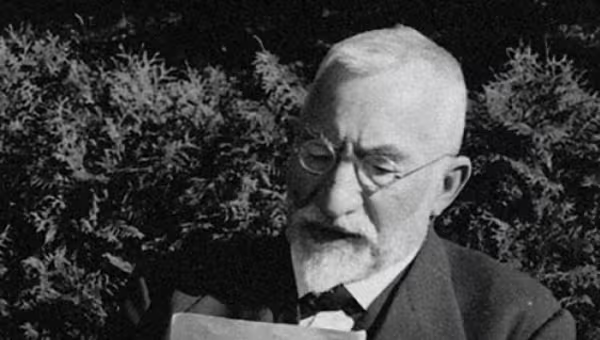
Otto SchmeilPrize

In 2016, the Schmeil Foundation(external link) established thePrize support early-career researchers in biological and medical research.
The prize is Academy of Sciences and Humanities every two years by the Heidelberg Academy of Sciences and Humanities and comes with a cash award of 15,000 euros.

ThePrize awarded every two years.

Who can be nominated?

The Prize awarded to a young researcher who already possesses the necessary qualifications for outstanding scientific work. The proposed works must have been published or submitted for publication within the past two years.

Nominees for the award should be no older than 40. If several candidates have contributed equally to the work, the Prize may be awarded Prize in equal shares.

Who is allowed to make suggestions?
  • all members of the Mathematics and Natural Sciences Section of the Heidelberg Academy of Sciences and Humanities
  • the management of all academic institutions at universities in Baden-Württemberg (rectorates, deaneries, executive directors, institute directors)
  • the management of all non-university research institutions in Baden-Württemberg (executive directors)
  • Unsolicited applications are not accepted.
The prize founder

Otto Schmeil (external link) (1860-1943) followed in the footsteps of his father and grandfather by pursuing a career as a teacher. At that time, there was a significant gap between the state of knowledge in biology and teacher training. Otto Schmeil was one of the first in his field to use detailed and vivid illustrations to present even complex topics in biology in a more understandable way.

Schmeil's textbooks for natural history lessons focused on observing nature and discovering causal relationships.
Schmeil's books "Der Mensch" (Man) and "Pflanzenkunde" (Botany) quickly became widely read. Even today, they are still among the highest-circulation textbooks worldwide. "Der Schmeil" has accompanied generations of schoolchildren through their school years.

Otto Schmeil had three children: Johannes (1886-1957), Margarethe (1893-1976), and Werner (1896-1968). Johannes, the eldest, was the initiator of the Schmeil Foundation(external link), which was established to commemorate his father Otto Schmeil and his three sons who were killed in the war. Following the professional orientation of Otto and Johannes Schmeil, the foundation's mission was established as supporting biological and medical research.

The award winners

The Prize awarded every two years since 2016 for outstanding work by researchers in the fields of medicine and biology.

All previous award winners:

yearNameTitle
2024Sepp, MariCellular development and evolution of the mammalian cerebellum using single-cell sequencing technologies
2022Bertolini, MatildeInteractions between nascent proteins translated by adjacent ribosomes drive homomer assembly
2022Fenzl, KaiInteractions between nascent proteins translated by adjacent ribosomes drive homomer assembly
2020Cardoso-Moreira, MargaridaGene Expression Across Mammalian Organ Development
2018Haas, SimonRevising classical models of hematopoietic stem cell commitment by single cell analyses
2018Velten, LarsRevising classical models of hematopoietic stem cell commitment by single cell analyses
2016Cryle, MaxWork on the biosynthesis of glycopeptide antibiotics
nomination deadline

Every two years March 1 - June 30

What needs to be submitted?
  • Cover page

  • Justification of the proposal, maximum two pages
  • resume
  • list of publications
  • award-worthy work

The documents should be submitted as a single PDF file and sent to hadw[at]hadw.de.

When will the decision be made?

The Academy will announce its decision at the beginning of the year. The winner and their mentor will be notified of the result in writing.

Do you have any questions?

You can reach us by phone at 06221 54-3265 or by email at hadw[at]hadw.de.

If you wish to send the documents by mail, please send them to:

Heidelberg Academy of Sciences and Humanities
Executive Secretariat
Karlstraße 4
69117 Heidelberg