
Das Deutsche Rechtswörterbuch (DRW)
Das Deutsche Rechtswörterbuch (DRW) is a comprehensive dictionary of historical legal language that covers the legally relevant vocabulary of German (as well as other West Germanic languages) from the beginning of written records in late antiquity through the early 19th century.
In addition to legal technical terms such as “Akzise,” “Pfefferlehen” or “Servitut,” it also includes words from everyday language whenever they take on special significance in a legal context; for example, the DRW includes entries on “Kuß,” “lachen,” and “sinnlich.” It explains professions, tax terms, coins, and weights—many of which are often forgotten today. Articles such as “Acker,” “feiern,” “Nachbarschaft,” and “Saubär” reflect everyday life in the legal sphere. The DRW is thus not only a key reference work for legal historians but also a helpful tool for anyone working with historical German (or West Germanic) texts. Not least because of its generally accessible and free online version, the dictionary is therefore used far beyond Germany’s borders.
To date, approximately 100,000 entries covering the letters “A” through “S” have been completed. The entries are compiled by an interdisciplinary team of scholars at the DRW research project, drawing on an archive of approximately 2.5 million examples and a growing text database. The underlying corpus contains about 8,400 titles—sources and collections of sources spanning a wide variety of text genres from diverse regions of (primarily Central) Europe. It includes not only words from all varieties of German—including High German and Low German—but also from other West Germanic languages, such as Old English, Lombardic, Old Frisian, and Middle Dutch.
Founded in 1897 by the Prussian Academy of Sciences, the dictionary project has been overseen by the Heidelberg Academy of Sciences and Humanities since 1959. The DRW was one of the first dictionaries in Germany to go online in 1997/99. The retro-digitization of the old volumes was made possible by a grant from the German Research Foundation.
Publications by the research project
Information on additional publications by the research project can be found here.
Terms of Delivery
Please contact the following for terms of delivery:
J.B. Metzler Publishing, Part of Springer Nature
Springer-Verlag GmbH, Uhlandstraße 14, D-70182 Stuttgart
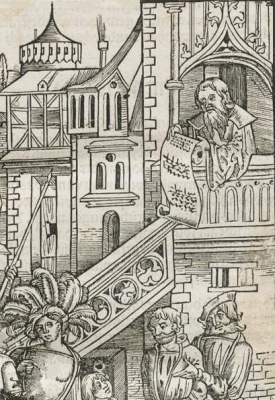
The Pronouncement of the Judgment, illustration from the *Laienspiegel* (1509)
The Dictionary of Old German Legal Language
Das Deutsche Rechtswörterbuch (DRW) is not an encyclopedic dictionary, but a dictionary of words. This means that it presents individual words and their meanings, rather than legal institutions or legal concepts with their histories and various terms, which are covered under a general heading.
Das Deutsche Rechtswörterbuch—as a dictionary of the older language—is a historical dictionary. It covers the language of law from the beginning of the written tradition in Latin documents from the Migration Period up to around 1800. For contemporary legal language, you must consult a modern legal dictionary. Examples include those by Creifelds and Köbler.
Furthermore, it is a dictionary of German legal language.
According to 19th-century theory—the period in which the DRW was conceived—“German” serves as a generic term for the entire West Germanic language family, as Jacob Grimm defined it in his introduction to the *Deutsches Wörterbuch*: “so that the Frisian, Dutch, Old Saxon, and Anglo-Saxon languages are nonetheless included within the German language in the narrower sense” [Volume I, Leipzig 1854, p. XIV].Finally, Das Deutsche Rechtswörterbuch is a dictionary of legal language. The term “legal language” does not refer to technical jargon in the strict sense, but rather to general vocabulary in its legal contexts. It illustrates how legal concepts and legal institutions have manifested themselves in everyday language. The DRW thus contains not only legal technical terms but also all words of general language, provided they occur in legal contexts. For example, even an adjective like “nackt” is included—in its legally relevant meaning of “in a state of nudity as evidence of adultery.” You will find words such as “to do,” “kiss,” “cauldron,” and “linden tree” as well as “litigation contestation,” “pledge constitution,” and “parish field.”
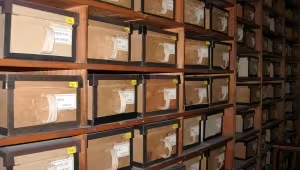
Document Archive Card Index Shelving Units
History of the DRW
1896/97
The DRW was founded as an institution of what was then the Royal Prussian Academy of Sciences. This was the classical era of German legal history, featuring names such as Karl von Amira, Heinrich Brunner, Richard Schröder, and Ulrich Stutz stand out, and with the compilation of the *Deutsches Wörterbuch*, Friedrich Kluge’s *Etymologisches Wörterbuch*, the *Schweizerisches Idiotikon*, and several other major dialect dictionaries, it was a golden age of lexicography.
The DRW’s founding commission included the legal historians Karl von Amira, Heinrich Brunner, Ferdinand Frensdorff, Otto von Gierke, and Richard Schröder, as well as the historian Ernst Dümmler and the historical linguist Karl Weinhold. The Heidelberg legal scholar Richard Schröder assumed organizational leadership—thus, the dictionary project was based in Heidelberg from the very beginning. The founding committee published the dictionary’s outline in the *Savigny-Zeitschrift für Rechtsgeschichte* and called for contributions to the dictionary. The effort was successful: by the time the first volume of the dictionary was completed in 1932, approximately 250 people had participated in excerpting the sources, including students, “older individuals, doctors, professors, archivists, teachers, and laypeople from all walks of life with expertise in history and linguistics,” as Eberhard von Künßberg summarized in the preface to the first volume of the DRW.
1917
Eberhard Freiherr von Künßberg was appointed director of the dictionary. In this role, he demonstrated “the utmost prudence and the finest linguistic and legal acumen.” Furthermore, beginning in 1933, he safeguarded the dictionary from making concessions to the prevailing spirit of the times. His death in 1941 and the aftermath of World War II dealt severe blows to the dictionary, the effects of which continued into the 1970s.
1959
The Heidelberg Academy of Sciences and Humanities assumes responsibility for the dictionary: until that time, it had still been legally assigned to the German Academy in Berlin (East) as the legal successor to the Royal Prussian Academy.
1970
The start of a series of urgently needed reforms of the project.
1971
Günther Dickel assumes the scholarly direction of the dictionary.
1973
Heino Speer is appointed director of the research project.
1985
Following the death of G. Dickel, Speer also assumes the scholarly direction of the DRW. This also marked the beginning of the gradual introduction of electronic data processing.
1999
With the DFG-funded, worldwide, and free-of-charge online publication—initially of a portion of the dictionary—the project began to achieve visible success. Internet users now have access to nearly all completed dictionary entries, both in an electronic version (fully searchable and with numerous links) and as online facsimiles of the print edition. This online offering is rounded out by facsimiles and, in some cases, electronic full-text versions of numerous source texts, providing additional research options.
2007
Upon Heino Speer’s retirement, Andreas Deutsch is appointed director of the research project.
No fewer than five volumes of the DRW (namely Volumes 7–11) were edited and shaped academically by Heino Speer. He has now turned his attention increasingly to the DFG project DRQEdit, which he initiated and directs, and which aims to make all important German-language legal texts from the 15th and 16th centuries available online. He is now primarily engaged in Austrian legal history (see his project RepÖstRG).
The DRW is produced according to a fixed publication schedule. A double installment is scheduled to be completed every twelve to thirteen months; five double installments make up one volume. Each volume is expected to contain over 5,000 entries, so that the total vocabulary to be covered in the DRW will amount to approximately 120,000 entries. The dictionary project is scheduled to be completed in 2035/36.
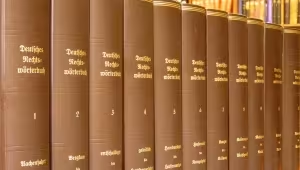
New Informational Video
A video profile of the German Legal Dictionary
This new five-minute video about the research project describes how the dictionary is compiled, provides a brief overview of the project’s history, and offers a few tips and tricks for using the freely accessible online version. Just click on the image to play the YouTube video (as external content):
New DRW Double Issue
DRW Double Issue “Vol. 14, Issues 7 and 8” Published
In early 2023, the fourth double issue of Volume 14 of Das Deutsche Rechtswörterbuch (DRW) was completed. This double issue contains 1,118 entries—beginning with “taugbar” and ending with “Toppschilling.”
For Volume 14, the publisher has slightly revised the DRW’s design. The format of the issues has been adapted to international standards. For those who have their DRW volumes bound, however, this does not entail any significant change, as the internal print format remains entirely unchanged; the volumes can therefore be trimmed to the usual format during binding.
DRW Conference
Concluded Conference “Land Rights and Land Law Reforms” from March 29 to 31, 2023
Following the conference on “Municipal Rights and Municipal Law Reforms,” for which the conference proceedings have already been published (see below), a companion conference focusing on rural rights and rural law reforms took place in late March 2023. These are essentially similar to their urban counterparts and often serve as precursors to today’s laws. They regulate not only the organization of urban public life—including criminal law and procedure—but also the affairs of citizens, such as family law and inheritance law.
About 500 years ago, the reception of Roman law in Germany gave rise to a new generation of territorial “codifications”—the so-called land law reforms, often drafted by learned jurists. They were not always thoroughly imbued with Roman law, but they were significantly more systematic than their predecessors. The burgeoning art of printing enabled their dissemination in often lavish editions with ornate title pages. But what are the distinctive features of the rural law reforms? Are there significant differences compared to the municipal law reforms?
Scholars from various disciplines presented important provincial laws and provincial law reforms at the conference and discussed their content and language. A conference proceedings volume is planned.
The detailed conference program can be found here (PDF).
Harbarth, President of the Federal Constitutional Court, offered his congratulations
125 Years of Das Deutsche Rechtswörterbuch—2022 Anniversary
What is a “Schnatbaum”? And what is a “Stirnenstößer”? Das Deutsche Rechtswörterbuch (DRW) answers these and many other questions. The comprehensive dictionary of historical German legal language celebrated its 125th anniversary in 2022. Work on the research project—now housed at the Heidelberg Academy of Sciences and Humanities—began in 1897. Approximately 100,000 entries have already been published—and 1,000 new entries are added each year.
Federal Constitutional Court President Harbarth offered his congratulations
Stephan Harbarth, President of the Federal Constitutional Court, congratulated the Heidelberg research project on this remarkable anniversary. In his greeting, he emphasized the central contribution of Das Deutsche Rechtswörterbuch to the study of German legal language. The dictionary brings to life the “linguistic dimension of our historical technical language.” The “insights that emerge when Das Deutsche Rechtswörterbuch uncovers the roots of our contemporary legal language” are remarkable. Harbarth added, verbatim:
“In the 125th year of Das Deutsche Rechtswörterbuch, it is time to express our heartfelt thanks to the research project for the care and preservation of our historical linguistic heritage and to express our admiration for what has been achieved thus far. The journey that began 125 years ago has already come a long way. And yet, as Jacob Grimm wrote in his *Poesie des Rechts* (*Poetry of Law*), ‘much that is believed to be lost or forgotten […] still remains to be resolved’ from ‘the entire treasure of language.’ The task, therefore, remains as immense as it is significant.”
1,400 Years of Linguistic History in a Single Dictionary
Das Deutsche Rechtswörterbuch traces the entire development of German legal language—from the oldest (West) Germanic linguistic records through the 19th century. For example, the earliest attestation of the word “Graf” comes from a royal charter dating to 479 A.D. The entry for “absetzen” even includes an example from before 384 A.D.—from Bishop Wulfila’s Gothic Bible, which was consulted for comparative purposes. In addition to High and Low German sources, the DRW includes, among others, Lombardic, Old English, Old Frisian, and Middle Dutch texts. Only in this way can the linguistic and legal development of Central Europe be adequately reflected. Hardly any other dictionary covers such a broad time frame.
Over 100,000 word entries are complete
Sorted alphabetically, Das Deutsche Rechtswörterbuch begins with the entry “Aachenfahrt.” In 2021, the final entries beginning with “S” were completed. The double issue 5–6 of Volume 14—containing entries from “Subjekt” to “Taufzeuge”—is currently in press. The dictionary is being compiled by an interdisciplinary team of scholars. “Our goal is to explain the sometimes complex meanings of words in a way that is as accessible as possible,” reports Professor Andreas Deutsch, who has served as the project’s scientific director since 2007. “Since the dictionary explains not only core legal vocabulary but also legally relevant words from everyday language, the DRW is not only a reference work for lawyers and legal historians but for anyone interested in history. We see this very clearly in the number of online users.”
A Research Project Spanning Five German States
Founded in 1897 as a project of the Royal Prussian Academy of Sciences in Berlin, work on Das Deutsche Rechtswörterbuch began during the German Empire. Over the years, up to 250 volunteers from a wide variety of European countries combed through important legal sources for relevant terms. They recorded significant examples on index cards. The approximately 2.5 million “citation slips” accumulated over time were collected in the “Dictionary Archive” in Heidelberg, which later became the DRW research project. It was not until 1914 that the first entries were completed. Then World War I and the global economic crisis, which began shortly after the founding of the Weimar Republic, hampered the work. During the Nazi regime of terror, research center director Eberhard von Künßberg suffered reprisals because he was married to a Jewish woman. Yet he steered the project undeterred by attempts at political interference. Künßberg’s death and World War II brought the dictionary work to a temporary halt. Getting back on track during the division of Germany proved difficult: Formally, the “Academy of Sciences of the GDR” succeeded the Prussian Academy, but the Heidelberg-based DRW research project could neither be supervised nor funded from East Berlin. Consequently, the DRW found a new home at the Heidelberg Academy of Sciences and Humanities. The DRW thus became a joint German-German project. The publishing house was based in Weimar, and printing took place in the GDR. The DRW began its digitization efforts even before German reunification. In addition to the “reference slips” from the early years, an electronic text archive has since served as the basis for article editing. As early as 1997, the DRW became one of the first dictionaries in Germany to publish its first entries online. Today, DRW-Online offers numerous additional research options that go far beyond what the founding fathers of 1897 could have imagined.
New Anthology
Volume “Municipal Laws and Municipal Law Reforms” Published in the DRW Series
Andreas Deutsch (ed.), Municipal Laws and Municipal Law Reforms (Academy Conferences 32; Publication Series of Das Deutsche Rechtswörterbuch), 681 pages, approx. 50 illustrations, Price: €68.00 - 978-3-8253-4898-4, Heidelberg: Universitätsverlag Winter, 2021.
The “New Reformation” of the Imperial City of Nuremberg (1479) marked the beginning of the era of “municipal law reforms,” which lasted well into the 17th century. With these modernized municipal laws—which almost seem like precursors to today’s codifications—the self-assured magistrates sought to demonstrate their independence, making use of the burgeoning printing press to do so. Shaped by jurists trained in Roman law, the municipal law reforms are more systematic than their predecessors. However, they often contain less Roman law than one might expect.
This volume profiles this genre of sources and—for the first time in this form—provides criteria for distinguishing them. To gain a clear picture—including in contrast to older law—individual medieval municipal laws are first presented following introductory essays. These are followed by descriptions of the major municipal law reforms and examples of failed reforms—including examples from beyond the German-speaking world.
In addition to a detailed introduction to the topic by the editor, the volume contains contributions by Gerhard Köbler, Gerhard Dilcher, Arend Mihm, Bernd Kannowski, Katalin Gönczi, Dieter Pötschke, Almuth Bedenbender, Manshu Ide, J. Friedrich Battenberg, Heike Hawicks, Wendt Nassall, Klaus-Peter Schroeder, Johannes Laschinger, Anja Amend-Traut, Petr Kreuz, Sonja Breustedt, Christoph Becker, and Stephan Dusil. For more information about the volume, visit the publisher’s website: https://www.winter-verlag.de/detail/978-3-8253-4898-4/Deutsch_Hg_Stadtrechtsreformationen/