About the Heidelberg Academy of Sciences and Humanities
What is the Heidelberg Academy of Sciences and Humanities?
The Heidelberg Academy of Sciences and Humanities is located in Heidelberg. Heidelberg is in the state of Baden-Württemberg.
It is: the Academy of Sciences of the state of Baden-Württemberg.
It is over 100 years old.
It is commonly referred to as the “Academy.”
“Academy” means:
A group of professors meets regularly at the Heidelberg Academy.
They are professors from all over Baden-Württemberg.
Professors teach subjects—just like teachers at schools.
These subjects are also called “sciences.”
Sciences include, for example: history, medicine, languages
Each professor has his or her own field of study. The professors talk to one another about their fields of study. This way, they learn about each other’s work. And they can understand one another better.
And there are young scientists at the Academy.
Young scientists means they are just starting out in their field.
At the Academy, professors and young scientists come together. And they can get to know one another.
There are projects at the Academy.
A project means:
People work together on a task. The task is large and difficult. When they discover something about the task, they write it down.
An example of a project:
The Goethe-Woerterbuch
Goethe:
The German poet Johann Wolfgang von Goethe knew a great many words.
And he wrote a great deal.
Because he wasn’t just a famous poet.
He was also a minister in Weimar.
That’s why he wrote many administrative texts.
Goethe also conducted many scientific experiments.
For example, he was very interested in light and color.
And then he wrote down the results of these experiments.
He also wrote many letters.
All of this has been published.
Goethe was already very famous throughout Europe during his lifetime.
Dictionary:
Many years ago, it was decided to compile a dictionary from his works.
That is the Goethe-Woerterbuch.
It contains all the words that Goethe used.
That’s around 90,000!
Many people have compiled lists of all these words.
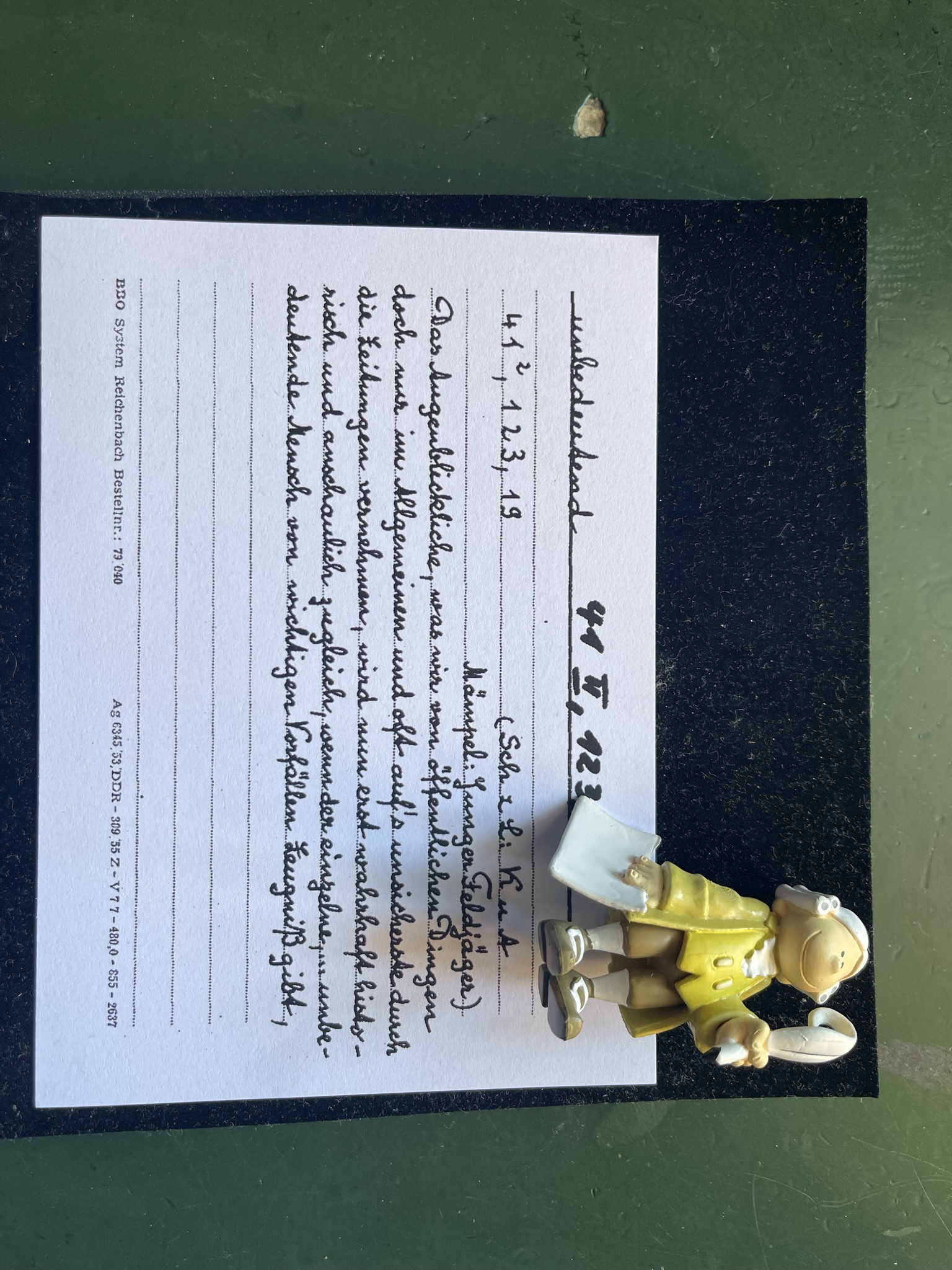
And they’ve written 3 million index cards with the words on them.
These slips of paper are called “index cards.”
On them, you can look up exactly how Goethe used a particular word.
You can see an example of such an index card at the bottom of the page.
Goethe lived about two hundred years ago.
Although we mostly use the same words today as Goethe did back then.
But sometimes we mean something different by them.
For example, back then people sometimes called someone “stupid.”
But that doesn’t mean he was stupid.
It could also mean that someone had poor eyesight and couldn’t see well.
Or: People would say someone had “Witz.” And by that they meant that he was particularly clever.
Not that he was particularly good at telling jokes!
So, as you can see from the Goethe-Woerterbuch: Words change.
They don’t always mean the same thing.
You can also find words in the Goethe-Woerterbuch that no longer exist today.
Or you can look up difficult words.
That’s why the Goethe-Woerterbuch isn’t just useful for researchers.
Anyone can use it if they want to know: What different meanings can a single word have?
And so that everyone can use it, it’s available online, just like many other dictionaries:
https://woerterbuchnetz.de/ (Link to another website)