

Organization
Organization of the Academy
The Heidelberg Academy of Sciences and Humanities is a statutory body under public law and serves as the Academy of Sciences for the State of Baden-Württemberg. It enjoys the special protection and support of the Ministry of Science, Research, and the Arts (external link).
The Academy consists of three pillars: the Academy Members, research projects, and the Young Academy | HAdW.
The Academy’s plenary assembly is composed of the members (internal link) of the Mathematical and Natural Sciences Class and the Philosophical and Historical Class. Each class may have a maximum of 50 full members. In addition, up to 50 Corresponding Members may be appointed to each class. The president is elected by the plenary assembly, and the Secretaries are elected by their respective classes. The president and Secretaries form the Academy’s Executive Board.

The Executive Board
 HAdW
HAdW
Hans-Georg Kräusslich
President of the Academy
He is a virologist and served as dean of the Heidelberg Faculty of Medicine at Heidelberg University until September 30, 2023. From 2015 to 2019, Hans-Georg Kräusslich served as Secretary of the Mathematical and Natural Sciences Class.
 HAdW
HAdW
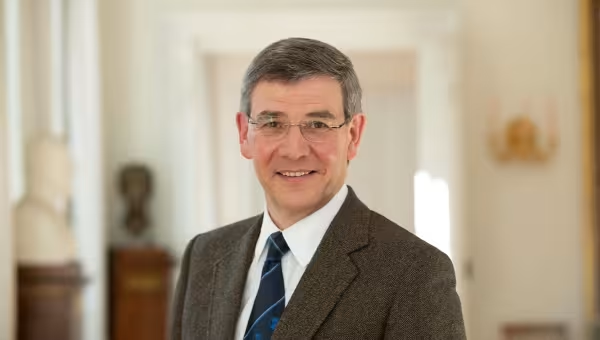
Sabine Dabringhaus
Secretary of the Philosophical-Historical Class
Her research focuses include, among other things, the history of the late imperial period in China, nationalism in 20th-century China, and the history of the Chinese humanities.
 HAdW
HAdW
Lutz Gade
Secretary of the Mathematical and Natural Sciences Class
His areas of research include, in particular, organometallic chemistry, homogeneous catalysis, and coordination chemistry (stereoselective catalysis), as well as functional dye chemistry.
 HAdW
HAdW
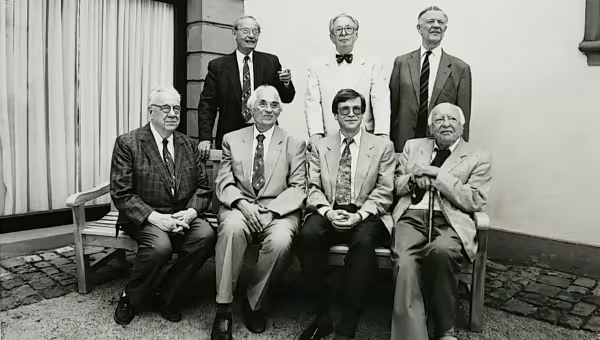
Past Presidents
The office of president has existed at the Academy only since 1941. The term of office is currently three years, and reelection is possible.

Ombudspeople
The Academy’s two ombudspersons have divided their areas of responsibility. One ombudsperson is responsible for “Good Scientific Practice,” and the other for “Collaborative Behavior” in the workplace. You can contact them at any time.
Staff Council
The Staff Council represents all employees of the Academy. Its responsibilities are defined by the Baden-Württemberg State Employee Representation Act. The Staff Council consists of six members elected by the Academy’s employees.