WIN Conferences

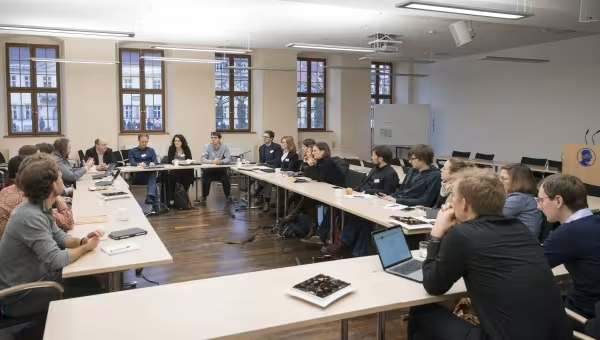
Interdisciplinary research and the promotion of early-career researchers are key priorities for the Heidelberg Academy of Sciences and Humanities. Through the Young Academy | HAdW, the Academy has been supporting outstanding young researchers in Baden-Württemberg since 2007 in organizing WIN-Conferences (formerly known as Academy Conferences). The Academy provides funding for this purpose, assists with organization, and offers scholarly advice. The goal is to give this group of researchers the opportunity to organize international, interdisciplinary scholarly conferences on their own initiative and with complete independence. In keeping with the Academy’s mission, these conferences are intended to foster scholarly dialogue across disciplinary boundaries and must therefore have an interdisciplinary focus.

With these conferences, the Academy deliberately sought to go beyond the scope of conventional support for early-career scholars.

Since 2019, up to three conferences per year have typically been funded in this format. The WIN-Conferences held to date have demonstrated a high degree of commitment, creativity, and responsible and successful execution. Supporting independent organization by young researchers has thus proven to be particularly fruitful and innovative, and it encourages the Academy to continue this initiative with great interest and enthusiasm and to further advance young research.

Eligible applicants are researchers exclusively in the early stages of their academic careers following the completion of their doctorate. Applicants must be employed at a research institution in Baden-Württemberg and must not have been appointed to a tenured professorship at the time of application. Researchers already affiliated with the Academy are ineligible to apply.

Funded by:

The Conference

Conviviality as a Religious Educational Task in the Past and Present (internal link)
(March 25–26, 2026)
Christopher Nunn (University of Heidelberg), Katrin König (University of Heidelberg/University of Paderborn)
External link to the conference program

The Conferences
  • Measuring Culture – Advancing Computational Approaches in Sociology, Political Science, and Linguistics
    (May 8–9, 2025)
    Mark Wittek, Agnieszka Falenska, University of Stuttgart
  • Interdisciplinary Workshop on Experimental Social Science on the Causes and Consequences of Appearance-based Discrimination
    (June 11–13, 2025)
    Johanna Gereke, University of Mannheim
  • Overcoming Uncertainties in Cold-Region Hydrology (internal link)
    (September 29–October 1, 2025)
    Léa Bussière, Heidelberg University
WIN-Conferences 2024

Conferences

WIN-Conferences 2023

The Conferences

Reports on the individual conferences can usually be found in the Academy's Annuals (external link).

2022
  • Historical Modelling of Biodiversity Loss: Reassessing European Imperial History
    Organizer: Dr. Javier Francisco (University of Freiburg)
  • An interdisciplinary methods conference for early-career researchers (PhD & postdocs) in the fields of childhood and age(ing) research
    Organization: Dr. Anna Wanka and Tabea Freutel-Funke (University of Stuttgart)
  • Early Medieval Mobility – Interdisciplinary Approaches
    Organization: Dr. Laury Sarti (Department of History, Albert Ludwig University of Freiburg)
  • 1st Molecular Systems Engineering for Bioapplications (MSEB)
    Organizers: Jun.-Prof. Eva Blasco (University of Heidelberg), Dr. Mohammadreza Taale (KIT/University of Heidelberg), and Dr. Maria Villiou (University of Heidelberg)
2021
  • Translation, Interpretation, Adaptation. Music between Latin America and Europe, 1920–2020
    Organizers: Dr. Christina Richter-Ibáñez (University of Tübingen)
  • Water and Nutrient Fluxes in Ecosystems under a Changing Climate—A Tracer-Based Perspective
    Organization: Dr. Natalie Orlowski, Dr. Michael Rinderer, Jaane Krüger, Dr. Maren Dubbert (University of Freiburg)
  • Philosophy of Science Meets Machine Learning
    Organization: Dr. Thilo Hagendorff, Dr. Thomas Grote, Dr. Eric Raidl (University of Tübingen)
  • Safeguarding Human Rights in Transnational Supply Chains – How Can a National Law Solve a Global Problem?
    Organizers: Dr. Astrid Wiik and Dr. Leonhard Hübner (University of Heidelberg)
  • Political Positioning. Linguistic and Social Practices
    Organization: Dr. Mark Dang-Anh (Leibniz Institute for the German Language, Mannheim)
2020
  • Content Meets Structure: Integrating Different Perspectives on Social Networks
    Organizer: Dr. Lydia Repke (Leibniz Institute for the Social Sciences, Mannheim)
2019
  • The Silence of Organizations. How Organizations Cover Up Wrongdoings
    Organization: Dr. Kristina Höly and Dr. Sebastian Starystach (Max Weber Institute for Sociology, University of Heidelberg)
  • Change and Transformation of Premodern Credit Markets: The Importance of Small-Scale Credits
    Organization: Mag. Stephan Köhler (University of Mannheim)
  • Interdisciplinary Multi-Species Biacoustics Workshop
    Organization: Dr. Barbara Klump, Dr. Nora Carlson, Dr. Jens Koblitz (Max Planck Institute for Ornithology, Radolfzell)
2016
  • Freedom and Responsibility—The Constitution and Human Rights in Hungary and Germany Through the Ages
    Organization: Dr. Fruzsina Molnár-Gábor (University of Heidelberg)
2015
  • Baltic-German Cultural Relations from the 16th to the 19th Century. Media – Institutions – Actors. (Sub-conference II: Between the Enlightenment and National Awakening)
  • In cooperation with the Bulgarian Academy of Sciences: Social Dimensions of Food in the Prehistory of the Eastern Balkans and Neighboring Areas
2014
  • Baltic-German Cultural Relations from the 16th to the 19th Century. Media – Institutions – Actors. (Subconference I: Between the Reformation and the Enlightenment)
  • In cooperation with the Academy of Athens (Hellenic Academy of Sciences): Gaze, Vision, and Visuality in Ancient Greek Literature. Concepts and Contexts from Homer to Plutarch
2013
  • In cooperation with the Learned Society of the Czech Republic: Saints, Heroes, Tyrants. Interwoven Styles of Rule in the Long Century of the Luxembourgs
  • Digital Geoarchaeology—The Use of New Technologies in Interdisciplinary Human-Environment Research
2012
  • From social altruism to commercial exchange: Gift Giving and the “Embedded” Economy in the Ancient World
  • Another Africa? (Post-)Colonial Imaginations of Africa in Russian, Polish, and German Culture
  • History(ies) of the Gulag - Reality and Fiction
2011
  • Bilingualism—Sociolinguistic and Cultural Scenarios
2010
  • New Perspectives in Quantum Statistics and Correlations
  • Facing the Multicore Challenge
2009
  • The Left-Alternative Scene and New Social Movements in the 1970s
  • "New" Approaches in Medicine: Alternative Medicine—A Curse or a Blessing?
2008
  • Objects and Humans in Antiquity. The Living Present – Bringing the Living to Mind
  • Statehood and the Formation of the State in Late Antiquity and the Early Modern Period
2007
  • Water—A Source of Conflict in the 21st Century. From Crisis Diagnosis to Problem Management
  • European Business and Economic Ethics: Diagnosis – Dialogue – Debate
  • Overcoming Dictatorship in Europe: New National and Transnational Perspectives
Eligible Applicants

To apply, you must:

  • hold a Ph.D. Only researchers in the early stages of their academic careers following the completion of their Ph.D. are eligible to apply. Family-related life stages are taken into account in the review process. Researchers already affiliated with the Academy are ineligible to apply.
  • work at a research institution in Baden-Württemberg,
  • not yet have been appointed to a tenured professorship at the time of application. Junior professorships and tenure-track professorships are eligible to apply.
General Conditions
  • The grant amount is generally a maximum of 11,000 euros per conference.
  • Approved funds must be spent within the respective fiscal year (including publication costs). Funding may be requested for travel expenses (in accordance with the State Travel Expenses Act of Baden-Württemberg), material costs (e.g., conference materials, invitations), and funds for student and research assistants; however, funding is not available for academic staff or speaker fees.
  • Within the budget, a cost center for the publication of the conference may be requested. Only open-access publications are funded.
  • The conference should preferably be held on the Academy’s premises. There is no charge for the use of the facilities. The Academy’s lecture hall is designed to accommodate up to approximately 60 conference participants.
  • If the Academy’s facilities are used, no more than four conference days should be planned. The conference cannot be scheduled over a weekend. When submitting the application, it is sufficient to specify a desired time frame; if the application is approved, the date must be coordinated with the Academy.
  • Speakers to be invited do not need to have been contacted at the time of application.
The Application
  • The application—and thus the conference—must have an interdisciplinary focus. The application must specify the topic to be addressed and explain how this can only be achieved through an interdisciplinary conference. In addition to a description of the content, a conference schedule must be submitted as an attachment. Speakers to be invited must be listed but must not yet have been contacted.
  • The application may not exceed five pages. In addition, a budget proposal (max. 1 page) and a CV with a list of publications (max. 2 pages per person) must be submitted. [Times New Roman 12pt, line spacing 1.15].
  • Mr. Georg Wolff is available to answer any questions you may have regarding the calls for proposals. Please direct any inquiries with the subject line “WIN-Conference” to hadw@hadw-bw.de (email link).