

archaeogenetics
Duration: 2020–2021
The Heidelberg Academy of Sciences and Humanities HAdW) is a community of scholars from various disciplines. For this reason, members of the Philosophy and History Class and the Mathematics and Natural Sciences Class have an interest in the relationship between history and the natural sciences and have utilized the Academy’s interdisciplinary nature to address various interdisciplinary questions in a cross-class working group.
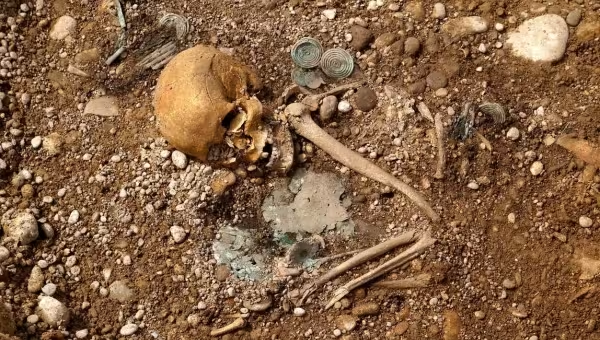
A project-based approach was taken to explore new methods in the field of archaeogenetics , as scientists from various disciplines have recently begun using new techniques to generate historical data.
Given its central role and public visibility, archaeogenetics was ideally suited for this interdisciplinary project. It analyzes ancient DNA—and thereby generates new data, for example on kinship, but also on migrations. This applies, for instance, to the so-called Migration Period at the threshold between Antiquity and the Middle Ages, with more recent, much-discussed studies on the migration of the Lombards, Anglo-Saxons, Huns, and other groups. In addition, there have been spectacular aDNA studies of ancient pathogens (such as the Justinian Plague of the 6th–8th centuries and the so-called “Black Death” since 14th century).
Archaeogenetics is likely the most visible new field—if only because aDNA analyses are incorporated very directly and with great public impact into contemporary political discussions about origin and identity. In addition, however, there is a growing number of other methods whose historical significance is currently being tested and debated: In climate and environmental history, for example, pollen analyses and the study of ice cores play a significant role, while isotope analyses have become important in research on human diet and mobility.
From the perspective of historical disciplines (such as history, but also archaeology), these new methods generate highly interesting data. However, they also raise fundamental questions regarding interdisciplinary collaboration between the natural sciences on the one hand and the humanities and cultural studies on the other.
Members of the working group
Directed by:
- Steffen Patzold
- Wolfgang Reinhard
Members:
- Ekkehard Bautz
- Hans-Joachim Gehrke
- Mischa Meier
- Volker Mosbrugger
- Ulrich Platt
- Wolfgang Reinhard
- Hans Weidenmüller
- Albrecht Winnacker