

Portrait of the Academy
Profile
The Heidelberg Academy of Sciences and Humanities HAdW) is the state academy of Baden-Württemberg. As a scholarly community and non-university research institution, it serves as the strong, impartial voice of science within the state and beyond. The Academy stands for the outstanding standing of Baden-Württemberg as a center of science and, in the great tradition of academies, offers a special venue for high-level scholarly discourse. It is founded on science-driven processes, serves the scientific community, and recognizes its social responsibility in doing so.
Non-university research institution
As a non-university research institution, the Academy provides a framework for long-term scholarly projects and contributes to the development of digital research methods. Its focus is on basic research in cultural and intellectual history. The HAdW the institutional framework for long-term research projects in Academies' Programme (internal link): Here, continuous observational series and data collections are developed, and extensive text editions and encyclopedias are compiled and made accessible to the public. In this way, the Academy contributes to the preservation and exploration of cultural heritage—and provides foundational knowledge that serves scholars in research and teaching as well as the general public. Scientific responsibility for the individual projects rests with commissions composed of Academy members and international experts.
Academic Community
The Heidelberg Academy of Sciences and Humanities scholarly exchange among its members, thereby contributing to the development of new research questions and fostering dialogue with the next generation of scholars. In doing so, it sees itself as a bridge between academic disciplines—and as a reliable partner for policymakers and the public when it comes to providing evidence-based decision-making frameworks.
Its members volunteer out of a sense of conviction: to preserve and make accessible cultural heritage, to promote interdisciplinary knowledge exchange, and to advance scholarship that takes social responsibility seriously.
Youth Academy | HAdW
The Young Academy | HAdW a platform for interdisciplinary and intergenerational exchange. It supports outstanding young researchers, raises the profile of excellent early-career research in Baden-Württemberg, and brings it recognition.
By bringing together talented researchers from across the country, the Academy strengthens Baden-Württemberg as a center of scientific excellence and fosters a lasting connection between the awardees and the region. Members of the Young Academy are actively involved in the Academy’s work over an extended period and help shape its direction.
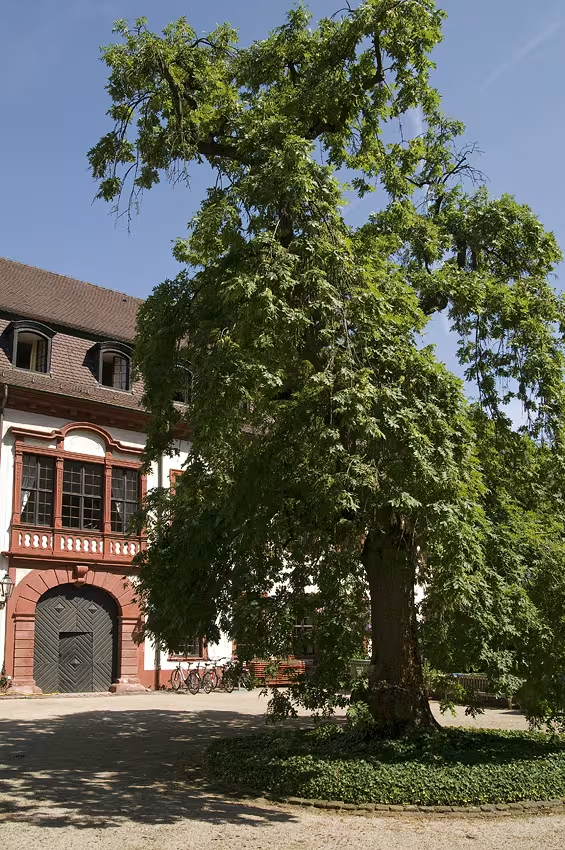
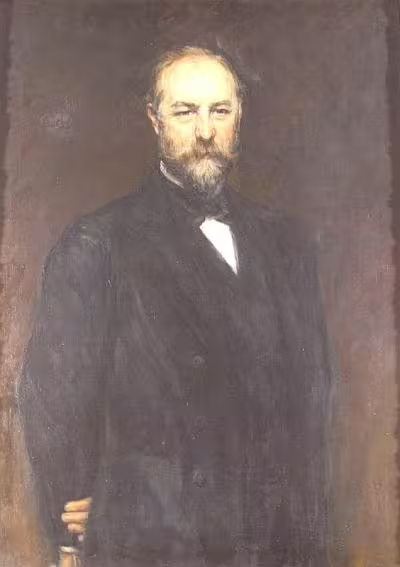
Heinrich Lanz
History of the Heidelberg Academy of Sciences and Humanities
Early Years (1909–1933)
After several failed attempts in the 19th century, the Heidelberg Academy of Sciences and Humanities owes Academy of Sciences and Humanities existence to the patronage of the Lanz family, industrialists from Mannheim. In 1909, in memory of Heinrich Lanz (d. 1905), who ran Germany’s largest agricultural machinery factory, the family provided one million gold marks as endowment capital. The new academy’s organizational structure mirrored that of the other German academies (Berlin, Munich, Göttingen, Leipzig): two classes—the Mathematical and Natural Sciences Philosophical and Historical class and the Philosophical and Historical class —each headed Philosophical and Historical class a secretary, who took turns representing the academy as a whole.
According to the 1909 bylaws, the “Heidelberg Academy of Sciences and Humanities, Heinrich Lanz Foundation” (as it was known until around 1925) was an “association of scholars dedicated to fostering science, expanding it through research, and encouraging and supporting scientific inquiry.” Each class comprised ten full members, who were required to reside in Heidelberg; associate members could come from the rest of Baden. since , the Academy has been headquartered in the former Grand Ducal Palace on Karlsplatz in Heidelberg.
The financial resources were insufficient for larger in-house projects. During the period of inflation, the foundation’s capital was also nearly lost, without the Heidelberg Academy receiving regular government grants in its place; since it began to receive support from the state of Baden in varying amounts. The first major undertakings were the “Recovery of the Fossil Finds from Mauer (Homo heidelbergensis)” (1910–1944) and “The Babylonian-Assyrian Dictionary” (1912–1925).
The Heidelberg Academy during the Nazi era (1933–1945)
The Heidelberg Academy responded to the challenge posed by National Socialist ideology and its implementation by the state in much the same way as nearly all academic institutions in Germany. The guiding principle behind its actions was organizational survival—the preservation of the institution. To achieve this goal, almost any Prize was Prize , above all the renunciation of legal rights, collegiality, and solidarity with persecuted members, as well as the abandonment of academic standards in new elections. The opportunistic tactic of adapting as much as possible and often preemptively conforming to save a reputation that had become questionable led to culpable failure. Although the Academy did not conduct any research projects typical of the Nazis, five National Socialists were elected in the 1934/35 elections, three of them to vacant seats in disciplines traditionally under the Academy’s purview (astronomy, geology, physiology). The “Nazi faction,” although a small minority among the 37 full members, immediately set about expelling the Jewish members from the Academy under the leadership of the physiologist Johann Daniel Achelis. Since those affected were initially unwilling to yield to the pressure and resign, the Mathematical and Natural Sciences Class came to a complete standstill between the summer semester of 1936 and the end of 1937—meetings no longer took place, and the 1937 annual session was also canceled. Within the “Cartel of German Academies of Sciences,” Heidelberg became a pioneer in pushing for a uniform Reich-wide solution for the expulsion of “non-Aryan” members, while the Reich Ministry of Education, Science, and Public Enlightenment (REM) reserved the right to make the decision in 1936. In February 1937, the secretary of the Mathematics and Natural Sciences Class, Otto Heinrich Erdmannsdörfer, noted that in a survey, a minority of class members still advocated “for the retention of non-Aryans under all circumstances,” even though just a few months earlier the “battle sheet” of the Heidelberg group of the NSDStB, “Der Heidelberger Student,” had sharply attacked the Academy for its outdated understanding of science and demanded the “complete purging” of “Jews and friends of Jews.” In silent protest against the treatment of Jewish members, the botanist Ludwig Jost left the Heidelberg Academy in 1937. The Philosophical and Historical class completely out of these disputes and merely pointed to the necessity of achieving a uniform regulation across the Reich.
On November 15, 1938, a "quick letter" from the REM demanded that the Reich Citizenship Law of 1935 (Reich citizens are "citizens of German or related blood") be applied to regular and corresponding members. Those affected were to be encouraged to resign; if they refused, the ministry would revoke their membership. The order was repeated on February 1, 1939, and then also enforced in Heidelberg for "Jews, Mischlinge, and gentlemen married to Jewish women or Mischlinge of the first degree," albeit not without exceptions.
The result of the forced resignations or removals from the membership list was: Of 37 full members (as of April 1, 1933), seven were expelled from the Academy (four from the Mathematical-Scientific Class, three from the Philosophical-Historical Class); of 38 corresponding/associate members, five were expelled (one from the Mathematical-Scientific Class, four from the Philosophical-Historical Class).
In the elections held in the following years until the end of the war, supporters of the regime, critics of the regime, and those with little ideological exposure were elected. The statutes of 1939, which also introduced the Führer principle and made additional elections dependent on confirmation by the ministry, expanded the catchment area for full members beyond Heidelberg to southwestern Germany and now also included the universities and colleges of Freiburg, Karlsruhe, Darmstadt, and Frankfurt; after the conquest of Alsace, Strasbourg was added. Heads of research institutes and industrialists could also be elected.
The financial situation of the Heidelberg Academy remained precarious, so that only two new major projects could be launched in the Department of Philosophy and History: the edition of the works of Nikolaus von Kues (Cusanus) (1925–2015) and “Die Deutschen Inschriften” covering the period from approximately 500 to 1650 (in progress since , with preliminary work since )—a project Academy of Sciences and Humanities by nearly all German academies as well as the Austrian Academy of Sciences and Humanities .
The Heidelberg Academy after 1945
For the new beginning after May 8, 1945, two questions arose in particular: How would the Academy treat those members who had been forced out of the Academy as "non-Aryans" during the years of the Third Reich? And how would the Academy treat those members who could be accused of serious misconduct during the twelve years of Nazi rule, in particular active participation in the "purge" of the Academy? The first question was easy to answer. Members who had been expelled or had resigned were invited to rejoin the Academy as corresponding members. Most accepted this invitation, but not all. Apparently, not everyone felt that the Academy had struck the right tone in this delicate re-establishment of ties.
The Academy had a much harder time dealing with members under investigation. It initially resorted to introducing “suspended membership,” which—depending on the denazification proceedings and the university’s decisions—could, but did not necessarily have to, lead to reinstatement. In 1950, the Academy decided to determine the revocation of suspended memberships according to the rules for new elections. In fact, the Mathematical and Natural sciences class rejected the reelection of implicated members Mathematical and Natural sciences class some cases. On the other hand, however, even heavily implicated members were reelected. The Academy did not have the courage to make a clean break, or indeed to make a clear decision at all. In his history of the Heidelberg Academy, published in 1994—which contains an extensive analysis of this topic—the historian Wennemuth described the Academy’s handling of its past as “hesitant, half-hearted.”
However, the past remained present for the Academy well beyond the immediate post-war years, namely in the form of the question of whether it should or even must examine the behavior of candidates of the relevant age during the years of the Third Reich when electing them. As far as can be ascertained, there has never been a fundamental debate on this issue within the Academy. Even in the case of individual admissions, the question of whether a candidate was directly or indirectly involved in the injustices of the Nazi dictatorship was apparently not raised. Even if one acknowledges that there were reasons for the Academy not to link the elections to a kind of second, belated denazification process, one must nevertheless make the critical observation that the Academy apparently saw no reason to fundamentally reflect on its own behavior in this matter and to state the reasons why it behaved as it did.
The Heidelberg Academy from 1950 Onward
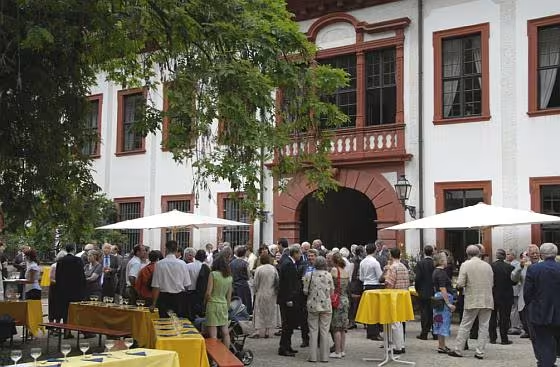
Starting in the 1950s, the Academy’s legal and financial status was gradually consolidated. In 1958, it became the Baden-Württemberg State Academy; in 1966, it was designated a public-law corporation; and since , its core budget has been included in the state’s budget. Accordingly, the Academy is composed of scholars who are based in Baden-Württemberg. In 2009, the Academy celebrated its 100th anniversary with a ceremony attended by the then Minister President of Baden-Württemberg, Günther Öttinger, and numerous other events.
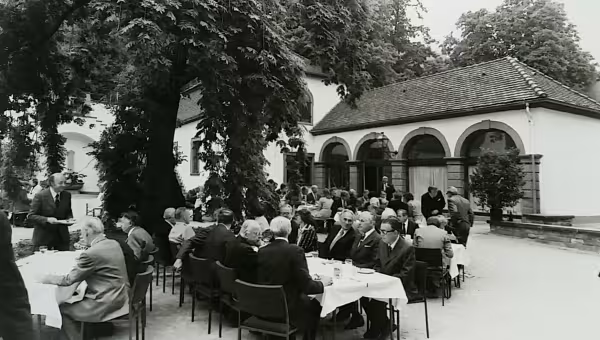
At the same time, the Academy’s research activities were expanding. This development received a decisive boost when the federal and state governments Academies' Programme the so-called Academies' Programme in the 1970s. The program was and remains dedicated to funding long-term research projects, a role previously fulfilled by the DFG. Both classes could now establish research positions for time-limited long-term research projects Academies' Programme by the Academies' Programme . Following a recommendation by the Science Council, purely natural science research projects were no longer included in the Academies’ Program starting in 2004. Since then, the Academies' Programme on long-term projects in the humanities. In a second statement in 2009, the Science Council clarified its position and encouraged interdisciplinary collaboration between the humanities and natural sciences in projects under the Academies’ Programme.
The Union of German Academies of Sciences and Humanities plays a decisive role in the distribution of program funds among the academies. It has existed under this name since as an association of the eight academies of sciences, which are now funded by the federal states. The state academies had previously organized their cooperation in a working group since 1950s, which was restructured into the Conference of Academies in the 1970s and eventually led to the founding of the Union as a registered association. The Heidelberg Academy of Sciences and Humanities involved in these alliances from the very beginning.
Despite this tradition, the Academy is constantly identifying new areas of activity. since , these have included the promotion of early-career researchers through a special program tailored to the Academy’s mission (the WIN Program). The awards that the Academy has been presenting in increasing numbers—beginning with the Academy Prize, established by the Friends of the Academy in 1984—are also intended for early-career researchers. since , initiatives for researchers in the early stages of their careers have been HAdW under the umbrella of the Young Academy | HAdW .
Literature on the history of the Academy
- Udo Wennemuth, Wissenschaftsorganisation und Wissenschaftsförderung in Baden. Die Heidelberger Akademie der Wissenschaften 1909-1949 (Heidelberg 1994).
- Udo Wennemuth, “The Heidelberg Academy of Sciences and Humanities Third Reich,” in *Acta historica Leopoldina* No. 22 (1995), pp. 113–132.
- Volker Sellin (ed.), The Europe of Academies (Heidelberg 2010).
- Heidelberg Academy of Sciences and Humanities ed.), Members of the Heidelberg Academy of Sciences and Humanities Who Were Deprived of Their Rights and Expelled During the Third Reich Academy of Sciences and Humanities Heidelberg 2009).
- Volker Sellin and Sebastian Zwies (eds.), The Heidelberg Academy of Sciences and Humanities Reflected in Its Inaugural Addresses, 1944–2008 (Heidelberg, 2009), including a list of full members, 1909–2008.
- Volker Sellin, Eike Wolgast, and Sebastian Zwies (eds.), Research Projects of the Heidelberg Academy of Sciences and Humanities Heidelberg, 2009).
- Ditte Bandini and Ulrich Kronauer (eds.), *Fruits from the Tree of Knowledge: A Festschrift in Honor of the Research Associates* (Heidelberg, 2009).
- Herbert von Bose, “The Heidelberg Academy of Sciences and Humanities,” in Jörg Kreutz, Wilhelm Kreutz, and Hermann Wiegand (eds.), *In omnibus veritas: 250 Years Academy of Sciences and Humanities Electoral Palatinate Academy of Sciences and Humanities Mannheim (1763–1806)*, Mannheim 2014, pp. 221–231.
- Tonio Hölscher, “Athena as the Emblem of the Heidelberg Academy of Sciences and Humanities,” *Athena* 1-2021, 6–9.
- Uta Hüttig and Hans-Georg Kräusslich (eds.), The Heidelberg Academy of Sciences and Humanities Reflected in Its Inaugural Addresses, 2009–2023 (Heidelberg, 2024),including a list of full members from 2009 to 2023.
- Matthias Ohm, “The Medals of the Heidelberg Academy of Sciences and Humanities,” Athene 2-2024, pp. 35–37.
- Matthias Ohm, “Academia in Nummis: Medals of the Mannheim and Heidelberg Academy of Sciences and Humanities,” in: Numismatisches Nachrichtenblatt, Issue 11/2024, pp. 413–420.