
Further research projects

In addition to the long-term projects of the National Academies Program, the Heidelberg Academy of Sciences and Humanities HAdW) is home to numerous research initiatives. This overview presents the broad spectrum of our externally funded projects, state-level initiatives, and academic collaborations.

The scope of research ranges from the cataloging of historical text corpora and the preservation of global cultural heritage to studies at the intersection of the humanities, natural sciences, and cultural studies.

Current / Completed Current
Completed

WIN-Kolleg

ENDOCRINO SELF


The project investigates how hormonal processes—particularly oxytocin and cortisol—influence conscious experience, affect regulation, and inner speech. The central question is how hormonal dynamics, as embodied processes, help shape our self-perception, our thinking, and our emotional experience. The project combines philosophical theory-building, phenomenological analysis, and empirical research.

WIN-Kolleg

From Pathology to Potential: An Interdisciplinary Approach to Researching Extreme Experiences of Embodiment (IDEE)

The IDEE project investigates experiences of (dis)embodiment—moments in which one’s usual experience of the body and self changes. Such experiences occur, for example, during meditation, flow, intense media use, or in connection with depression, anxiety, or eating disorders.


WIN-Kolleg

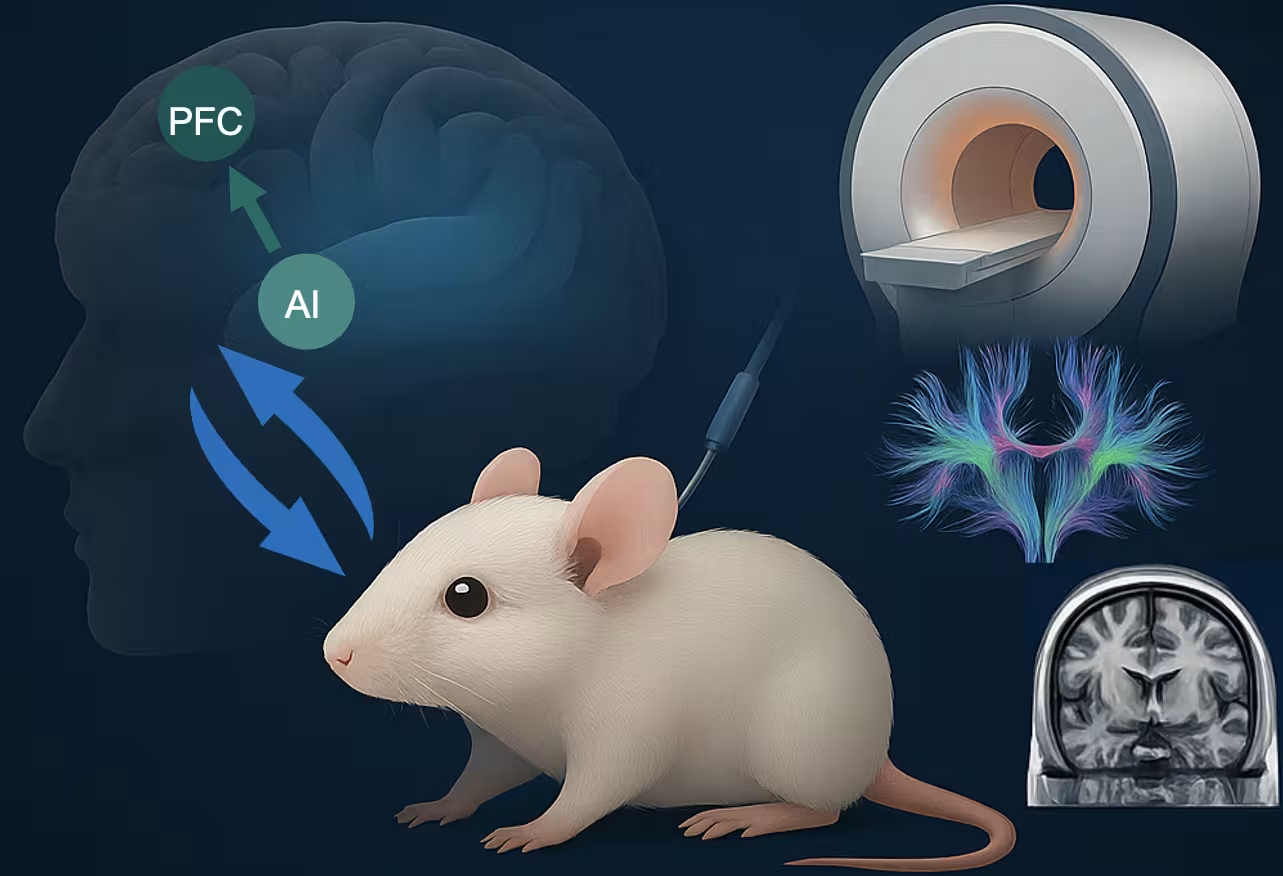
Neural Circuits of Embodiment


While theories of embodiment emphasize the importance of interoception, the underlying neural mechanisms remain largely unclear. This project investigates how the anterior insula (AI) integrates interoceptive signals and, through its connections with the prefrontal cortex (PFC), modulates cognitive control processes.

WIN-Kolleg

Complexity Reduction, Explainability, and Interpretability (KEI)


Machine learning (ML) algorithms make predictions that are relevant to our daily lives, but why they make certain decisions rather than others often remains difficult to understand; in a sense, they are “opaque.” In our project, we aim to understand how this opacity arises and how it might be addressed retroactively.

WIN-Kolleg

In the Age of Multiple Crises


How complex crises arise and how we can address them

Multiple crises have the potential to cause the collapse of social and political systems. This interdisciplinary project aims to examine the tension between complex crises and the need for sociopolitical measures to reduce this complexity.

WIN-Kolleg

Neutral by Choice


Cognitive Neuroscience Meets the Philosophy of Mind

Neutral mental states are systematically underrepresented in contemporary philosophical theories and cognitive neuroscience. This project is an attempt to restore that lost complexity and to arrive at a more naturalistic understanding of decision-making, one that allows for the possibility of being decidedly undecided.

third-party funded project

Buddhist stone inscriptions for CBETA


The project enables the integration of the digital data compiled by the Research Center for Buddhist Inscriptions in China with CBETA, an initiative that digitizes the Buddhist canon preserved in Chinese and makes it accessible in accordance with scholarly standards.

third-party funded project

Nepal Heritage Documentation Project (NHDP)


In cooperation with the Heidelberg Centre for Transcultural Studies (HCTS), endangered cultural assets in Nepal are being documented, recorded, and made accessible online.