
The temple as a canon of Egyptian religious literature
Duration: 2010 to 2022
After Alexander the Great conquered Egypt in 332 BC and his former general Ptolemy founded the Ptolemaic dynasty in 306 BC, a massive temple building program began throughout the country, the roots of which may date back to the 30th Dynasty (380–342 BC) and which was to continue into the third century AD.
The inscriptions in these late temples, which are sometimes difficult to read due to their expanded and specialized hieroglyphic system, contain extensive, diverse, and often unique information about cult and festival events, the religious topography of the Nile region, myths and groups of gods, construction history, and room functions. For this reason, some Egyptologists rightly refer to them as "stone libraries."
In addition to numerous desirable studies on individual topics, there has been a particular lack of a systematic overview of the core content, internal connections, design patterns, and problems of transmission history of the meticulously composed Ptolemaic-Roman temple decoration. One of the main goals of the Heidelberg Academy Project was to remedy this deficiency by gradually compiling a comprehensive index of the content and structure of Greek-Roman temple inscriptions. This was linked to the question of whether the temples reveal a binding set of text genres that form a kind of canon for Egyptian religion.
Although the project primarily dealt with Ptolemaic and Roman temple texts, this task gave it a bridging function to other areas of Egyptology: the analysis of the text tradition contributed to integrating these temple texts into the discipline far more than had previously been the case, transforming them from a specialised field into a natural part of Egyptology. The work of the research center was successfully completed on December 31, 2022.
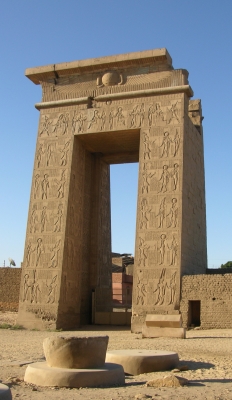
Propylon of the Temple of Khonsu at Karnak, known as the “Gate of Euergetes”/Bab el-Amara (HAdW)
Greco-Roman temples of Egypt: "Libraries of stone"
After Alexander the Great conquered Egypt in 332 BC and his former general Ptolemy founded the Ptolemaic dynasty in 306 BC, a massive temple building program began throughout the country, the roots of which may date back to the 30th dynasty (380–342 BC) and continue into the third century AD. While the pharaonic sanctuaries of Egypt (late third millennium to around the middle of the third century BC) contain comparatively sparse religious texts, the new temples were now endowed with extensive religious texts. While the Pharaonic sanctuaries of Egypt (late third millennium to around the middle of the third century BC) feature comparatively sparse religious texts, temples, chapels, and gate structures were now adorned with hieroglyphic inscriptions of sometimes considerable length to an extent previously unknown.
However, not only was a considerably larger amount of text integrated into the decorative program in the Ptolemaic-Roman temples of Egypt, but the script itself also underwent a significant enrichment of its character set; estimates suggest that the number of hieroglyphs now doubled. The late temple inscriptions, which are sometimes difficult to understand due to their expanded and specialized hieroglyphic system, contain extensive, diverse, and often unique information about cult and festival events, the religious topography of the Nile region, myths and groups of gods, architectural history, and room functions. For this reason, some Egyptologists rightly refer to them as "stone libraries."
The reasons for the almost excessive ornamentation of the temples since Ptolemaic period remain unclear. It is possible that the experience of centuries of political instability and foreign rule sparked a renewed engagement with the contents of their own religious tradition—archived in the temple library—and gave rise to a desire to preserve this body of theological thought in stone as comprehensively as possible. Changes in intellectual history may also have played a role: a “library system” revitalized by new impulses from the culturally Greek-influenced Ptolemies in the Nile Valley could also have led to the recodification of central texts from the local libraries and their transfer to the walls of the sanctuaries. Regardless of the “why,” the immense volume of inscriptions testifies to the enormous wealth of knowledge that the priesthood could draw upon when designing the temple decorations.
The most famous temple complexes from the Ptolemaic and Roman periods and the most significant "stone libraries" are the cult buildings of Dendara, Esna (Figs. 4–5), Edfu (Fig. 9), Kom Ombo (Fig. 10), and Philae (Fig. 1). The texts found in these temples contain many common or related themes, but also themes that reflect the local theological concepts of the respective sanctuaries.
Scope of the material
since of the 19th century, the often exceptionally well-preserved texts and depictions from Greco-Roman sanctuaries have been systematically documented and published in full or at least in part, so that as of 2010, a total of more than 13,000 printed pages of hieroglyphic temple texts are available. Despite this remarkable editorial achievement, the analysis of the corpus’s content is still in its infancy, as the published texts are generally limited to a copy of the inscriptions and a redrawing of the relief scenes. Only in exceptional cases do they include a translation or a commentary analyzing the content. It is likely due to this lack of scholarly processing that the temple inscriptions from the Greco-Roman period have, to date, received little attention in Egyptological research beyond the narrow circle of specialists.
From temple walls to the religious literary canon
In addition to numerous desirable studies on individual topics, there is a particular lack of a systematic overview of the core content, internal connections, design patterns, and problems relating to the history of transmission of the Ptolemaic-Roman temple decoration, which was composed in detail. One of the main goals of the Heidelberg Academy Project is to remedy this deficiency by gradually compiling a comprehensive index of the content and structure of the Greco-Roman temple inscriptions. Linked to this is the question of whether the temples reveal a binding corpus of text genres that forms a kind of canon for the Egyptian religion.
The basic prerequisite for any global, temple-wide understanding of the "stone libraries" with their complex and demanding text inventory is the precise recording, breakdown, and genre analysis of the individual texts. These are classified into categories on the basis of well-preserved, typical examples, which are examined in detail and analyzed for their specific characteristics. The aim of the project is therefore neither the publication of previously unpublished texts nor a complete translation and commentary on all inscriptions, but rather a fundamental classification and breakdown of the complete material, which is documented and illustrated using selected reference examples.
The central tool for text entry and classification is a comprehensive database (external link), in which each individual temple text is recorded in detail with basic and metadata for the first time:
- Publication/Bibliography
- dating
- installation location
- corresponding texts and parallels
- text type
- content, linguistic, graphic, editorial features
The temple as a textual structure
For a comprehensive understanding of Greco-Roman temple texts, it is essential not only to evaluate the previously defined and categorized text genres, but also to analyze the interrelationships between text and architecture. Since for the Egyptians the written word was not only a carrier of information but also possessed the power to establish reality, the inscriptions on the temple walls were given the status of active carriers and supporters of the cult function of the temple and its individual components; the framework of Egyptian theology with its complex internal connections is transferred here to the structure of the architecture. An examination of the texts must therefore always take into account where they are located, how they relate to each other spatially, and what conclusions can be drawn from this about the function of the text and space. Within the framework of the Academy project, which aims to elaborate in detail the patterns of design and use of temple texts, one of the key questions is whether certain texts are typical for certain architectural elements (doorposts, door jambs, architraves, etc.) and, if so, what are the connecting elements in terms of content and function of these inscriptions. The interrelationships between the inscriptions affixed to different parts of the temple, which transform the sanctuary into a multi-layered textual structure, only become apparent after a combined examination of text genre and text position.
Text forging between tradition and innovation
The enormous amount of text on the walls of the Ptolemaic-Roman temples marks the end of a millennia-old tradition of Egyptian religious literature. Even though individual examples have already demonstrated the creativity and high intellectual level of the priestly editors of that time, it remains unclear to what extent older texts were used in the drafting of most of the inscriptions.
When examining this question, particular attention should be paid to the "how," i.e., the philological and graphic (re)formation of religious traditions: In addition to stylistics, glossing and commentary, text abridgement and expansion, ancient Egyptian interpretation of terms (etymologies/etiologies), and the symbolic or allegorical use of hieroglyphs beyond their character as written signs also play a role here. Although the project primarily deals with Ptolemaic and Roman temple texts, this task gives it a bridging function to other areas of Egyptology: the analysis of the textual tradition will contribute to integrating these temple texts into the discipline far more than has been the case to date, transforming them from a specialised field into a natural part of Egyptology.
Database of temple texts
The project database is freely available on the Internet.
head of research
Prof. Dr. Christian Leitz (external link)
Employees
- Dr. Emmanuel Jambon (external link)
- Florian Alexander Löffler (external link), M.A.
- Dr. Bettina Ventker (external link)
- Dr. Daniela Mendel-Leitz (external link)
Former employees
- Dr. Stefan Baumann (external link)
- Prof. Dr. Holger Kockelmann (external link)
- Marcel Kühnemund (external link), M.A.
- Dr. Daniel von Recklinghausen (external link)
- Dr. Alexa Rickert (external link)
- Dr. Jan Tattko (external link)
Members of the commission accompanying the project
- Prof. Dr. Jan Assmann (Heidelberg)
- PD Dr. Dagmar Budde (Mainz)
- Prof. Dr. Tonio Hölscher (Heidelberg)
- Prof. Dr. Helmut Kipphan (Karlsruhe/Heidelberg)
- Prof. Dr. Lothar Ledderose (Heidelberg)
- Prof. Dr. Stefan Maul (Heidelberg), Deputy Chair
- Prof. Dr. Martina Minas-Nerpel (Trier)
- Prof. Dr. Joachim Friedrich Quack (Heidelberg), Chairman
- Prof. Dr. Kim Ryholt (Copenhagen)
- Prof. Dr. Claude Traunecker (Strasbourg)
monographs
- A. Rickert, Deity and Gift: An Economic Procession in the Soubassement of the Opett Temple of Karnak and its Parallel in Kôm Ombo, SSR 4, Harrassowitz, Wiesbaden 2011.
- Chr. Leitz, Geographical-Osirian Processions from Philae, Dendara, and Athribis. Soubassement Studies II, SSR 8, Harrassowitz, Wiesbaden 2012.
- Chr. Leitz, The Gaumonographies in Edfu and their Papyrus Variants. A Supra-regional Canon of Cultic Knowledge in Late Period Egypt. Soubassement Studies III, SSR 9, Harrassowitz, Wiesbaden 2014.
- H. Kockelmann/A. Rickert, From Meroe to India. Foreign peoples and Nubian gift bearers in Greco-Roman temples, Soubassementstudien V, SSR 12, Harrassowitz, Wiesbaden 2015.
- Chr. Leitz, The Regional Mythology of Egypt as Evidenced by the Geographical Processions of Egypt in the Late Temples, Soubassementstudien IV, SSR 10, Harrassowitz, Wiesbaden 2017.
- B. Ventker, Guarantors of Power, The Processions of the Kas and Hemusut in the Temples of the Greco-Roman Period, Soubassementstudien VI, SSR 18, Harrassowitz, Wiesbaden 2018.
- S. Baumann, Treasuries, Their Decoration and Spatial Design in Egyptian Temples of the Greco-Roman Period, SSR 19, Harrassowitz, Wiesbaden 2018.
- A. Rickert, The Horn of the Capricorn, The Stairs and the Roof Kiosk in Dendara as Sources for the New Year Festival, SSR 23, Wiesbaden 2019.
- C. Leitz/F. Löffler, Chnum, Lord of the Potter's Wheel, Ancient Egyptian Embryology According to the Esna Texts, The Ritual of "Offering the Potter's Wheel," SSR 26, Wiesbaden 2019.
- J. Tattko, Door Inscriptions in the Naos of the Hathor Temple at Dendara, A Study of Stylistics and Theology in Egyptian Temple Texts of the Greco-Roman Period, SSR 27, Wiesbaden 2019.
- C. Leitz, Chronocrats and Ritual Scenes, Investigations into the Interrelationships between Calendar Dates, Locations, and Offerings, SSR 32, Wiesbaden 2021.
- M. Kühnemund, Ritual Purity in the Temples of the Greco-Roman Period, SSR 34, Wiesbaden 2021.
collected works
- D. v. Recklinghausen/M. A. Stadler (eds.), KultOrte. Myths, Science, and Everyday Life in the Temples of Egypt, accompanying volume to the exhibition in Würzburg/Tübingen, Manetho Verlag, Berlin 2011.
- A. Rickert/B. Ventker (eds.), Ancient Egyptian Encyclopedias. The Soubassements in the Temples of the Greco-Roman Period, Soubassement Studies 1, SSR 7, Harrassowitz, Wiesbaden 2014.
- S. Baumann and H. Kockelmann (eds.), The Egyptian Temple as a Ritual Space: Proceedings of the International Conference, Heidelberg Academy of Sciences and Humanities, June 9–12, 2015, SSR 17, Harrassowitz, Wiesbaden 2017.
- A. Ashmawy/D. Raue/D. v. Recklinghausen (eds.), From Elephantine to the Coasts of the Sea, The Cult Topography of Egypt According to the Gau Processions of the Late Period and the Early Ptolemaic Era, SSR 24, Wiesbaden 2019.
essays
- Stone Libraries. A new project of the Heidelberg Academy of Sciences and Humanities. Göttinger Miszellen 227, 2010, 5–7. F.
- S. Baumann, The Description of the Nile Flood in the Nile Chamber of Edfu, in: ZÄS 139, 2012, 1–18.
- H. Kockelmann, On Cult Practices at Philae. A comparison of statements made by temple decorations and documentary findings, in: H. Beinlich (ed.), 9th Egyptological Temple Conference: Cult Depictions and Cult Reality, Hamburg, September 27–October 1, 2011, KSG 3.4, Wiesbaden 2013, 97–127.
- S. Baumann, The seasonal aspect of the departmental gods in the sacrificial entrance chamber of Edfu, in: Studies on Ancient Egyptian Culture 42, 2013, 37–57.
- D. von Recklinghausen, Two original names for Upper and Lower Egypt in the temple of Tôd, in: Chr. Thiers (ed.), Documents de Théologies Thébaines Tardives (D3T 2),CENiM8, Montpellier 2013, 111–129.
- S. Baumann, The Processions of Personified Mining Regions, in: A. Rickert/B. Ventker (eds.), Ancient Egyptian Encyclopedias. The Soubassements in the Temples of the Greco-Roman Period, Soubassement Studies I, SSR 7, Wiesbaden 2014, 329–336.
- S. Baumann, The Thematic Subdivision of Soubassements and Their Mapping (with Plans I-XXXIV): in: A. Rickert/B. Ventker (eds.), Ancient Egyptian Encyclopedias. The Soubassements in the Temples of the Greco-Roman Period, Soubassement Studies I, SSR 7, Wiesbaden 2014, 1047–1057.
- E. Jambon, The foundations inside the enclosure wall of Edfu. Preliminary reflections on the concept of "canon" in Ptolemaic and Roman temples, in: A. Rickert/B. Ventker (eds.), Ancient Egyptian Encyclopedias. The Soubassements in the Temples of the Greco-Roman Period, Soubassement Studies I, SSR 7, Wiesbaden 2014, 793–818.
- H. Kockelmann, On the lists of foreign peoples in the soubassements of Greco-Roman temples: Onomastics and instruments of ritual enemy destruction, in: A. Rickert/B. Ventker (eds.), Ancient Egyptian Encyclopedias. The Soubassements in the Temples of the Greco-Roman Period, Soubassement Studies I, SSR 7, Wiesbaden 2014, 301–319.
- H. Kockelmann, The Soubassement of Greco-Roman Temples as a Place of Hymnal Speech. An overview, in: A. Rickert/B. Ventker (eds.), Ancient Egyptian Encyclopedias. The Soubassements in the Temples of the Greco-Roman Period, Soubassement Studies I, SSR 7, Wiesbaden 2014, 539–606.
- C. Leitz, Geographical Soubassement Texts from the Greco-Roman Period: A Primary Source of Ancient Egyptian Cult Topography, in: A. Rickert/B. Ventker (eds.), Ancient Egyptian Encyclopedias. The Soubassements in the Temples of the Greco-Roman Period, Soubassement Studies I, SSR 7, Wiesbaden 2014, 69–126.
- C. Leitz, Aromatic Substances, in: A. Rickert/B. Ventker (eds.), Ancient Egyptian Encyclopedias. The Soubassements in the Temples of the Greco-Roman Period, Soubassement Studies I, SSR 7, Wiesbaden 2014, 483–516.
- C. Leitz, Ancient Egyptian Encyclopedias, in: A. Rickert/B. Ventker (eds.), Ancient Egyptian Encyclopedias. The Soubassements in the Temples of the Greco-Roman Period, Soubassement Studies I, SSR 7, Wiesbaden 2014, 1017–1045.
- D. Mendel-Leitz, The Soubassements of the Columns in the Temple of Athribis, in: A. Rickert/B. Ventker (eds.), Ancient Egyptian Encyclopedias. The Soubassements in the Temples of the Greco-Roman Period, Soubassement Studies I, SSR 7, Wiesbaden 2014, 819-839.
- D. von Recklinghausen, Monographs in the Soubassements, in: A. Rickert/B. Ventker (eds.), Ancient Egyptian Encyclopedias. The Soubassements in the Temples of the Greco-Roman Period, Soubassement Studies I, SSR 7, Wiesbaden 2014, 29–50.
- D. von Recklinghausen, Die sogenannten Zusatzgaue – Ein Überblick (The So-Called Additional Districts – An Overview), in: A. Rickert/B. Ventker (eds.), Altägyptische Enzyklopädien. Die Soubassements in den Tempeln der griechisch-römischen Zeit (Ancient Egyptian Encyclopedias. The Soubassements in the Temples of the Greco-Roman Period), Soubassementstudien I, SSR 7, Wiesbaden 2014, 127–151.
- D. von Recklinghausen, Hapi and the Ptolemies, in: ENiM – Égypte Nilotique et Méditerranéenne 7, 2014, 229–238 (online: recherche.univ-montp3.fr/egyptologie/enim/).
- A. Rickert, Festkalender im Soubassement, in: A. Rickert/B. Ventker (eds.), Altägyptische Enzyklopädien. Die Soubassements in den Tempeln der griechisch-römischen Zeit, Soubassementstudien I, SSR 7, Wiesbaden 2014, 528–437.
- A. Rickert, Die ökonomischen Prozessionen im Überblick, in: A. Rickert/B. Ventker (eds.), Altägyptische Enzyklopädien. Die Soubassements in den Tempeln der griechisch-römischen Zeit, Soubassementstudien I, SSR 7, Wiesbaden 2014, 337–360.
- A. Rickert, The Processions of Nubian Cities and Regions in Philae: A Preliminary Report, in: A. Rickert/B. Ventker (eds.), Ancient Egyptian Encyclopedias. The Soubassements in the Temples of the Greco-Roman Period, Soubassement Studies I, SSR 7, Wiesbaden 2014, 321–327.
- J. Tattko, Hydrological Processions – Embodiments of Individual Aspects of the Nile Flood and Fertile Land in the Soubassements of Temples from the Greco-Roman Period, in: A. Rickert/B. Ventker (eds.), Ancient Egyptian Encyclopedias. The Soubassements in the Temples of the Greco-Roman Period, Soubassement Studies I, SSR 7, Wiesbaden 2014, 361–440.
- J. Tattko, Overview of sources on themr channels,ww andpHw areas, in: A. Rickert/B. Ventker (eds.), Ancient Egyptian Encyclopedias. The Soubassements in the Temples of the Greco-Roman Period, Soubassement Studies I, SSR 7, Wiesbaden 2014, 153–223.
- B. Ventker, Food – Power – Protection: Kas and Hemusut in the Soubassements, in: A. Rickert/B. Ventker (eds.), Ancient Egyptian Encyclopedias. The Soubassements in the Temples of the Greco-Roman Period, Soubassement Studies I, SSR 7, Wiesbaden 2014, 441–463.
- B. Ventker, Priesterprozessionen im Soubassement, in: A. Rickert/B. Ventker (eds.), Altägyptische Enzyklopädien. Die Soubassements in den Tempeln der griechisch-römischen Zeit, Soubassementstudien I, SSR 7, Wiesbaden 2014, 685–715.
- S. Baumann, A Newly Discovered Edifice of Atum in Akhmim. Part of the Necropolis of the Primeval Gods? (together with G. Abdel Nasser and C. Leitz), in: ENIM 8, 2015, 187–221.
- S. Baummann, A New Doorway for Atum in Akhmim (together with G. Abdel Nasser and C. Leitz), in: EA 47, 2015, 3–6.
- S. Baumann, Fiction and Reality—Treasure Chambers and Secret Chambers in Egyptian Temples, in: Antike Welt 4/2015, 47–55.
- D. von Recklinghausen, The decoration of the temple of Amun (online: www.britishmuseum.org/naukratis [Naukratis: The Greeks in Egypt], January 2015).
- H. Kockelmann, "Who do the gods belong to? The roots of Egyptian cults between mythical norms and local exegesis," in: M. Ullmann (ed.), 10th Egyptological Temple Conference: Egyptian temples between standardization and individuality. Munich, August 29-31, 2014. Kingship, State, and Society in Early Advanced Civilizations 3 (5); Proceedings of the Egyptological Temple Conferences, Wiesbaden 2016, 81–97.
- S. Baumann, “The Temple as the House of God: Remarks on Spatial Structure and Function in Egyptian Temples,” in: S. Baumann and H. Kockelmann (eds.), The Egyptian Temple as Ritual Space. Theology and Cult in Their Architectural and Ideational Dimensions, Proceedings of the International Conference, House of the Heidelberg Academy of Sciences and Humanities, June 9–12, 2015, with the collaboration of Emmanuel Jambon, SSR 17, Wiesbaden 2017, 17–38.
- E. Jambon, “The Presentation of the Assembled Bouquet (ms ms). A Preliminary Study of a Ritual from the Greco-Roman Period,” in: S. Baumann and H. Kockelmann (eds.), The Egyptian Temple as a Ritual Space. Theology and Cult in Their Architectural and Ideational Dimensions, Proceedings of the International Conference, House of the Heidelberg Academy of Sciences and Humanities, June 9–12, 2015, with the collaboration of Emmanuel Jambon, SSR 17, Wiesbaden 2017, 351–388.
- H. Kockelmann, “Apotropaic Texts and Images in the Door Decorations of Greco-Roman Temples in Egypt: For the Protection of the Entrances to the Sacred Building and Its Chambers,” in: S. Baumann and H. Kockelmann (eds.), The Egyptian Temple as a Ritual Space: Theology and Cult in Their Architectural and Ideational Dimensions. Proceedings of the International Conference, House of the Heidelberg Academy of Sciences and Humanities, June 9–12, 2015. With the collaboration of Emmanuel Jambon, SSR 17, Wiesbaden 2017, 177–196.
- C. Leitz, “Room Designations in Athribis,” in: S. Baumann and H. Kockelmann (eds.), The Egyptian Temple as Ritual Space. Theology and Cult in Their Architectural and Ideational Dimensions, Proceedings of the International Conference, House of the Heidelberg Academy of Sciences and Humanities, June 9–12, 2015, with the collaboration of Emmanuel Jambon, SSR 17, Wiesbaden 2017, 83–106.
- F. Löffler, “The ‘Throne of the Gods’ in the Temple of Edfu—An Overview,” in: S. Baumann and H. Kockelmann (eds.), The Egyptian Temple as Ritual Space. Theology and Cult in Their Architectural and Ideational Dimensions, Proceedings of the International Conference, House of the Heidelberg Academy of Sciences and Humanities, June 9–12, 2015, with the collaboration of Emmanuel Jambon, SSR 17, Wiesbaden 2017, 307–349.
- D. von Recklinghausen, “The ‘Foreign’ Gods in the Temple of Esna: A Study of Their Ritual Significance in Temple Decoration,” in: S. Baumann and H. Kockelmann (eds.), The Egyptian Temple as a Ritual Space. Theology and Cult in Their Architectural and Ideational Dimensions, Proceedings of the International Conference, House of the Heidelberg Academy of Sciences and Humanities, June 9–12, 2015, with the collaboration of Emmanuel Jambon, SSR 17, Wiesbaden 2017, 537–563.
- A. Rickert, Step by Step: A Comparison of the Staircases Leading to the Roof in the Naoi of Late Period and Greco-Roman Temples, in: S. Baumann/H. Kockelmann (eds.), The Egyptian Temple as a Ritual Space. Theology and Cult in Their Architectural and Ideological Dimensions. Proceedings of the International Conference, House of the Heidelberg Academy of Sciences and Humanities. June 9–12, 2015. In collaboration with Emmanuel Jambon, SSR 17, Wiesbaden 2017, 39–82.
- J. Tattko, “The Sanctuary Circuit and Its Chapels at Edfu—Remarks on the Decoration of the Doorways,” in: S. Baumann and H. Kockelmann (eds.), The Egyptian Temple as a Ritual Space. Theology and Cult in Their Architectural and Ideational Dimensions, Proceedings of the International Conference, House of the Heidelberg Academy of Sciences and Humanities, June 9–12, 2015, with the collaboration of Emmanuel Jambon, SSR 17, Wiesbaden 2017, 83–106.
- F. Löffler, The public database of the research project "The Temple as a Canon of Egyptian Religious Literature—Presentation and User Guide." Göttinger Miszellen 252, 2017, 153ff.
- A. Rickert, Levure et lapis-lazuli. Naissance et développement du génie économique Hésa, in: M.-L. Arnette, Religion et alimentation en Égypte et Orient anciens, RAPH 43, Cairo 2019, 235-273.
- to the project portal (external link)on the University of Tübingen website
- Institute for Ancient Near Eastern Studies (external link)/ Institute for Ancient Near Eastern Studies:IANES (external link)
- Online publications Short bibliography (external link)