
Protestant church ordinances of the 16th century
Duration: 2002–2017
The research center’s mission was to publish editions of Protestant church ordinances(external link). These include ordinances and decrees issued by the authorities, through which Reformation doctrine and the rules of human coexistence based on it were introduced and enforced in territories and imperial cities.
The research center continued the edition project begun by Emil Sehling in 1902, which, after a turbulent history, still contained numerous gaps—especially in the western and northern parts of the empire—that could now be filled. The edition of the Protestant church ordinances was completed on schedule in December 2017.
This edition provides sources to serve as a foundation for interdisciplinary research. Its intended audience includes all historically oriented disciplines in the humanities, ranging from church and legal history to music and art history.
What are Protestant church constitutions?
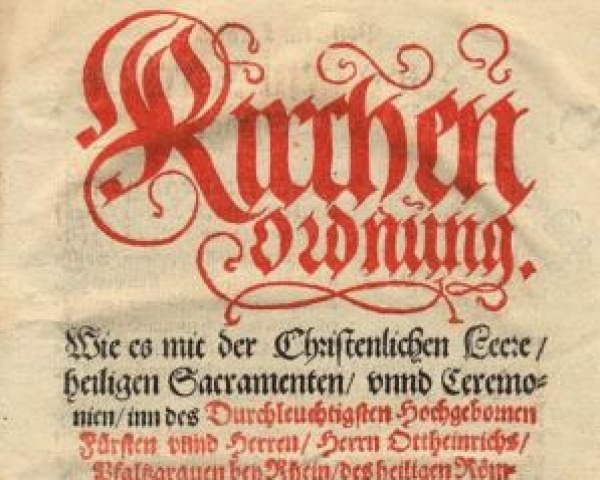
Princes and imperial city magistrates who decided to introduce the Reformation in their domains no longer recognized the hierarchical structure and liturgical regulations of the Roman Catholic Church. They took measures themselves to establish a church system based on Reformation principles. The regulations adopted for this purpose were already summarized by contemporaries under the term “church order.”
Based on Protestant doctrine, these sources provide guidelines for the confessional status of a territory or an imperial city, for the sphere of worship—which encompassed church services and the other official duties of the clergy—for matters of matrimonial law, as well as for the broad realm of moral discipline, and furthermore for the governing bodies of the emerging Protestant regional churches. Many church ordinances also contain provisions for the establishment or expansion of the school system.
The Significance of the Protestant Church Ordinances
With the enactment of church ordinances, princes and the magistrates of imperial cities began, for the first time, to exert significant influence over the religious life of their subjects.
The church ordinances formulated in the 16th century served as the foundation upon which ecclesiastical constitutions took shape in the emerging Protestant regional churches.
Due to the close link between religion and politics in the early modern period, church ordinances had an impact beyond the immediate sphere of the church. Their regulations were intended to serve the peace and “good order” of the state and were thus also a means for the princes to consolidate their rule.
The History of the Edition
At the end of the 19th century, the Erlangen-based jurist Emil Sehling (1860–1928) began compiling a collection of Protestant church ordinances; between 1902 and 1913, he published five volumes. After World War II, the Institute for Protestant Canon Law of the Evangelical Church in Germany (EKD) in Göttingen continued the project under the direction of Rudolf Smend, Otto Weber, and Ernst Wolf; from there, editorial responsibility passed to J. F. Gerhard Goeters in 1970. Between 1955 and 1980, ten additional volumes were published.
Seit 2002 wird die Edition an der Heidelberger Akademie der Wissenschaften unter der Herausgeberschaft von Gottfried Seebaß († 2008) und Eike Wolgast fortgesetzt und bis 2016 komplettiert. Der an der Akademie bestehende Themenschwerpunkt zur Grundlagenforschung im Bereich der Frühen Neuzeit wird mit der Arbeitsstelle zu den Kirchenordnungen verstärkt.
The editorial work
The structure of this edition is based on the guidelines developed by Emil Sehling more than 100 years ago and further refined during his time in Göttingen; these guidelines were only slightly modified in 2002: The source text is accompanied by a critical apparatus listing textual variants and by a commentary providing contextual explanations. Five indexes make the sources accessible and provide quick access to people, places, subjects, Bible passages, as well as songs and hymns. Concise introductions to the texts provide information on the historical context and the impact of the individual pieces on the Reformation process.
Chair of the Commission:
Prof. Dr. Peter Graf Kielmansegg
Head of the Research Unit:
- Prof. Dr. Gottfried Seebaß (2002–2006)
- Prof. Dr. Dr. h.c. Eike Wolgast (2006–2017)
Employees:
- Dr. Sabine Arend (2002–2016)
- Dr. Thomas Bergholz (2002–2008)
- Dr. Ursula Machoczek (2007)
- Dr. Martin Armgart (2008–2010)
- Dr. Gerald Dörner (2008–2017)
- Karin Meese, M.A. (2017)
Published volumes:
Edited by Emil Sehling, Erlangen
- Volume I(external link) and Volume II(external link) Saxony and Thuringia, along with adjacent areas (1902/04)
- Volume III (external link) Brandenburg, Upper and Lower Lusatia, Silesia (1909)
- Volume IV (external link) Prussia, Poland, Pomerania (1911)
- Volume V(external link) Baltic States, Mecklenburg, Lübeck, Lauenburg, Hamburg (1913)
Institute for Protestant Canon Law of the EKD (ed.), Göttingen
- Vol. VI/1(external link); VI/2 and VII/1(external link); VII/2, 1(external link) Lower Saxony (1955/57/63/80)
- Volume VIII (external link) Hesse I: Landgraviate until 1582 (1965)
- Volume XI(external link),Volume XII(external link), Volume XIII (external link) Franconia, Swabia, Old Bavaria (1961/63/66)
- Volume XIV(external link) Kurpfalz (1969)
- Volume XV (external link)Baden-WürttembergI: Hohenlohe (1977)
Heidelberg Academy of Sciences and Humanities ed.), Heidelberg
- Volume VII/2, 2 (external link) Lower Saxony: County of Schaumburg, Goslar, Bremen (2016)
- Volume IX ( external link) Hesse II: Landgraviate from 1582, Waldeck, Solms, Frankfurt, and others (2011)
- Volume X(external link) Hesse III: Nassau, Hanau-Münzenberg, Ysenburg (2012)
- Volume XVI(external link) Baden-Württemberg II: Württemberg, Baden, and others (2004)
- Volume XVII/1(external link); XVII/2(external link) Baden-Württemberg III/IV: Imperial Cities (2007/09)
- Volume XVIII (external link) Rhineland-Palatinate I: Zweibrücken, Veldenz, Sponheim, and others (2006)
- Volume XIX/1(external link);Volume XIX/2 (external link) Rhineland-Palatinate II: Wild and Rheingrafschaft, Leiningen, Wied, and others (2008)
- Volume XX/1 ( external link) Alsace I: Strasbourg (2011)
- Volume XX/2(external link) Alsace II: Hanau-Lichtenberg, Colmar, Mulhouse, Weißenburg, and others (2013)
- Volume XXI(external link) North Rhine-Westphalia I: Jülich-Kleve-Berg, Minden, Herford, Lippe, and others (2015)
- Band XXII (externer Link) Nordrhein-Westfalen II (2017)
- Band XXIII (externer Link) Schleswig-Holstein (2017)
- Volume XXIV(external link) Transylvania (2012)
CONFERENCE PROCEEDINGS:
Arend, Sabine / Dörner, Gerald (eds.), Church Ordinances – Their Impact on the World. Protestant Church Ordinances of the 16th Century (Late Middle Ages, Humanism, Reformation 84), Tübingen 2015
GENERAL REGISTER:
Emil Sehling, The Protestant Church Ordinances of the Sixteenth Century: General Register(external link), ed. by Eike Wolgast, rev. by Karin Meese, Tübingen 2020
 HAdW
HAdW
Church Order of Elector Ottheinrich of the Palatinate, 1556