
Monasteries in the High Middle Ages
Monasteries in the High Middle Ages
Duration: 2010 to 2024
The project “Monasteries in the High Middle Ages: Laboratories of Innovation for European Lifestyles and Models of Order” analyzed medieval monasteries as precursors of modernity. Between the 11th and 13th centuries, monasteries developed innovative ways of life and served as mediators between seclusion and social dynamics.
Two affiliated research centers at the Heidelberg Academy of Sciences and Humanities the Saxon Academy of Sciences and Humanities Leipzig supported the project. In Heidelberg, researchers examined texts from the 12th and 13th centuries that reordered theological and narrative content and created visionary concepts of a “better” world.
Objectives:
(a) New editions of key sources on religious life in the Middle Ages (including German translations of the Latin works).
(b) Substantive analysis of the texts from the perspectives of cultural studies and new methodological approaches.
Project leaders at the Heidelberg Research Center: Prof. Dr. Bernd Schneidmüller and Prof. Dr. Stefan Weinfurter (d. 2018)
Projects
Part A:
In the 12th century, Gerhoch von Reichersberg presented a vision in his work *On the Building of God* (*Opusculum de aedificio Dei*) in which all clergy live under a single rule, following the apostolic model. He supported his radical demands with quotations from canonical and patristic authorities. He drew this knowledge from the legal collections of his time. The new edition of the work offers a modern annotated edition with a German translation and a critical evaluation of the cited authorities.
Julia Becker (ed.), Gerhoch von Reichersberg, Opusculum de aedificio Dei. The Apostles as an Ideal (Edition, Translation, Commentary), KAI 8, 2020, 936 pages.
Information at: hadw
The Scutum canonicorum (“Shield of the Canons”), written in the mid-12th century by Arno, Gerhoch’s brother and dean at Reichersberg, conveys identity-forming guidelines for the regular canonical way of life. This central source is now appearing for the first time in a critically annotated edition with a German translation.
Julia Becker (ed.), Arno von Reichersberg, Scutum canonicorum (Edition, Translation, Commentary), KAI 11, 2022, 256 pages. For more information, visit: hadw
Project Component A.1
(Johannes Büge; until May 2023, Dr. Julia Becker)
Johannes Büge worked on the edition, translation, and commentary of Anselm of Havelberg’s *Anticimenon* (“Rebuttal”). In this work, written around 1149/50, Anselm addresses the unity of the faith and encourages dialogue between the Eastern and Western Churches. The goal is a modern new edition of this historical-theological treatise, which will be situated within the context of Anselm’s complete works and the institutionalization phase of the Premonstratensian Order.
Anselm’s writings also address the monastic way of life and its social significance in the 12th century, thereby complementing the new editions already published in Project Section A.1.
Project Section A.2: “
” (Jonas Narchi, M.A.)
Mr. Jonas Narchi, M.A., has produced a critical edition, translation, and commentary on Anselm of Havelberg’s *Epistola apologetica* (1138–1146). In this defensive letter, Anselm justifies the status of the Canons Regular in the face of criticism from the monks. The occasion was an incident in the Diocese of Halberstadt in which Petrus, provost of the Hamersleben Abbey, entered the Benedictine monastery of Huysburg, leading to a dispute between the canons and the Benedictines. In this letter, Anselm vehemently defends the way of life of the Canons Regular and the specific charism of the ordo canonicus. The edition of the letter contributes to reconstructing the self-understanding of various religious and social ways of life in the 12th century and fits perfectly into the work of Project Part A.1.
Jonas Narchi (ed.), Anselm of Havelberg, Epistola apologetica. Edition, Translation, Commentary, KAI 13), 2024, 264 pages.
For more information, visit: www.schnell-und-steiner.de
Part B:
In his search for the ideal community, the Dominican friar Thomas of Cantimpré found inspiration in bees during the 13th century. In his “Book of Bees” (Bonum universale de apibus), he described hierarchies and social dynamics using bees as an example, enriching his account with anecdotes from medieval life. His handbook supported the work of the Dominicans as preachers and teachers and attracted great interest even in the Middle Ages, as evidenced by over a hundred manuscript copies. For the first time, the “Book of Bees” has been published in a critically annotated edition with a German translation and an analysis.
Julia Burkhardt, Learning from Bees. Thomas of Cantimpré’s *Bonum universale de apibus* as a Blueprint for Community (Analysis, Edition, Translation, Commentary), KAI 7, 2020, 1,616 pages.
For more information, visit: hadw
Project Section B.1
(Researcher: Isabel Kimpel, M.A. / Academic Director: Prof. Dr. Julia Burkhardt)
The Cistercian monk Caesarius of Heisterbach (c. 1180–1240) is best known as the author of the *Dialogus miraculorum*. Another collection of examples, the “Eight Books of Miracles” (Libri VIII miraculorum, ca. 1225/27), has received less attention. However, these Libri VIII miraculorum are a remarkable source for the political, cultural, and religious history of the 13th century and serve as a means of theological edification and instruction. The new edition of the “Eight Books of Miracles” offers an annotated version of the Latin text, a German translation for the first time, and an analysis of the work and its manuscript tradition. It will be published in 2025 by Heidelberg University Publishing.
Project Part B.2: “
” (Dr. Volker Hartmann, completed in 2019)
The project focuses on the treatise *De regimine principum* by Aegidius Romanus (c. 1243–1316). The work was written shortly after the condemnation of Aristotelianism at the University of Paris in 1277. Despite its intended recipient (Philip IV) and although it is known as a mirror for princes, it was received and translated throughout Europe, even outside the courts. With several hundred manuscripts, it ranks among the most widely transmitted writings of the late Middle Ages.
The text’s success, which lasted into the 17th century, can be attributed in part to the author’s synthesis of ethically relevant aspects of Aristotelian philosophy. These principles were directed at princes and their subjects. The reflections on the king’s official powers are partly at odds with the statements in his later work “De ecclesiastica potestate” (ca. 1302), which supports papal universal sovereignty.
The goal is to provide a modern complete translation and the transcription of a selected manuscript.
Aegidius Romanus: On Princely Rule (ca. 1277–1279), based on the manuscript in Rome, Biblioteca Apostolica Vaticana, cod. borgh. 360 and using the editions Rome 1556 and Rome 1607, ed. by Volker Hartmann, Heidelberg: heiBOOKS, 2019, 1,313 pages.
https://books.ub.uni-heidelberg.de/heibooks/catalog/book/569
The Dresden Research Center (Project Director: Prof. Dr. Gert Melville)
The research center in Dresden examines monasteries and religious orders as catalysts of modernity. The focus is on the vita religiosa and its contribution to European models of social order, as it redefined the relationship between the individual and the community, as well as between rationality and a transcendent orientation toward meaning. The literature from the 11th to the 13th centuries is analyzed from legal and hortative perspectives.
The focus is on texts in which the cultural interpretive power of monasteries becomes programmatically tangible: admonitory writings, didactic treatises, monastic or religious rules and statutes, as well as commentaries on them, which determined the legal order of the communities. These writings were intended to have an internal impact, yet they were always in relation to the wider world.
Publications by the Research Center, 2010–2024
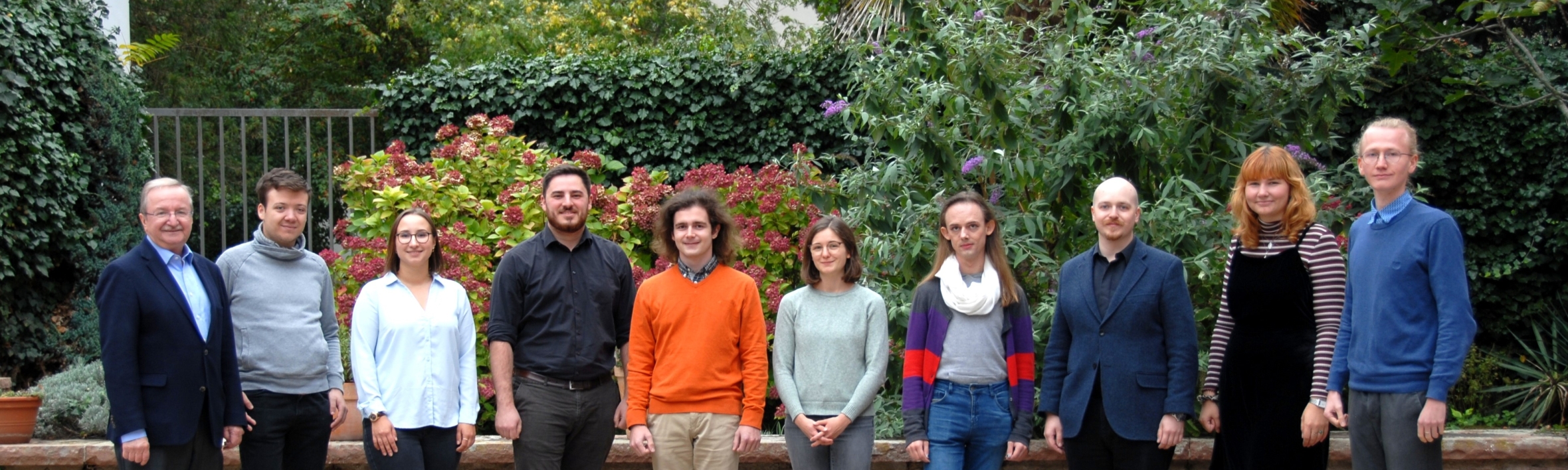
The Heidelberg Team 2023, from left to right: Bernd Schneidmüller, Sebastian Hauptmann, Isabel Kimpel, Jonas Narchi, Jonathan Oesterling, Stefanie Westenweller, Bastian Schmitz, Johannes Büge, Laura Eger, Moritz Niens.
head of research
- Prof. Dr. BerndSchneidmüller (Heidelberg)
- Prof. Dr. Dr. GertMelville(Dresden)
Employees
- JohannesBüge, M.A. (Heidelberg)
- IsabelKimpel, M.A. (Heidelberg)
- JonasNarchi, M.A., M.A. (Heidelberg)
- PD Dr. JörgSonntag (Dresden), Head of the Department
- MarcusHandke, Ph.D. candidate (Dresden)
auxiliary personnel
- Camilla Amerini, B.A. (Heidelberg)
- Samuel Breitinger, B.A. (Heidelberg)
- Laura Eger, B.A. (Heidelberg)
- Matteo Ettner, B.A. candidate (Heidelberg)
- Helene Hellinger, B.A. (Heidelberg)
- Jonathan Oesterling, B.A. (Heidelberg)
- Laura Schuster, B.A. (Heidelberg)
Partners
- Dr. JuliaBecker (Würzburg), Research Fellow for the Academy Project "The Formation of Europe through the Overcoming of Division in the 12th Century" (BAdW)
- Prof. Dr. JuliaBurkhardt (Munich), external collaborator (LMU Munich), scientific director of project component B.1
- PD Dr. MirkoBreitenstein (Dresden), Director of FOVOG
Interacademic Commission of HAdW the SAW
- Prof. Dr. GiancarloAndenna (Milan)
- Prof. Dr. BarbaraBeßlich (Heidelberg)
- Prof. Dr. CarmenCardelle de Hartmann(Zurich)
- Prof. Dr. Jens-D.Haustein (Jena)
- Prof. Dr. ThomasHolstein (Heidelberg)
- Prof. Dr. AndreasHolzem (Tübingen)
- Prof. Dr. WolfgangHuschner (Leipzig)
- Prof. Dr. NikolasJaspert (Heidelberg)
- Prof. Dr. BrunoKlein (Dresden)
- Prof. Dr. ArminKohnle (Leipzig), Vice Chair
- Prof. Dr. VolkerLeppin (Yale University in New Haven, USA), Chair
- Prof. Dr. ChristinaLutter(Vienna)
- Prof. Dr. EvaSchlotheuber (Düsseldorf)
- Prof. Dr. MartialStaub (Sheffield)
- Prof. Dr. ChristophStrohm (Heidelberg)