
Historical and Recent Flood-Related Conflicts
Historical and Recent Flood Conflicts on the Rhine, Elbe, and Danube: The Tension Between Natural Sciences, Technology, and Social Ecology
Duration: 2012 to 2014
The project analyzed and compared historical, recent, and projected conflicts and potential for conflict in the context of flooding. Using the Rhine, Elbe, and Danube as case studies, a methodological toolkit for analyzing solutions to global water conflicts was developed through transdisciplinary collaboration.
Flooding is increasingly understood as a process that is both physical and socially shaped, the course and influence of which cannot be fully predicted or controlled. Therefore, it is possible to develop a concept for managing floods that no longer relies solely on controlling and containing them. Instead, in adapting to and reducing flooding, it promotes solutions that take into account the complexity of the interrelationships between nature, technology, and society. The factors that constitute the spatial context and societal response to flooding interact closely with one another with regard to
- the spatial and temporal integration of natural processes, structural measures, and demands for protection and land use,
- risk awareness and interpretations of threat and safety,
- coping and preparedness as a long-term process of learning and negotiation,
- normative regulation,
- and the division of labor between planning, construction, and operation.
Conflicts of interest frequently arose or continue to arise among participating groups and/or local residents over economic, ecological, or social factors. A comparative historical analysis is indispensable as a foundation for future conflict mediation. Methods of environmental system modeling can also make a decisive contribution to the successful prevention, resolution, or mediation of disputes. The theoretical approach involves examining the transferability of a socio-ecological spatial concept to the specific research question and, if successful, to water conflicts in general.
This three-year research project was funded by the Klaus Tschira Foundation (external link).
Chair of the Scientific Commission:
Prof. Dr.-Ing. E.h., Ph.D. Hermann H. Hahn
Director of the research project:
- Prof. Dr. Dr. Franz-Josef Brüggemeier
- Prof. Dr.-Ing. Rainer Helmig
Staff:
- Dr. Thomas Haas
- Dipl.-Geogr. Katharina Stork
Contact:
University of Stuttgart
Institute for Water and Environmental System Modeling
Chair of Hydromechanics and Hydrosystem Modeling
Pfaffenwaldring 61, 70569 Stuttgart
Phone: 0711-685-64667 and -64511
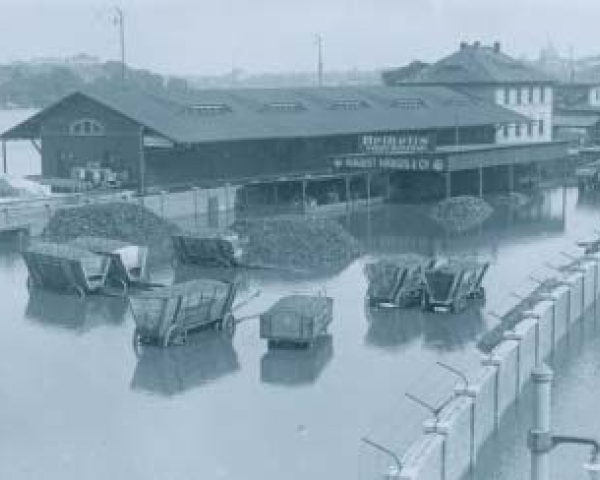
January 1932: The Elbe River overflows its banks near Dresden (Federal Archives, Image 102-12896, anonymous, undated photo)