
In the Age of Multiple Crises

In the Age of the Polycrisis: How Complex Crises Arise and How We Can Address Them

In recent years, the world has experienced a variety of crisis situations that can be understood as a complex system of parallel, overlapping, and interconnected crises. These polycrises have the potential to cause the failure of social and political systems, yet they have so far received insufficient attention in academic research, both conceptually and in terms of their impact. This interdisciplinary project aims to examine the tension between complex crises and the necessary sociopolitical reduction of this complexity. For it is precisely this reduction of complexity that carries the risk of causing crisis communication to fail or of polarizing social discourse.

To date, there has been no theory-driven conceptual examination of the term “polycrisis” in the social sciences. Its application to empirical observations thus far has not been sufficiently theorized; consequently, it remains analytically unclear how a polycrisis can be identified and which individual crises, in what form, constitute a complex system of systemic risks. We therefore see the sociological conceptualization of polycrises as an opportunity to reduce complexity. Furthermore, there have been hardly any empirical analyses to date regarding the course, management, and consequences of polycrises for societies and states. This is due, on the one hand, to the fact that academia has not yet reached a consensus on an adequate conceptualization of polycrises. On the other hand, however, the few empirical studies that exist demonstrate that the analysis of polycrises and the reduction of their complexity pose significant methodological challenges.

This research project aims to conceptualize the emergence, development, and progression of polycrises, as well as to examine their impact on social and political discourses and, consequently, on crisis management, in order to provide insights into how these novel crises can be addressed. To this end, we aim to answer two questions in this research project:

  1. How can the dynamics (origin, development, and progression) of polycrises be described and conceptualized more effectively?
  2. How do global polycrises influence social and political discourse regarding crisis management and the simplification of complex issues?

To explore the complex issue of multiple crises and their effects, theoretical approaches and research methods from the fields of international relations and American studies are combined, including, for example, complexity theory, the theory of ontological security, and methods from corpus-based discourse analysis.

As a first step in this research project’s work program, theoretical assumptions will be developed based on the literature in international relations, polycentrism, sociology, and complexity research. These assumptions will address the question of how polycentric crises can be conceptualized and what potential impacts various polycrises may have on nation-states and their societies. Although IR research has dealt extensively with the concept of crisis, the discipline has so far lacked a systematic understanding of what “polycrisis” means and encompasses. Against this backdrop, this research project integrates, as a first step, approaches to concept formation in order to develop a thorough conceptualization of polycrisis. This is intended to contribute to understanding the widespread uncertainty and complexity that have become characteristic features of today’s international politics.

In a second step, we then apply the developed concept of the polycrisis and, using a mixed-methods approach, examine specifically how social and political discourses take shape in the context of global polycrises. The first case study addresses the polycrisis of global climate change and natural disasters, as well as the social, societal, and political factors that exacerbate their impacts. The second case examines the polycrisis of the war in Ukraine and the associated economic, food supply, and energy crises. Due to their complexity and multifaceted nature, both cases represent ideal types of a polycrisis, but they potentially vary in terms of their diffusion and non-linearity.

Due to their diffuse complexity, polycrises are often perceived differently within societies, leading to disagreement over whether a crisis situation exists at all, who or what caused the crisis, and how it can be overcome. Due to their complexity and the seemingly never-ending uncertainty, polycrises have the potential to polarize crisis discourses, which in turn can influence crisis management. Through the methodological approach of quantitative and qualitative discourse analysis, the project aims to explore the concept of the polycrisis and thereby provide insights into state action in these crisis situations and the perception thereof. The United States remains a decisive factor here as a global superpower. However, the project also aims to draw comparisons with other political systems, such as Germany. Here, we are interested in the role that discourse patterns and actors play in the perception and addressing of complex crises, and whether these contribute to the effective management of polycrises (reduction of complexity). Due to their particular complexity, polycrises convey a high degree of uncertainty regarding the expected material and immaterial costs for society and the state. Consequently, governments, societies, and individuals strive to reduce the enormous complexity of today’s polycrises in order to legitimize societal mediation and acceptance of crisis management in the first place.

The WIN-Kolleg offers attractive conditions for interdisciplinary collaboration and networking within our research project. When examining perception and communication in crisis situations, the project can benefit from collaboration with other disciplines—for example, in addressing how crisis communication unfolds not only at the national and societal levels, but also how it is processed by individuals on a personal, psychological level. This allows for a holistic understanding of the societal impacts of polycrises and also enables an examination of individual crisis vulnerability and resilience.

WIN Fellows


Dr. Gordon M. Friedrichs

Gordon Friedrichs is a Senior Research Fellow in the MAGGI Research Group at the Max Planck Institute for Comparative Public Law and International Law in Heidelberg. Previously, he was a Fulbright Schuman Fellow at the Kellogg Institute for International Studies at the University of Notre Dame and a postdoctoral researcher at the Department of Political Science at the University of Freiburg.

His research focuses on international relations and comparative foreign policy analysis. Specifically, his research examines (1) the effects of polarization and populism on the foreign policy of democracies, with a focus on the United States; (2) the resilience and transformation of global governance institutions; and (3) interstate relations in East Asia and the Asia-Pacific region. More broadly, he is interested in how the interplay between domestic and foreign policy influences the role of states in the areas of security, trade, and the rule of law.

He has published three books: *U.S. Global Leadership Role and Domestic Polarization: A Role Theory Approach* (Routledge, 2020), *The Politics of Resilience and Transatlantic Order* (co-authored with Sebastian Harnisch and Cameron Thies, Routledge, 2019), and *National Role Conceptions in a New Millennium: Defining a Place in a Changing World (co-edited with Michael Grossman and Francis Shortgen, Routledge, 2022). His research has also been published in International Studies Review, Foreign Policy Analysis, International Politics, Journal of Global Security Studies, International Relations, and the Journal of International Relations, among others.

You can find more information about Gordon Friedrichs here.


Dr. Natalie Rauscher

Natalie Rauscher is a postdoctoral researcher at the Heidelberg Center for American Studies (HCA) at Heidelberg University. Her research focuses on public and political discourses regarding the future of work and the platform economy in the United States. Her other research interests include social movements, social media, U.S. philanthropy and think tanks, as well as natural disasters in the United States. 

In her postdoctoral project, Natalie Rauscher is examining philanthropy in the United States in the 21st century, focusing in particular on how new actors and new approaches to giving within (mega)philanthropy might affect public trust in this sector. 

In 2021, her dissertation was published by Springer under the title *The Future of Work in the United States: Discourses on Automation and the Platform Economy* as part of the *Contributions to Economics* series. She has also published in journals such as *Zeitschrift für Politikberatung*, *Zeitschrift für Politikwissenschaft*, and *Politische Vierteljahresschrift*. 
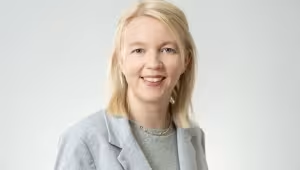


Members of the research team


Stella Kim

Stella Kim is a research fellow at the Heidelberg Academy of Sciences and Humanities and is pursuing a Ph.D. on how complex crises—particularly climate change, pandemics, and strategic rivalries—impact armed conflicts in the evolving multipolar order of the 21st century. She completed her master’s degree in Security, Intelligence, and Strategic Studies in 2022 at the University of Glasgow, the University of Trento, and Charles University in Prague. She holds a bachelor’s degree in political science from Goethe University Frankfurt, during which she also studied at Ewha Womans University in Seoul.

Previously, she worked for various European think tanks, where she published papers primarily on defense strategies in the Indo-Pacific region, as well as at the Federal Ministry of Defense and the European External Action Service, which brings together her research interests in security, defense, conflict analysis, and diplomacy in the Euro-Atlantic and Asia-Pacific regions.


Steven Schwarz

Steven Schwarz is a research fellow at the Heidelberg Academy of Sciences and Humanities. As part of his doctoral research, he is examining the role of domestic sectors and economic actors in the formulation and implementation of foreign and security policy in international relations in the age of polycrisis, using the examples of the Federal Republic of Germany and Japan.

Steven Schwarz earned his Master of Arts in Political Science at the University of Heidelberg, where he also completed related coursework at the Faculty of Law. During a one-year study abroad program at the Institut d'études politiques de Lille (Sciences Po Lille), he also earned a Certificat d'Études Politiques. Prior to that, he earned a Joint Bachelor of Arts in History and Political Science at the Technical University of Darmstadt. During his bachelor’s program, he also spent a semester studying at the Department of International Politics at Aberystwyth University in Wales. His master’s studies were supported by a scholarship from the Friedrich Naumann Foundation for Freedom.

In October and November 2025, Schwarz spent two research periods in Tokyo as a visiting scholar at Sophia University and the University of Tokyo. 
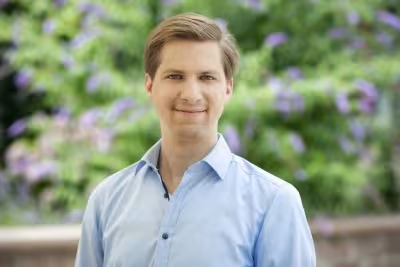

Frederike Kanschat

Frederike Kanschat is a research assistant on the “In the Age of Polycrisis” project at the Heidelberg Academy of Sciences and Humanities, where she studies the complex interplay of global crises. She holds an LL.M. in International Law from the University of Glasgow, as well as master’s degrees from the Institut Barcelona d’Estudis Internacionals and the University of Tartu. She completed her bachelor’s degree in International Relations. During the Philip C. Jessup International Law Moot Court Competition, she represented Estonia on issues concerning the rights of stateless persons and the powers of the UN Security Council. Prior to that, she gained experience at the Max Planck Institute for Comparative Public Law and International Law and at a political monitoring firm.

Research Activities


Dr. Gordon M. Friedrichs

Conference and Workshop Papers

(2025): “Divided within, unreliable abroad? Patterns of political polarization and foreign policy consistency in democracies,” International Political Science Association World Congress, Seoul.

(2025): “A Comparative Role-Theoretical Approach to National Role Conceptions Regarding the International Legal Order,” Workshop: Comparative International Legal Policy: National, Regional, and Transnational Approaches, Humboldt University, Berlin.

(2025): “Retaliatory Economic Statecraft: Autocratic Responses to Western Trade Sanctions,” Workshop: The Geopoliticization of Trade Policy, University of Salzburg.

(2025): “Assessing National Role Conceptions and Social Structural Change: A Machine Learning Approach to UN General Assembly Debates” (with Spencer White and Jule Sommer) Annual Convention of the International Studies Association, Chicago.

(2025): “Constructing Conflict and Cooperation: Economic Role Negotiation in U.S.-China Relations” (with Stella Kim) Annual Convention of the International Studies Association, Chicago.

(2025): “Role Change in the International Legal Order: A Comparative Analysis of International Legal Role-Taking by the U.S., Germany, and the People’s Republic of China” (with Sebastian Harnisch), Annual Convention of the International Studies Association, Chicago.

Presentations

(2025) “Autocratic Alliance: The North Korea–Russia Comprehensive Strategic Partnership Treaty,” Monday Meeting of the Max Planck Institute for Comparative Public Law and International Law, Heidelberg.

(2025) “Transatlantic Security Community? Challenges and the Future of the North Atlantic Treaty Organization” Academy for Political Education, Tutzing.

(2024) “Quo Vadis USA – Change in Foreign Policy?”, Forum for International Security, University of Heidelberg.

(2024) “Reflections on the 2024 U.S. Presidential Elections: Implications for Democracy and Foreign Policy,” Monday Meeting of the Max Planck Institute for Comparative Public Law and International Law, Heidelberg.

(2024) “Reliable Ally?: The United States and Its Leadership Role in NATO,” Atlantic Academy Rhineland-Palatinate Summer School.

“How to conceptualize polycrises and how to study them,” Heidelberg Academy of Sciences and Humanities, Heidelberg.

(2024) “Complexity Theory, International Relations, and Polycrisis,” Goethe University, Frankfurt am Main.


Activities related to workshop and conference panel organization

“Cities as Global Actors in International Politics: Patterns, Processes, and Impacts” Roundtable (with Judith Keller) at the Annual Convention of the International Studies Association, Chicago.

“Expanding Authority in Global Governance: Power, Legitimacy, and Common Goods” panel (with Janne Mende) at the annual convention of the International Studies Association in Chicago.

“Cities as Global Actors in International Politics: Patterns, Processes, and Impacts” Workshop (with Judith Keller), Max Planck Institute for Comparative Public Law and International Law, Heidelberg.

“Multiplication of Global Governance Authority: Contestation, Institutionalization, and Constellations” Workshop (with Janne Mende, Ruji Auethavornpipat, and Marie Lohrum), Max Planck Institute for Comparative Public Law and International Law, Heidelberg.

“Domestic Division, Foreign Policy Change, and International Trust in U.S. Global Authority,” panel (with Florian Böller) at the annual meeting of the German Association of American Studies, Heidelberg.


Dr. Natalie Rauscher

Conference Papers & Presentations

Workshop and Conference Planning

(June 2025) -Disciplinary Transformations? The Impact of the Humanities on Reshaping the Digital Humanities.” Hengstberger Symposium. Internationales Wissenschaftsforum Heidelberg. (Conference organization)   

(June 2024) Authority and Trust in American Politics and Society. Annual Conference of Political Scientists in the German Association for American Studies (DGfA). Heidelberg Center for American Studies, Heidelberg University. (Conference organization)

(2022) Natural Disasters in the United States: Understanding Risks and Vulnerability. International Conference. Heidelberg Center for American Studies (HCA), University of Heidelberg. (Conference organization)

(2023) Hazardous Territory – Environmental Discourses, Ownership, and Disaster Policies in the United States. America and Ownership: Territory, Slavery, Jubilee, 69th Annual Meeting of the DGfA/GAAS, University of Rostock. (Workshop organizer)

Conference papers

(2024) with Welf Werner. Natural Disaster Resilience. Why Is the U.S. Breaking with Positive Global Trends of the 20th Century? Second International Conference on “Action vs. Inaction in the Face of Climate Change” (AICC 2024), Strasbourg, France.

(May 2024) Dis/Trust. Annual Conference of the Irish Association of American Studies (IAAS). Clinton Institute for American Studies, University College Dublin, Ireland.

(2023) Natural Disasters in the United States: What Role Do Media Discourses and Disaster Narratives Play in the U.S.’s Vulnerability Crisis? Doing Area Studies in the Polycentric Condition. CrossArea e.V. Annual Conference 2023 and DIMAS Kick-Off Event, University of Regensburg.


Publications

Monograph

(2021) The Future of Work in the United States: Discourses on Automation and the Platform Economy. Contributions to Economics. Springer International Publishing: Cham.

Anthologies

(2025) Natural Disasters in the United States – Making Sense of Risks and Vulnerability. Edited by Natalie Rauscher and Welf Werner. Cham: Springer. (forthcoming)

(2024) Participation in American Culture and Society. Edited by Philip Löffler, Margit Peterfy, Natalie Rauscher, and Welf Werner. Heidelberg: Winter.

Chapters in anthologies

(2024) “Reporting Catastrophes: Mainstream Media and Vulnerability to Disasters in the U.S.” In: Natural Disasters in the United States – Making Sense of Risks and Vulnerability. Edited by Natalie Rauscher and Welf Werner. Cham: Springer. (forthcoming)

(2024) “In the Face of Disaster: Narratives of Community Vulnerability and Resilience in Media Coverage of Natural Catastrophes in the USA.” In: Vulnerability: Real, Imagined, and Displayed Fragility in Language and Society (Interdisciplinary Perspectives on Applied Linguistics). Edited by Silvia Bonacchi. V&R, Göttingen. (peer-reviewed)

(2024).Introduction: Participation in Crisis?” In : Participation in American Culture and Society. Edited by Philip Löffler, Margit Peterfy, Natalie Rauscher, and Welf Werner. Heidelberg: Winter.

(2024) “The Left Behind: Economic Policy Developments, Rising Inequality, and Dwindling Economic Prospects for the American Workforce Since the 1970s.” In: Economic Crises as Opportunities? Working Life Between Cooperation and Regulation in Historical Perspective. Edited by Katja Patzel-Mattern. Stuttgart: Franz Steiner Verlag. (Under review)

Articles in journals

(2023) American Philanthropy in the Age of Political Polarization: Conservative Megadonors and Foundations and Their Role in Spreading Climate Skepticism.Politische Vierteljahresschrift (PVS). (peer-reviewed)


Science Communication

Science Blogs

(2023)“Polarized Philanthropy: Conservative Foundations and Climate Skepticism in the U.S.” DVPW Blog.

(2022) with Swetha Ananth.“Can (Mega) Philanthropy Cure the World? Global Health, HIV/AIDS, and the Gates Foundation.” HCA Graduate Blog

Podcasts

(2022) Altruism, Philanthropy, Charity – Perspectives on a Universal Concept. Podcast: Marsilius in Conversation, Marsilius Kolleg, Heidelberg University.

Public Lectures

(2024) Apocalyptic Wine Tasting: Unequenchable Immortality. University of Heidelberg. In cooperation with the Käte Hamburger Centre for Apocalyptic and Post-Apocalyptic Studies and the Wein Refugium, Heidelberg.

(2022) This Time Is Different, or Is It? Universal Basic Income in Recent Discourse on Technological Change in the United States. Current Issues in North American and Cultural Studies. North American Studies Program, University of Bonn.

(2022) Young Marsilius Fellows Symposium 2022: Knowledge Creates Perspectives, Interpretation and Meaning of Natural Disasters. Marsilius Kolleg, Heidelberg University.

Public panel discussions

(2024) Marsilius Colloquium: Crisis Prevention. Why? How? How Much? Marsilius Colloquium, Heidelberg University.

(2022) Biden’s State of the Union Address – Discussion. Amerikahaus NRW. 


Stella Kim

Conference and Workshop Papers

(2025): “Strategic Rivalries in the 21st Century: How Regime Type Dyads Shape Internationalized Intrastate Conflicts”. International Political Science Association World Congress, Seoul.

(2025): “Constructing Conflict and Cooperation: Economic Role Negotiation in U.S.-China Relations” (with Stella Kim) Annual Convention of the International Studies Association, Chicago.

(2025): “The Polycrisis in World Affairs: Theoretical Foundations and Practical Applications.” Discussant. Annual Convention of the International Studies Association, Chicago.

Continuing Education and Professional Development

(2025) Winter School at VU Amsterdam: Data Analysis in R

(2024) USI Lugano Summer School: Qualitative Comparative Analysis

Participation in conferences and symposia

(2024) “Politics in the Polycrisis” – DVPW Congress 2024. Göttingen.


Steven Schwarz

Conference and Workshop Papers

(2025) “The Renaissance of Japan’s Industrial Policy—Japan and the Global ‘Chip War’”. General Conference 2025, Thessaloniki.

Continuing Education and Professional Development

(2025) Case Study Research: Method and Practice

Participation in conferences and symposia

(2024) “Politics in the Polycrisis” – DVPW Congress 2024. Göttingen.

Anthologies


Articles in professional journals

  • Friedrichs, Gordon M. and Jule Sommer. “Ontological Security Crisis and Role Conception Change: The Impact of the Russian Invasion of Ukraine on the European Union's Role Conceptions” (2024). The European Journal of International Relations (forthcoming).


  • Friedrichs, Gordon M. and Natalie Rauscher. “Icon of Freedom? American Society and U.S. Leadership in the (Poly)Crisis” (2024). Athene: Journal of the Heidelberg Academy of Sciences and Humanities.


Dr. Gordon M. Friedrichs

Max Planck Institute for Comparative Public Law and International Law
Im Neuenheimer Feld 535
69120 Heidelberg

Phone: +49 (0) 6221 482-787

friedrichs@mpil.de


Dr. Natalie Rauscher

Heidelberg Center for American Studies
Curt and Heidemarie Engelhorn Palais
Hauptstraße 120
69117 Heidelberg

Phone: +49 (0) 6221 54 38 78

nrauscher@hca.uni-heidelberg.de


Call for Papers 

Shifting Political Order(s) in the Polycrisis:

Complexity and Challenges in Global, Regional, and Domestic Governance

workshop

December 4 & 5, 2025, at the Heidelberg Academy of Humanities and Sciences

Gordon Friedrichs (Max Planck Institute for Comparative Public Law and International Law &

Heidelberg Academy of Sciences and Humanities

Stella Kim (Heidelberg Academy of Sciences and Humanities) 

Steven Schwarz (Heidelberg Academy of Sciences and Humanities)

Statement of Aims

The 21st century is defined by a confluence of crises that intersect, overlap, and interact in ways that challenge existing political orders at the international, regional, and domestic levels. This phenomenon, commonly referred to as a polycrisis, describes a system of multiple, interconnected crises occurring simultaneously across various domains. Rather than isolated events, a polycrisis emerges from complex global and transnational interdependencies that amplify their impact, perpetuating the risk of systemic failures. These crises place immense strain on political institutions, governance structures, societies, economies, and political leaders, challenging their capacity for effective policy responses.

We argue that a polycrisis is characterized by two key dimensions of complexity. On the one hand, horizontal complexity, where multiple crises coexist and interact across different policy areas without necessarily having a direct causal link but with mutually reinforcing consequences. On the other hand, vertical complexity, which refers to the multilayered nature of individual crises, involving a diverse range of actors—state and non-state—across multiple levels of governance, leading to overlapping and often competing policy responses. Combined, these dimensions of complexity make the effective management of a polycrisis challenging. Its origin is often diffuse, its trajectory nonlinear, and its impact highly unpredictable. 

This workshop aims to examine the multifaceted impacts of the polycrisis on political systems at various levels of governance. Specifically, we seek to explore how the polycrisis is reshaping existing international, regional, and domestic governance structures.

Political order—whether at the international, regional, or domestic level—refers to the institutional, normative, and decision-making structures that underpin stability and governance. A polycrisis is shaped by multidirectional feedback loops, where crises not only escalate through positive feedback—reinforcing and amplifying systemic disruptions—but may also trigger negative feedback, stabilizing responses that mitigate cascading failures. However, these feedback mechanisms operate within interconnected subsystems, where governance structures at the domestic, regional, and international levels interact in unpredictable ways. Traditional state-centric approaches to crisis management increasingly struggle to navigate these dynamics, as intervention in one subsystem may produce unintended ripple effects across others.

We invite paper proposals that contribute to the empirical and theoretical understanding of the polycrisis across different levels of governance, case studies, and policy areas. We particularly welcome contributions that examine how the polycrisis shapes, disrupts, or reinforces international, regional, and domestic political orders, exploring shifts, transformations, resilience mechanisms, and stability in response to overlapping and interconnected crises. Contributions may focus on, but are not limited to, the following themes:

1. Polycrisis and the International Order 

At the international level, the polycrisis challenges the resilience of international institutions, disrupts global governance mechanisms, and raises questions about the ability of international organizations and multilateral forums to manage systemic risks. Papers in this category may examine:

• How international actors navigate interdependencies in times of crisis, including the potential for new forms of institutional coordination or fragmentation. 

• The relationship between polycrisis and global conflict dynamics, including geopolitical rivalries, great power competition, and transnational security challenges. 

• The evolving role of multilateral organizations such as the United Nations, the World Trade Organization, or the International Monetary Fund in responding to interconnected crises. 

• The impact of global economic shocks, climate crises, and health emergencies on the restructuring of international governance. 

2. Polycrisis and Regional Order 

At the regional level, the polycrisis poses governance challenges that test the ability of regional organizations to provide effective crisis responses while managing interdependencies and sovereignty concerns. We welcome contributions that examine: 

• How regional organizations such as the European Union, ASEAN, the African Union, or Mercosur (as well as others) adapt to the pressures of simultaneous crises. 

• The impact of regime complexity on regional crisis responses and governance effectiveness. 

• Comparative analyses of regional resilience strategies for managing transnational crises, including migration waves, pandemics, and financial instability.

3. Polycrisis and Domestic Order 

At the domestic level, the polycrisis affects state institutions, public trust, and decision-making processes, shaping national resilience and influencing foreign policy behavior. We encourage submissions that explore: • Comparative analyses of national polycrisis management strategies and institutional adaptability. 

• The impact of multiple crises on foreign policy decision-making, including how domestic crises shape a country’s international engagement and crisis diplomacy. 

• The interplay between domestic political competition (e.g., party politics, populism, and political polarization) and national responses to transnational crises. 

• How multiple crises affect the legitimacy of political institutions, including the resilience of democratic and authoritarian governance models. 

4. Cross-cutting approaches

We also encourage interdisciplinary and cross-cutting contributions that explore overarching theoretical and methodological questions, including: 

• Theoretical and methodological tools for analyzing the intersection of complexity, crisis management, and political order. 

• How different types of actors—nation-states, intergovernmental organizations (IGOs), non-governmental organizations (NGOs), multinational corporations (MNCs), and transnational advocacy networks—respond to polycrises, and what challenges arise from their interactions. 

• How systemic crises such as the COVID-19 pandemic, global climate change, the Russia-Ukraine war, or the crisis of Chimerica influence and shape other crises, reshaping global, regional, and domestic political orders. 

• How crises spread across sectors (economic, environmental, security, technological) and what governance mechanisms exist—or fail—to contain their spillover effects. 

Submission Guidelines

We invite scholars from various disciplines, including but not limited to international relations, international political economy, global governance, peace and conflict studies, and foreign policy analysis, to submit paper abstracts of no more than 300 words by April 11, 2025. Please send your abstract to Gordon Friedrichs (friedrichs@mpil.de). Notification of selection will be sent out by late April. We will discuss early drafts of the papers at an authors’ workshop in Heidelberg on December 4 and 5, 2025

To ensure a productive exchange, we ask that you submit early draft working papers of 7,000–8,000 words by November 24, 2025, to be discussed at the workshop and later published in a special issue or an edited volume. We are able to cover a limited amount of travel and accommodation expenses. Please contact us as soon as possible if you need financial support to attend the workshop. We look forward to receiving your contribution and welcoming you to Heidelberg in December!