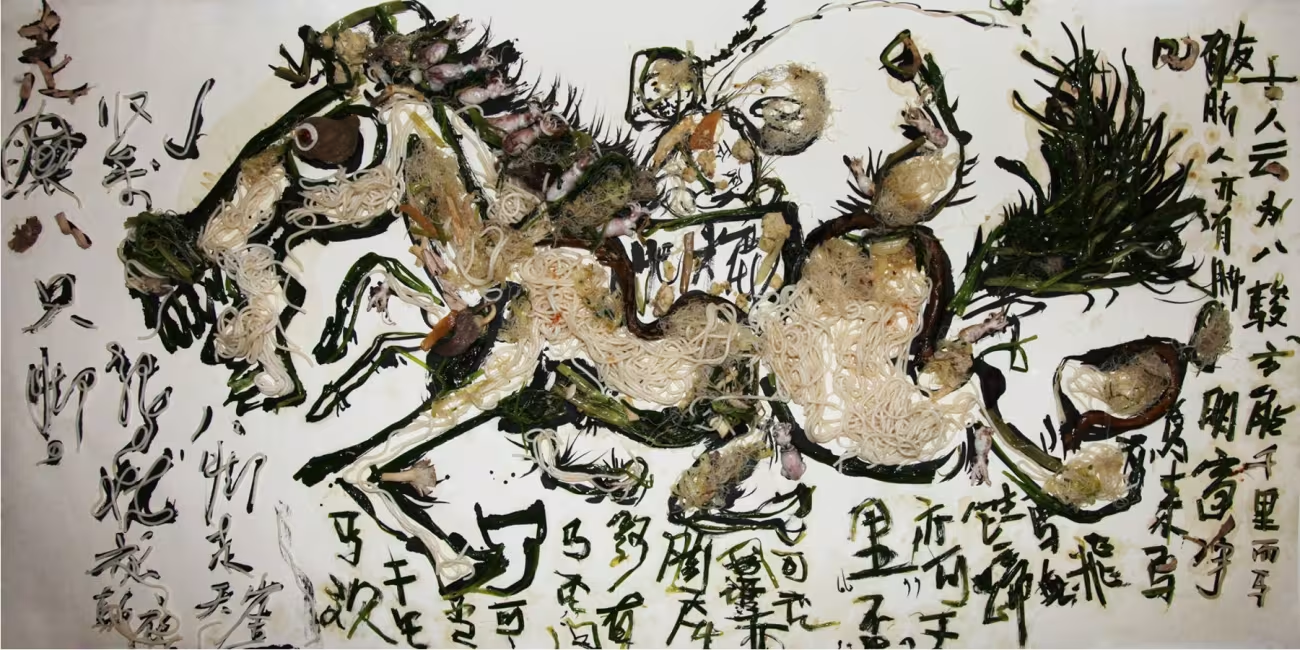
Exhibition “Mightier Than the Sword: Writing Freedom” and Accompanying Program
FROM WILL TO FREEDOM – CHINA IN A GLOBAL CONTEXT: A CONTRIBUTION TO THE YEAR OF SCIENCE 2024 – FREEDOM Exhibition at the University Museum and Betriebswerk Heidelberg through December 15, with an accompanying program.
Exhibition by the Heidelberg Academy of Sciences and Humanities State Academy of Baden-Württemberg) and Heidelberg University (University Museum)
About the exhibition:
-More information about the artists and their works
The exhibitionis taking placeas part of the Year of Science 2024 –Freedom, which is sponsored by the Federal Ministry of Education and Research, and as part of the “PERSPEKTIVE: FREIHEIT” series organized by the Union of German Academies of Sciences and Humanities. The Heidelberg Academy of Sciences and Humanities State Academy of Baden-Württemberg), under the direction of Academy Member Prof. Dr. Barbara Mittler, is organizing a series of events titled “From the Will to Freedom – China in a Global Context,” which are also being held in cooperation with Heidelberg University, the Confucius Institute based there, and the KlangForum Heidelberg.
While all the arts in China have always been inextricably linked to politics and structures of power, calligraphy in particular served as a kind of lingua franca, not only holding together the vast territory with its diverse regional cultures and dialects—and thus ensuring cultural cohesion within the immense empire—but also conferring social status and granting access to power upon those who possessed the aptitude to use and understand these media. The cultural elite and officials of the Chinese empire, the so-called literati, who were recruited through the imperial examinations, set the standards for traditional culture. Successfully passing the imperial examinations (keju kaoshi 科举考试) was the key to positions in the imperial administration and thus to social advancement. The main component of these examinations consisted of composing essays or poems on topics from the canonical texts according to strict stylistic rules. However, literary style and an understanding of the classics were not the only criteria for quality; above all, the examinee’s handwriting—their calligraphic style—was also crucial. According to Pierre Bourdieu’s concept of cultural capital, literati participated in this cultural capital in several ways: 1. incorporated—they inherited and acquired the disposition to understand and consume cultural objects, 2. objectified—they possessed collections of ancient artifacts, paintings, and calligraphies, as well as 3. institutionalized—they held academic degrees and titles and were therefore the authority that rendered valid aesthetic judgments. The close connection between art and calligraphy on the one hand and politics and the underlying power structures on the other, as manifested in this way, resulted in a subtle coding of the represented content and endowed calligraphy—as well as the closely related traditional ink painting—with a transformative, revolutionary potential.
The exhibition presents contemporary works by artists of Chinese origin who draw on the potential of calligraphy and art. The works on display include painting, calligraphy, sculpture, photography, and video. They combine traditional elements—techniques, materials, and aesthetics—with contemporary concepts and media. Exciting, unorthodox, and humorous, they paint a vivid picture of contemporary art in China and the diaspora.
Martina Köppel-Yang (curator of the exhibition)
Artists featured in the exhibition:
Chen Tong (b. 1962, lives in Guangzhou)
Huang Rui (b. 1952, lives in Beijing and Paris)
Li Zhengtian (b. 1942, lives in Guangzhou)
Yang Jiechang (b. 1956, lives near Heidelberg and in Paris)
Zheng Guogu (b. 1970, lives in Yangjiang)
Yangjiang Group (Chen Zaiyan (b. 1971) / Sun Qinglin (b. 1974) live in Yangjiang)
Harald Kröner (born 1962, lives in Pforzheim)
Notes:
"From the Will to Freedom – China in a Global Context"– Educational Program of the China School Academy (PDF)(internal link)
Concerts:“Freedom II – Do You Hear the People Sing?(internal link): Liberation = Freedom?” on November 23 and 24, 2024, 7:00 p.m., HebelHalle Heidelberg
In Athene Magazine 1-2024, which was published in June with the theme "Freedom," features a detailed article on the exhibition as well as on the Academy’s other events taking place as part of the Year of Science.
The Science Years ( external link) are an initiative of the Federal Ministry of Education and Research(external link) in collaboration with Wissenschaft im Dialog(external link). The Union of German Academies of Sciences and Humanities ( external link) and its member academies regularly participate in the Science Years through various engagement formats.
Further information:
- Forthe opening of the exhibition(external link) in the Joint Center "Worldmaking" newsletter, November 2024
- About Science Year 2024 – "Freedom"(external link)
- Additional events organized by the Academies of Sciences (external link) as part of the "Freedom" Science Year
The exhibition will run at the University Museum until December 15 and at the Heidelberg Depot until December 16, 2024.
Locations: Old University, University Museum (external link), Grabengasse 1 (access during the opening; on other days, access via Augustinergasse 2, 69117 Heidelberg) and the depot, Am Bahnbetriebswerk 5, 69115 Heidelberg
Hours:
University Museum: Tue–Sat from 10:30 a.m. to 4:00 p.m. (last admission: 45 minutes before closing).
The exhibition at the depot is open during event hours.
Curator-led toursof the exhibition *MIGHTIER THAN THE SWORD—Writing Freedom* with Dr. Martina Köppel-Yang
Thursday, December 12, 2024
5:00 p.m. Depot
6:15 p.m. University Museum
7:15 p.m. CATS Film Screening