
Language switcher (content)

Walter Witzenmann Award

In view of the great importance of cultural and social science research, Witzenmann GmbH (external link) established the Walter Witzenmann Prize in 1997 to promote young scientists in Baden-Württemberg. The prize is awarded to works that address important social and cultural changes and/or the possibilities and effects of technological transformation and, in the case of historical works, demonstrate a connection to the present.

The prize is endowed with 10,000 euros.

Who can be nominated?

Researchers should not be older than 35 years of age. The proposed works should have been accepted as scientific achievements by a university or research institute in the state of Baden-Württemberg and published or submitted for publication in the past two years. If several authors have made a significant contribution to the award-winning work, the prize may be awarded to them in equal parts.

Who is allowed to make suggestions?
  • All members of the Philosophy and History Class of the Heidelberg Academy of Sciences
  • the management of all academic institutions at universities in Baden-Württemberg (rectorates, deaneries, executive directors, institute management)
  • the management of all non-university research institutions in Baden-Württemberg (executive directors)
  • Unsolicited applications are not accepted.
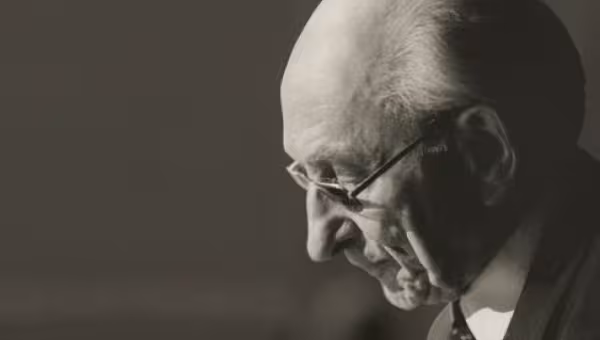
Walter Witzenmann Award

In 1854, Heinrich Witzenmann and a partner founded a jewelry factory in Pforzheim. Their invention of the metal hose opened up a new, promising industrial sector for the two entrepreneurs, leading them to abandon jewelry manufacturing. Today, Witzenmann (external link) is a global manufacturer of metal hoses, expansion joints, and vehicle parts, among other things, with more than twenty subsidiaries worldwide.

Entrepreneur and local politician Walter Witzenmann (external link) (1908-2004) studied economics and sociology, earning his doctorate in philosophy in 1935 under Alfred Weber in Heidelberg. He then went on to work for the Witzenmann company, which he later managed for decades as the third generation of his family to do so.

Walter Witzenmann passed away on August 15, 2004, the year in which Witzenmann GmbH celebrated its 150th anniversary.

Important cultural and technical changes and transformations in societies: Since 1998, a wide range of works from very different fields of research have been honored in this category.

All previous award winners:

yearNameTitle
2025Linder, SimonA church in conflict in the digital present. Why a theology of digitality requires synodality and a culture of debate
2024Zschoche, Paula JohannaLiability of trade unions for labor disputes
2023Jebe, JohannaRules, writing, correction – Carolingian designs for monasticism reflected in the written works of St. Gallen and Fulda
2022Bossert, Leonie N.A shared future for humans and animals – animals in sustainable development
2021Rothenburg, DanielToo Much Water. Irrigation, Salinity, and Communities in the Murray-Darling Basin, Australia. An Environmental History
2020Silence, MaxIslamic Sermons and Public Piety in Bangladesh: The Poetics of Popular Preaching
2019Reinhardt, KarolineKant and migration. An investigation into the systematic relevance of cosmopolitanism
2018Cubelic, SimonThe Colonial Restoration of the Dharmaśāstra. The Law of Obligations in Sarvoru Śarman's Vivādasārārņava
2017Rauber, JochenStructural change as a change in principles. Theoretical, dogmatic, and methodological building blocks of a model of principles in international law and its dynamics.
2016Begass, ChristophThe senatorial aristocracy of the Eastern Roman Empire, ca. 457–518. Prosopographic and social history studies
2015Domisch, JörgOn the question of transfer of ownership to heirs in classical Roman law
2014Dangel, TobiasHegel and Aristotle's metaphysics of the mind
2013Thomale, ChrisPerformance as freedom—Autonomy of performance in the law of unjust enrichment
2012Maier, Felix K.Expect the unexpected everywhere – The contingency of historical processes in Polybius
2011Eickmeyer, JostThe Jesuit Heroides Letter. On the Christianization and Contextualization of an Ancient Genre in the Early Modern Period
2010Stockhammer, Philipp WolfgangContinuity and Change—Post-Palatial Pottery from the Lower City of Tiryns
2009Herzberg, Stephan UlrichPerception and knowledge in Aristotle
2008Sigelen, AlexanderZacharias Geizkofler (1560‒1617). Service to princes and family politics. A biographical case study on political culture in the Holy Roman Empire around 1600
2007Beßlich, BarbaraThe German Napoleon Myth. Literature and Memory (1800‒1945)
2006Krüger, ChristineAre we not brothers? German Jews in the national war of 1870/71.
2005Tumat, AntjePoet and composer: Aesthetics and dramaturgy in Ingeborg Bachmann and Hans Werner Henze's "Der Prinz von Homburg"
2004German, AndreasThe Klagspiegel and its author Conrad Heyden. On the origin, content, and significance of a legal book from the reception period
2003Valk, ThorstenMelancholy in Goethe's work. Genesis – Symptoms – Therapy
2002Jung, SabineThe logic of direct democratic procedures
2001Korn, LorenzAyyubid architecture in Egypt and Syria—construction activity in the context of politics and society 564–658 / 1169–1258
2000Lobinger, ThomasLegal obligation and autonomous binding. On the reasons for the emergence of asset-increasing performance obligations in civil law
1999Brockhaus, CathrinAphra Behn and her London comedies: The playwright and her work in late 17th-century England
1998Roth, Johannes GeorgAlfeni Digesta. Studies on a late Republican legal text
Nomination deadline:

Annually March 1 - June 30

What needs to be submitted?
  • Justification of the proposal, maximum two pages
  • resume
  • list of publications
  • award-worthy work and the two doctoral and postdoctoral theses.

The documents should be submitted as a single PDF file and sent to hadw[at]hadw-bw.de.

When will the decision be made?

The Academy will announce its decision at the beginning of the year. The winner and their mentor will be notified of the result in writing.

Do you have any questions?

You can reach us by phone at +49 (0)6221 54-3265 or by email at hadw[at]hadw-bw.de.

If you wish to send the documents by mail, please send them to:

Heidelberg Academy of Sciences and Humanities
Executive Secretariat
Karlstraße 4
69117 Heidelberg