
Commentary on fragments of Greek comedy (KomFrag)
Large parts of ancient Greek literature have only been preserved in fragments of varying lengths. This is particularly true of comedy, a genre whose image is largely determined by the two authors whose complete plays have survived: Aristophanes (5th/4th century BC) and Menander (3rd/2nd century BC).
By commenting on the fragmentary works of comedy writers—including fragments by Aristophanes and Menander—this research project breaks new ground in literary history and corrects and supplements the previously rather one-sided view of a central genre of European literature.
The aim of the commentaries is, on the one hand, to explore the texts, which are generally difficult to understand, from all possible angles and, on the other hand, where possible, to attempt a reconstruction of the plays and to classify the authors in terms of literary history. The fragments and testimonies are translated into German. The results achieved in the commentaries will be incorporated into general studies on comedy and comic techniques such as parody and satire, as well as on political function. The project is internationally networked and collaborates with centers for research into fragmentary Greek literature in Italy, Great Britain, and the USA.
Portal of the research center on the University of Freiburg website
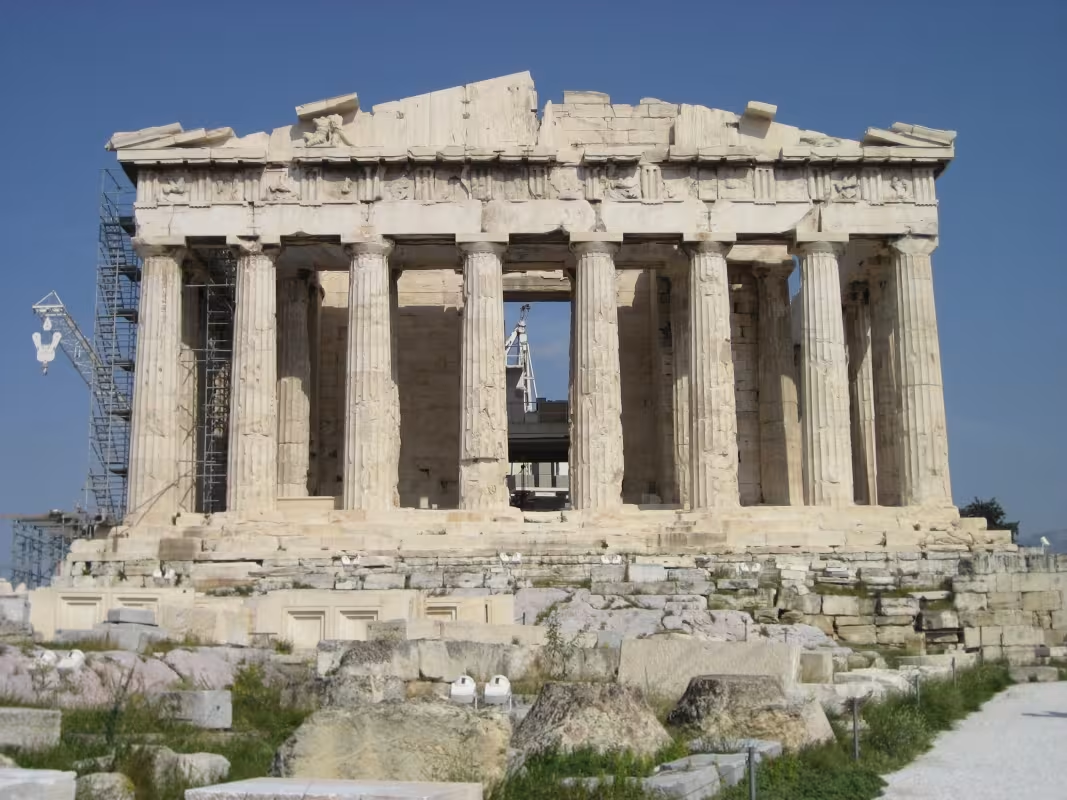
Acropolis of Athens
The KomFrag project was included in the Academies Program in 2011 and is scheduled to run for 15 years. This will go some way toward closing a gap in our understanding of literature from classical antiquity—and thus of the history of education.
Large parts of Greek literature—especially from the Archaic, Classical, and Hellenistic periods—are attested not by complete texts, but by fragments. This applies not only to pre-Socratic and Hellenistic philosophy or early poetry, to name a few significant examples, but also to drama. This means that it is impossible to present a history of Greek literature without including the fragmentary texts that have survived, and that even such a history must remain fragmentary.
In contrast to Greek tragedy, we have an enormous number of testimonies and fragments from over 200 authors of comedy, which have now been published in the monumental edition of Poetae Comici Graeci (edited by R. Kassel and C. Austin), but are still awaiting scholarly analysis. This research project breaks new ground in literary history by commenting on the fragmentary works of comedy authors, thereby correcting the previously rather one-sided view of a central genre of European literature.
The aim of the commentaries is, on the one hand, to make the texts, which are generally difficult to understand, accessible from various perspectives (philological-literary-historical, archaeological, historical) and, on the other hand, where possible, to attempt a reconstruction of the plays themselves and to classify the authors in terms of literary history.
The material
In total, we know of 8501 comedy fragments by 253 poets whose names are known to us. In addition, there is a considerable amount of evidence about the lives and works of the poets themselves. Most of the fragments date from the 5th century BC and can be attributed to the poets Kratinos, Aristophanes, and Eupolis. Other well-documented authors include Pherekrates, Theopamp, and Hermippos. The source situation for the 4th century BC is similarly good, with Antiphanes and Alexis in particular being attested by a large number of fragments. From the Hellenistic period (late 4th century – 1st century BC), Menander is particularly well documented, for example through papyrus finds from the late 19th century, but also through numerous fragments. Other authors from this era include Philemon and Diphilos.
Interdisciplinary approach
The project is primarily philological in nature. However, due to the special nature of the comedy texts, close cooperation with ancient history and archaeology is necessary. The first result of the cooperation with archaeologists from the University of Würzburg is an Archaeologia comica, which is currently in planning and will compile the realia described in the comedies and comedy fragments in an encyclopedia-like format. Another project is the Onomastikon comicum, a compilation of all the people mentioned in the comedies, which will serve as a working basis for research in ancient history and onomastics. Literary and cultural studies interests are covered by investigations into forms of comedy, while aspects of educational and reception history are covered by the study of the tradition and specific carriers of comedy texts.
International networking
The project is explicitly designed to attract external staff. There are currently 21 external staff members from the UK, Italy, the US, and Greece. The number of inquiries is steadily increasing. Workshops and conferences contribute to the international visibility of the research project. The international network is particularly evident in the high-caliber scientific advisory board, consisting of Professors Glenn W. Most (Pisa), Heinz-Günther Nesselrath (Göttingen), S. Douglas Olson (University of Minnesota), Alan H. Sommerstein (Nottingham), and Antonios Rengakos (Thessaloniki).
Dionysus Theater, Athens
Free access publications
Five years after publication, the volumes are available in open access at:
https://digi.hadw-bw.de/view/frc
The indexes of the published volumes can be found at:
https://www.komfrag.uni-freiburg.de/frc_baende-und-indices/indices
An alphabetical index of all volumes is currently being compiled.
Funded by the Innovation Fund of the University of Freiburg, a database has been created based on the indices of the volumes published to date, containing the realia mentioned in Greek comedy.
Accessible at: https://www.altphil.uni-freiburg.de/LGgK.html
Digital KomFrag
In addition to the XML/TEI format, the creation of cross-volume indexes for improved indexing and handling is a major concern of the research center. The initial results of this work will be presented here next year.
head of research
Professor Bernhard Zimmermann
Employees
Former employees
- PD Dr. Christian Orth
- Dr. Virginia Mastellari
Members of the commission accompanying the project
- Prof. Dr. Michael Erler (Würzburg)
- Prof. Dr. Sabine Föllinger (Marburg)
- Prof. Dr. Hans-Joachim Gehrke (Freiburg), Chairman
- Prof. Dr. Tonio Hölscher (Heidelberg)
- Prof. Dr. Irmgard Männlein-Robert (Tübingen)
- Prof. Dr. Mischa Meier (Tübingen), Deputy Chair
- Prof. Dr. Franco Montanari (Genoa)
- Prof. Dr. Oliver Primavesi (Munich)
- Prof. Dr. Ernst A. Schmidt (Tübingen)
Comic Fragments
2019
FrC 21: Timokles, by Kostas Apostolakis
FrC 16.1: Alkenor – Asklepiodo]ros, by Giulia Tartaglia
FrC 2: Krates, by Serena Perrone
Reviews:D. Anderson in: ClR 70 (2020) 1f. || M. Pellegrino in: BMCR 2021.03.56
2018
FrC 3.6: Kratinos, 299–514, by S. Douglas Olson & Ryan Seaberg
FrC 10.11: Aristophanes fr. 821–976, by A. Bagordo
2017
FrC 3.1: Kratinos, Introduction and Testimonies, by Francesco-Paolo Bianchi
FrC 10.10: Aristophanes, Inc. Fab. fr. 675–825, by Andreas Bagordo
FrC 10.3: Aristophanes, Aiolosikon–Babylonioi, by Christian Orth
FrC 6: Hermippos, by Nicola Comentale
FrC 8.1: Eupolis, Introduction, Testimonies, and Aiges–Heilotes, by S. Douglas Olson
FrC 12: Archippos, by Elisabetta Miccolis
2016
FrC 3.2: Kratinos, Archilochoi – Empipramenoi, by Francesco-Paolo Bianchi
FrC 8.2: Eupolis, Kolakes – Chrysoun Genos, by S. Douglas Olson
FrC 10.9: Aristophanes, fr. 590–674, by Andreas Bagordo
FrC 20: Amphis, by Athina Papachrysostomou
2015
FrC 17: Anaxandrides, by Benjamin Millis
Reviews: T. Gargiulo in: Anzeiger für die Altertumswissenschaft 69 (2016): 87–92.
FrC 9.3: Nikochares – Xenophon, by Christian Orth
Reviews: M. Napolitano in: Anzeiger für die Altertumswissenschaft 69 (2016): 98–104.
2014
FrC 1.1: Alkimenes – Kantharos, by Andreas Bagordo
Reviews: I. C. Storey in: BMCR 2015.01.15|| Ruffel, I. in: Anzeiger für Altertumswissenschaften 69 (2016): 10–13
FrC 9.2: Aristomenes – Metagenes, by Christian Orth
Reviews: S. E. Kidd in: Anzeiger für Altertumswissenschaften 68 (2015): 178–180.
FrC 7: Phrynichos, by Felice Stama
Reviews:G. Mancuso in: BMCR 2015.11.10||F. Conti Bizzarro in: Lexis 35 (2017): 450–454.
FrC 8.3: Eupolis, Incertarum Fabularum Fragmenta et Dubia
Reviews: M. Napolitano in QS 87 (2018): 279–306.
FrC 1.2: Leukon – Xenophilos, by Andreas Bagordo
2013
FrC 15: Nikophon, by Matteo Pellegrino
Reviews: I. Rodríguez Alfageme in: CFC (g) 24 (2014): 395–6 || G. Mancuso in: BMCR 2014.04.40|| St. Novelli in: Lexis 32 (2014): 475–78 || M. Pinto in: QS 82 (2015): 259–61|| F. Zogg in: Gnomon 87 (2015): 684–8||
FrC 4: Telekleides, by Andreas Bagordo
FrC 9.1: Alkaios – Apollophanes, by Christian Orth
Reviews: E. Chepel in: BMCR 2014.07.34
Comic Studies
Bernhard Zimmermann (ed.), 2500 Years of Comedy (Studia comica 8). Heidelberg 2017.
Federico Favi, Fliaci: Testimonianze e frammenti (Studia Comica 7). Heidelberg 2017.
Stylianos Chronopoulos, Mockery in Drama: Dramatic Functions of Personal Ridicule in Aristophanes' The Wasps and Peace. ( Studia comica 6), Heidelberg 2017.
Stylianos Chronopoulos & Christian Orth (eds.), Fragments of a History of Greek Comedy. (Studia Comica 5). Heidelberg 2015.
Michele Napolitano, I Kolakes di Eupoli: introduction, translation, commentary. (Studia comica 4). Mainz 2012.
Silvio Schirru, The Fable in Aristophanes. (Studia comica 3). Berlin 2009.
Christian Orth, Strattis. The Fragments. A Commentary (Studia Comica 2). Berlin 2009.
Serena Pirrotta, Plato Comicus, The Fragmentary Comedies. A Commentary (Studia Comica 1). Berlin 2009.
Comic Library
Research center blog
project-specific page of the research center
Cooperation partners of the research center
- German Association of Classical Philologists
- Italian Association of Classical Culture
- Academy of German-Italian Studies, Merano
- Ignazio Buttitta Foundation, Palermo
- International Center for Research and Studies on Carnival, Masks, and Satire, Putignano
- Center for Studies on Classical Theater, University of Turin
You can find the latest news from the research center on the project's website.
address
Seminar for Greek and Latin Philology
University of Freiburg
Platz der Universität 3
79085 Freiburg im Breisgau
telephone
+49 (0) 761 / 20 394 88
bernhard.zimmermann [at] altphil.uni-freiburg.de
Web editing of this project page
Dr. Francesco Paolo Bianchi