

Historical-critical complete edition of Osiander's works
Andreas Osiander (1496-8/1552) always stood in the shadow of the great reformers Luther, Melanchthon, Zwingli, and Calvin. It was only the ten-volume complete edition of his writings, sermons, expert opinions, and correspondence that revealed his multifaceted significance for the history of the Reformation. Active as a preacher for the Reformation in the imperial city of Nuremberg since 1522, he played a decisive role in shaping its fortunes until 1548. Unwilling to comply with the reversal of Reformation achievements enforced by the emperor and implemented by the city council, he left Nuremberg and spent the last years of his life until his death in 1552 as a professor at the young University of Königsberg. Among the circle of Luther and Melanchthon's students there, a dispute arose over his Christology and doctrine of justification, so that from then on his reputation among the Reformers remained damaged.
This edition documents Osiander's comprehensive contribution to the history of the Reformation in Nuremberg and his original and controversial positions in the theological debates of the 16th century. The church order for Brandenburg-Nuremberg, to which he made a significant contribution, became a model for many later church orders. His catechism sermons achieved high print runs and were also translated into English and even Icelandic. As an expert on medieval Jewish traditions, he defended the Jews against allegations of ritual murders and other suspicions.
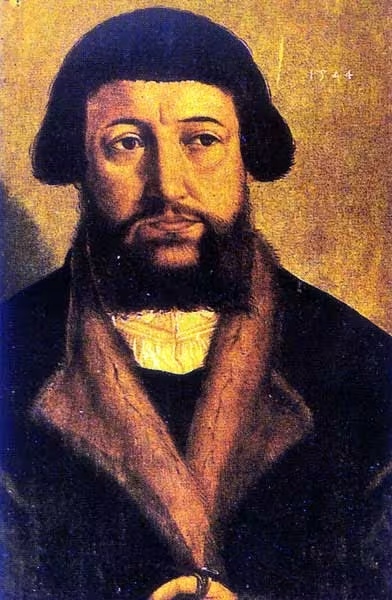
Andreas Osiander by Georg Pencz, paper drawing, 1544, Rome
History of the research center
Work on the edition began in 1969 at the Research Center for the History of the Reformation under the direction of Professor Gerhard Müller. After collecting and reviewing all of the material to be edited, the first volume was published in 1975 in collaboration with Dr. Gottfried Seebaß and edited by a rotating team of young scholars. After Professor Müller was elected bishop of the Evangelical Lutheran Church in Brunswick, the research center was headed by Professor Dr. Seebaß in Heidelberg. Initially funded by the DFG, the project was taken over by the Heidelberg Academy of Sciences in 1984. It was completed in 1997 with the publication of the tenth volume.
complete edition
Writings and letters
- 1522 to March 1525 (PDF) (37 MB)
- April 1525 to the end of 1527 (PDF) (36 MB)
- 1528 to April 1530 (PDF) (42 MB)
- May 1530 to the end of 1532 (PDF) (27 MB)
- 1533 to 1534 (PDF) (32 MB)
- 1535 to 1538 (PDF) (28 MB)
- 1539 to March 1543 (PDF) (110 MB)
- April 1543 to the end of 1548 (PDF) (40 MB)
- 1549 to August 1551 (PDF) (40 MB)
- September 1551 to October 1552, as well as posthumous works and addenda (PDF) (58 MB)
Chairman of the Commission
Retired Regional Bishop Prof. Dr. Gerhard Müller †
head of research
Prof. Dr. Gottfried Seebaß †