Edition

The academy project Bible Glossaries as Hidden Cultural Carriers: Judeo-French Cultural Exchange in the High Middle Agesbegan in January 2023. It is led by Jewish studies scholar Prof. Dr. Hanna Liss (Heidelberg College of Jewish Studies) and Romance studies scholar Dr. Stephen Dörr.
The project is scheduled to run for a total of 18 years and contributes to the Judeo-French linguistic and literary tradition, which is being examined for the first time in an interdisciplinary manner in terms of its significance for cultural studies, linguistics, and the history of theology. The aim is to edit and contextualize Hebrew-French Bible glossaries and French glosses in Hebrew script in Hebrew Bible and Talmud commentary literature (tosafot). The project work will be integrated into a digital working environment throughout in order to make the research usable beyond the project.

The project maintains collaborations with the following scientific individuals and institutions:
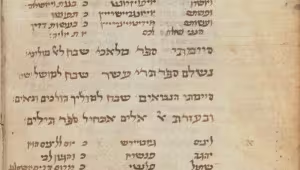
Multilingualism is today, as it was in medieval Europe, a sign of elite education. The Jewish diaspora in medieval northern France was fluent in Hebrew and Aramaic, as their most important sources of knowledge were written in these languages. However, Old French wastheir common language of communication with the Christian population, and a significant group of Francophone Jews was very receptive to French culture and literature. This Jewish-French literacy is documented in various texts from the 12th to 14th centuries. These include Old French glosses in Hebrew script on religiously important texts such as the Bible and the Talmud. These were collected in Hebrew-French Bible glossaries.
The glossaries are exceptional witnesses to a simultaneously developing (Jewish and Christian) French (Biblical) reading culture in Western Europe. They form fundamental texts for researching the interrelationships between Jewish intellectual history and the non-Jewish environment. Their analysis contrasts the historical portrayal of a painful antagonism between Christian and Jewish relations with the image of a culturally fruitful interdependence between French vernacular literature and Jewish intellectual society, which has only been recognized and appreciated to a limited extent until now.
By using state-of-the-art digital tools, the project will establish a solid praxeological, philological, and linguistic foundation for presenting Jewish religious education as part of the shared intellectual heritage of the French-speaking world in the Langue d'oïl region. By bringing together unique expertise from Jewish studies, Romance studies, and Middle High German philology, the project will contribute to a fundamental reassessment of Jewish culture in medieval France, according to which Jews aspired to be a powerful part of European educational culture.
Most of the glossaries are being edited and historically and philologically processed for the first time as part of the project. A total of approximately 105,000 entries are being examined.
The texts are exceptional examples of Jewish and Christian French (biblical) reading culture in Western Europe. The glossaries therefore form fundamental texts for research into the interrelationships between Jewish intellectual history and the non-Jewish environment. The historical portrayal of a painful antagonism in Christian-Jewish relations is juxtaposed with the image of a culturally fruitful interdependence that has only been recognized and appreciated to a limited extent thus far.
Using state-of-the-art digital tools, the project is establishing a solid praxeological, philological, and linguistic foundation for presenting Jewish religious education as part of the shared intellectual heritage of the French-speaking world.
BIBLICAL MASORAH DATABASE 2.1 (developed by Clemens Liedtke, MA)
BIMA 2.1 is a collaborative, digital, and open source work environment, database, and user interface. BIMA 2.1 enables the transcription, translation, and analysis of any source text in a workspace where images and text are immediately visually linked by colored text paths drawn directly onto the surface of high-quality images of manuscript pages. BIMA 2.1 displays the manuscripts via the IIIF protocol, from where they are further processed.
Liss, Hanna and Dörr, Stephen, “Hebrew-French Bible Glossaries and the Question of Jewish-French Cultural Exchange in the High Middle Ages: A Reevaluation,” Corpus Masoreticum Working Papers2, 2022, 22–50 (open access)
Claudio Lagomarsini, "Talmudic glosses in Hebrew, or rather in medieval French" in: Il sole 24 ore 12.4.2024: https://amp24.ilsole24ore.com/pagina/AFeb38PD
Sabine Arndt and Stephen Dörr, “The Beginning of Wisdom by Hagin the Jew: A Lexicon Between Tradition and Innovation,” Mélanges Joëlle Ducos (forthcoming, 2025).
Stephen Dörr, “The Language of the Jews in the French Middle Ages,” in: The Values of the Vernacular: Essays in Medieval Romance Languages and Literatures in Dialogue with Simon Gaunt, ed. by Hannah Morcos, Maria Teresa Rachetta, Henry Ravenhall, Natasha Romanova, and Simone Ventura, Rome, Viella (print 2025)
Stephen Dörr, Review of Ariane Pinchon, ed., Wauchier de Denain, Li Seint Confessor, Paris (Honoré Champion) 2024 (Les classiques français du Moyen Âge, 204), Francia-Recensio 2025/1, Middle Ages – Moyen Âge (500–1500), DOI: https://doi.org/10.11588/frrec.2025.1.109368.
Stephen Dörr, Review of Peter Nahon, Les parlers français des israélites du Midi, Strasbourg 2023, RF 137 (2025) 162-166.
Stephen Dörr, Review of Franz Staller, ed., Fragment of a Hebrew-Old French Bible Glossary from the University Library of Salzburg: Critical Edition, Linguistic History Analysis, and Historical-Geographical Context (Situation of the Jewish Minority in Lorraine between 1220 and 1350), Innsbruck : Studia Verlag Innsbruck 2023, 292 p., Zeitschrift für romanische Philologie 140 (2024), 992-996.
Hanna Liss, “Early Hebrew Printing and the Quality of Reading: A Praxeological Study,” in Premodern Jewish Books, their Makers and Readers in an Era of Media Change, ed. by Katrin Kogman-Appel and Ilona Steimann, Brepols, Turnhout, 2024, 251–274.
Hanna Liss, “Between Imagination and Exegesis: The Masora Figurata Illustrations of the Two Menorot in Vatican ebr. 14,” In Images – A Journal of Jewish Art and Visual Culture16 (2023), 1–19
Hanna Liss, "'Hebraica and Gallica Veritas': The Function of the Hebrew-French Glossaries in 12th Century Jewish and Christian Exegesis," in: From Theodulf to Rashi And Beyond - Texts, Techniques, and Transfer in Western European Exegesis (800–1100), ed. by Johannes Heil and Sumi Shimahara, Leiden/Boston: Brill, 2022, 119–146.
Hanna Liss and Stephen Dörr, “Hebrew-French Bible Glossaries and the Question of Jewish-French Cultural Exchange in the High Middle Ages: A Reevaluation,” Corpus Masoreticum Working Papers 2, 2022, 22–50 (https://journals.ub.uni-heidelberg.de/index.php/cmwp/article/view/89053).
Hanna Liss, “Teaching in Tiny Letters. Eliyyah ben Berekhyah ha-Naqdan’s Way of Teaching as Displayed in MS Biblioteca Apostolica Vaticana ebr. 14,” Corpus Masoreticum Working Papers 1, 2022, 1–20 (https://journals.ub.uni-heidelberg.de/index.php/cmwp/article/view/87168).
Katelyn Mesler, “Did Perets Trabot Write the Makre Dardeke? A Case Study in the Confusion of Names” (submitted to La Revue des Études Juives)
Katelyn Mesler, Introduction to “Florilegium (Cambridge, University Library, MS Ff.6.53).” Posted Oct. 2024. https://cudl.lib.cam.ac.uk/view/MS-FF-00006-00053/1
12:00 p.m.: Lecture by Prof. Dr. Hanna Liss/Clemens Liedtke, M.A.: 'Corpus Masoreticum' and 'Hebrew-French Glossaries': Hebrew-French Text Cultures of the Middle Ages in Heidelberg DH Projects'
(Access data via the HCDH distribution list)
6 p.m. sharp: Lecture by Dr. Erica Baricci, University of Insubria, Como: The Ma'asé Ester. A Judeo-Provençal Poem about Esther
July 3, 2023, 237 ENTANGLEMENTS BY NUMBERS: NETWORKS OF ASTRONOMY AND MATHEMATICS
Lecture by Sabine Arndt: Lost in Translation – The Arabic, Latin, and Hebrew Versions of Pseudo-Euclid’s Book of Mirrors
July 5, 2023, 1137 JEWISH-CHRISTIAN ENTANGLEMENTS IN THE MIRROR OF MEDIEVAL MANUSCRIPTS AND CHARTERS
Lecture by Hanna Liss: Clavis Verborum Biblicorum
Location: College for Jewish Studies, Heidelberg
Provisional program:
9:30 Coffee
10:00 a.m. Hanna Liss (College of Jewish Studies/Heidelberg Academy of Sciences): Welcome note and introduction: “A common French reading? The Origins of the Project Hebrew French Bible Glossaries and the Question of the Function of the Old French Translations in Jewish Commentary Literature
10:45 Stephen Dörr (Bible glossaries as hidden cultural carriers/Heidelberg Academy of Sciences): Les gloses judéo-françaises et la Bible du XIIIe siècle: premières observations.
11:30 Thierry Revol (Strasbourg): The Anglo-Norman Bible: glosses and translations, linguistic reflection at work
1:00 p.m. Lunch together
2:00 p.m. Alessandra Arcidiacono (Bible glossaries as hidden cultural carriers/Heidelberg Academy of Sciences): L’Exode dans la Bible du XIIIe siècle: premiers pas pour une édition critique.
2:45 p.m. Caterina Bellenzier (University of Siena): Independent translation or revision? The13th-century Bibleas a basis for analyzing the relationship between theAnglo-Norman Bible andJean de Sy's Bible.
3:30 p.m. Roberta Decolle (University of Siena): Between identity and variation: notes on the translation of biblical vocabulary in several Romance language versions
4:15 p.m. Claudio Lagomarsini (University of Siena): The Three Editions of the 13th-Century Bible ( First Volume)
5:00 p.m. Summary and outlook
Organization: Alessandra Arcidiacono, Stephen Dörr (Academy project: Bible glossaries as hidden cultural carriers)
January 25, Lecture by Alessandra Arcidiacono: Otherness in the Old Testament. Moses: "a stranger in foreign lands"
May 23, 2024, lectures by Hanna Liss and Stephen Dörr on the topic: Biblical glossaries, hidden cultural treasures -- Current research and perspectives
Location: College for Jewish Studies, Heidelberg.
Program:
10:00 a.m. Hanna Liss
Welcome & Introduction
10:15 a.m. Sabine Arndt
Between Translation and Commentary: the Function of Old French in Medieval Hebrew Glossaries
11:00 Kate Mesler
Three Lapidaries in the Leipzig Hebrew-French Glossary
11:45 Daniele Baglioni / Marco Maggiore
Manuscripta Italica Allographica: A New Project for the Study of Allographies in the Italo-Romance Area
12:45 Lunch break
2:00 p.m. Federico Boschetti
The creation of a digital scholarly edition of Italian allographic manuscripts
2:45 p.m. Davide Mastrantonio
Notes on syntactic and textual features of the Elegia giudeo-italiana
3:30 p.m. Bernardino Pitocchelli
Between tradition and innovation: on changes in Judeo-Italian translations of the Bible in the 16th century
4:30 p.m. Stephen Dörr
Summary and outlook
Organization: Alessandra Arcidiacono, Stephen Dörr (Academy project: Bible glossaries as hidden cultural carriers)
Location: College for Jewish Studies, Heidelberg. 6 p.m.
Welcome: Hanna Liss / Stephen Dörr
Presentation of the collaboration: Maria Grazia Cammarota (University of Bergamo)
Critical studies on written and oral cultural heritage. International collaboration in doctoral training
between philology and linguistics
Keynote speech: Richard Trachsler (University of Zurich)
Textual philology, the dethroned supreme discipline. Remarks from the perspective of a medievalist
Prof. Dr. Hanna Liss
Heidelberg College of Jewish Studies
Landfriedstraße 12
69117 Heidelberg
Dr. Stephen Dörr
General inquiries to bibelglossare@hadw-bw.de