Documents on the History of Religion and Law of Pre-modern Nepal
The project, through its digital platform Documenta Nepalica, makes accessible a corpus of documents and texts central to the history of religion and law in pre-modern Nepal. This material has attracted only partial scholarly attention to date, and the project aims to present it comprehensively in both printed and digital form.
The rare historical corpus material, which originated at the intersection of India and Tibet and between Hinduism and Buddhism, is unique in terms of content and volume. It has been filmed and documented by the Nepal-German Manuscript Preservation Project of the German Oriental Society, among others, but has been catalogued and processed only to a limited extent. The material encompasses temple documents (edicts, land grants, contracts, deeds of donation, letters, and the like), legal documents (verdicts concerning moral conduct, letters of indulgence, caste regulations), and, to a lesser degree, narrative and eulogistic texts relating to local shrines.
As a group, these texts form the essential foundation for the still largely unexplored history of numerous temples and other sanctuaries in Nepal (primarily in the Kathmandu Valley), as well as for tthe study of South Asian legal practices, which remain comparatively underexamined. The corpus also sheds light on the development of elite cultures, the legitimization and staging of power, and the significance of the textualization and codification of law within the broader context of ethnologically recorded jurisprudence.
Introducing the Project
Click for a short profile “Documents on the History of Religion and Law of Pre-modern Nepal” (External link to YouTube)
Brochure
Documents on the History of Religion and Law of Pre-modern Nepal: FSNepalbroschüre (PDF, German)
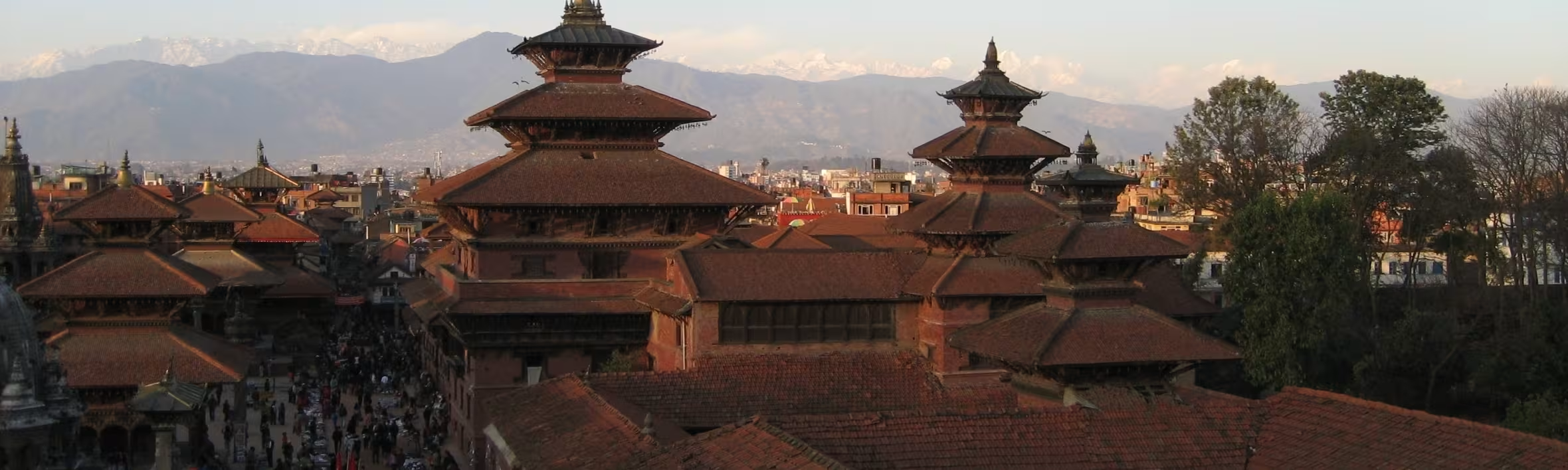
As a result of its territorial expansion and development as a nation state, Nepal experienced an unusually fast and extensive increase in the production of records and documents during the 18th and 19th centuries. In government administration, in temples, in the judicature and in economic life, the use of written records reached a new level of quality.
The research project ‘Documents on the History of Religion and Law of Pre-modern Nepal’ is dedicated to the study of this diverse historical material drawn from temple, administrative and legal documents. As the only major non-colonial corpus of documents, it is of particular historical interest for South Asia.
The goal of this research project, based in Heidelberg and Patan (Nepal), is to systematically examine this unique corpus and to publish selected documents in the form of editions, translations, and commentaries. A central focus is the creation of a publicly accessible database—a first in the study of South Asian documents. At the same time the documents under examination are analyzed in light of broader cultural-historical themes, such as the development of elite cultures, the legitimization and staging of power, forms of religious policy, the codification of law, and the emergence of public order. This allows for the construction of a multifaceted picture of Nepal’s socio-cultural transformation processes from the late 18th century to the first half of the 20th century.
The Material
The research is based on archival materials from the National Archives of Nepal (Rashtriya Abhilekhalaya, Kathmandu) and other government organizations, which were microfilmed by the Deutschen Morgenländischen Gesellschaft (DMG) as part of the Nepal-German Manuscript Preservation Project (NGMPP) but have so far been only partially cataloged and, with few exceptions, have neither been published nor translated, nor have they been subjected to in-depth scientific analysis. Under a bilateral agreement between the Royal Government of Nepal and the Federal Republic of Germany, copies of the microfilms are stored at the National Archives of Nepal and the Oriental Department of the Berlin State Library (SBB). In close cooperation with these institutions, the project aims to gradually catalog and digitize the NGMPP’s entire collection of over one hundred thousand historical documents—which had previously been explicitly excluded from cataloging efforts—for the first time. In doing so, the project also makes a substantial contribution to the preservation of the NGMPP’s microfilm collection, which is arguably unique in South Asia.
In addition to the material filmed by the NGMPP, documents from other collections are also to be included over time (e.g., the Asha Archive in Kathmandu; the Hodgson Collection in London). The corpus of documents is highly diverse. It includes, among other things, temple documents (decrees, land grants, contracts, foundation deeds, letters, etc.) and legal documents (judgments regarding moral conduct, letters of indulgence, caste regulations). This material is not only being cataloged but also indexed by content using the database. Initial insights already reveal the potential of the Nepalese documents, which is likely to provide fields of activity for entire generations of researchers. The project focuses chronologically on the early Śāha (1769–1846) and Rāṇā periods (1846–1951)—on Nepal’s “long 19th century.”
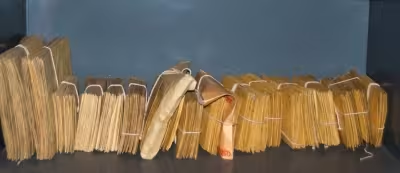
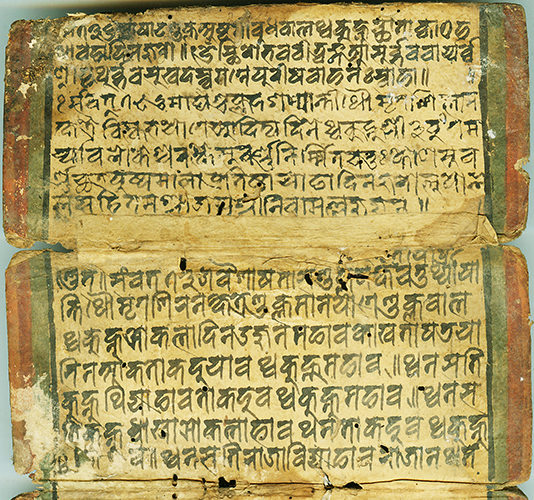
Dokumente im nepalischen Nationalarchiv (Foto: Manik Bajracharya/HAdW)
Research
The document corpus offers great potential for research in both philology and cultural studies. To make the best possible use of this broad spectrum and illustrate it with examples, individual staff members—depending on their prior knowledge and academic specializations—work on various research topics, such as elite cultures, the development of public order and state administration, festivals, temples, and other religious sites, deities, etc.
For more on the research topics, see the “Research Topics” menu above.
 |  |  |  |
|
|
|
|
|
|
|
|
|
|
|
|
|
|
|
|
|
|
|
|
|
|
|
|
|





Documenta Nepalica – Book Series
Publications
Documenta Nepalica – Book Series
The research project publishes the “Documenta Nepalica – Book Series” as an open access series (CC BY-SA 4.0) heraus. The volumes are also available as print-on-demand editions.
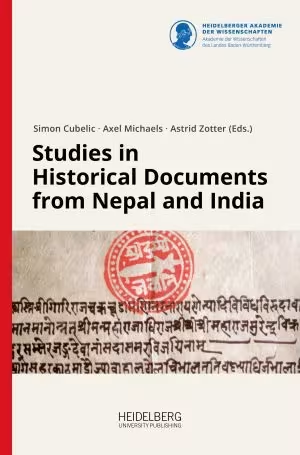
Vol. 1
Simon Cubelic, Axel Michaels, Astrid Zotter (Hrsg.), Studies in Historical Documents from Nepal and India, Heidelberg: Heidelberg University Publishing, 2018 (Documenta Nepalica – Book Series, Vol. 1), DOI: 10.17885/heiup.331.454.
"This volume is the outcome of the conference “Studying Documents in Premodern South Asia and Beyond: Problems and Perspective”, held in October 2015 in Heidelberg. In bringing together experts from different fields—including Indology, Tibetology, History, Anthropology, Religious Studies, and Digital Humanties—it aims at exploring and rethinking issues of diplomatics and typology, the place of documents in relation to other texts and literary genres, methods of archiving and editing documents, as well as their “social life”, i.e. the role they play in social, religious and political constellations, the agents and practices of their use, and the norms and institutions they embody and constitute", 10.17885/heiup.331.454.
Vol. 2
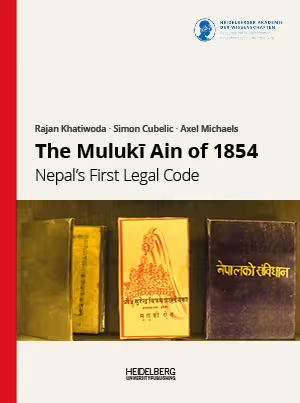
Rajan Khatiwoda, Simon Cubelic, Axel Michaels (Hrsg.), The Mulukī Ain of 1854. Nepal's First Legal Code, Heidelberg: Heidelberg University Publishing, 2021 (Documenta Nepalica – Book Series, Vol. 2), DOI: 10.17885/heiup.769.
"The Mulukī Ain of 1854—the law code with constitutional features drafted at the initiative of Prime Minister Jaṅga Bahādura Rāṇā—is the foundational legal text for modern Nepal. It covers almost every aspect of public, criminal, private and religious law, ranging from the organisation of the state and courts to murder and other delicts, the workings of the caste system and the joint family, matters of purity and penance, customary law, widow-burning and witchcraft. As such, the Mulukī Ain is a unique source not only for the political, social and economic life of 19th-century Nepal, but also for the place of traditional Hindu jurisprudence in South Asian legal cultures", 10.17885/heiup.769.
Vol. 3
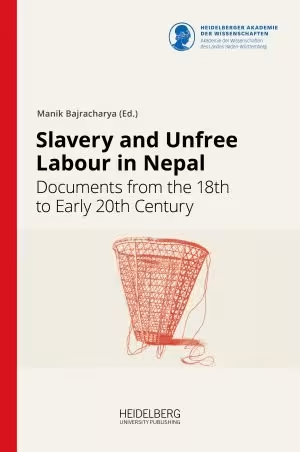
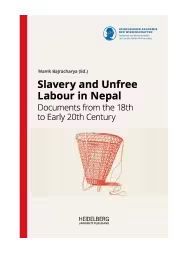
Bajracharya, Manik (Hrsg.), Slavery and Unfree Labour in Nepal: Documents from the 18th to Early 20th Century, Heidelberg: Heidelberg University Publishing, 2022 (Documenta Nepalica – Book Series, Vol. 3), DOI: 10.17885/heiup.1003.
"The topic of slavery is largely under-represented in the historiography of Nepal. This source book, aware of this disparity and wishing to encourage future studies on the topic, provides the reader with editions, translations and a study of selected documents and legal texts of Nepal from the period of the eighteenth to the early twentieth century. These sources are concerned with such different aspects of slavery as donations, transactions, bondservitude, forced labour, emancipation, and law.", 10.17885/heiup.1003.
Vol. 4
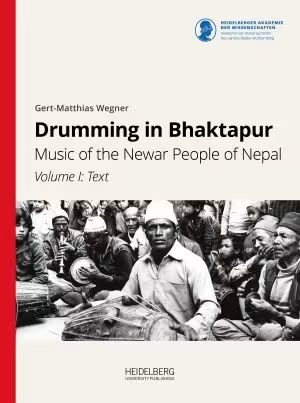
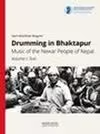
Wegner, Gert-Matthias, Drumming in Bhaktapur: Music of the Newar People of Nepal, Volume I: Text, Volume II: Transcriptions, Heidelberg: Heidelberg University Publishing, 2023 (Documenta Nepalica – Book Series, Vol. 4), DOI: https://doi.org/10.17885/heiup.1246.
"This groundbreaking publication offers a unique resource of information about one of the most glorious and diverse musical cultures of the Himalayas. The numerous drum traditions of Bhaktapur in the Kathmandu Valley are a vibrant aspect of traditional Newar culture that saw its heyday between the thirteenth and eighteenth centuries. The three Malla kingdoms of Bhaktapur, Lalitpur and Kathmandu competed in art, architecture, music, dance and opulent town rituals celebrating the presence of the gods. Music served as a portal between the human world and the realm of the gods.
This study documents the role and repertoires of the different percussion genres in a transcribed and commented form for practical use and as a teaching aid. It also includes a dictionary of Newari terms related to music. As it focuses on the musical life of Bhaktapur during the decade starting from 1983, it could serve as a point of reference for comparison with the present situation. This publication is an outstanding contribution to the preservation of Newar culture.", 10.17885/heiup.1246.
Vol. 5
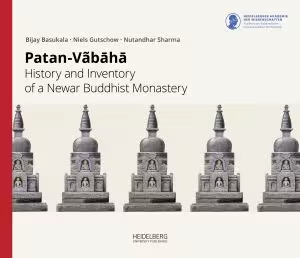
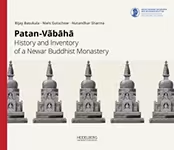
Bijay Basukala, Niels Gutschow, Nutandhar Sharma, Patan-Vãbāhā : History and Inventory of a Newar Buddhist Monastery, Heidelberg: Heidelberg University Publishing, 2022 (Documenta Nepalica – Book Series, Vol. 5), DOI: https://doi.org/10.17885/heiup.1116.
"This volume presents the religious, architectural, and textual background of Vãbāhā, one of the 16 main monasteries of Patan, located in one of the three royal cities of the Kathmandu Valley in Nepal. The history of the Buddhist monastic courtyard and its objects is presented along with 42 inscriptions, dating from 1596 CE to 2021.", 10.17885/heiup.1116.
Vol. 7
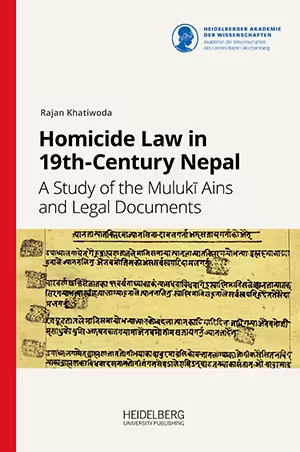
Khatiwoda, Rajan. Homicide Law in 19th-Century Nepal: A Study of the Mulukī Ains and Legal Documents. Heidelberg: Heidelberg University Publishing, 2024 (Documenta Nepalica: Book Series, Vol. 7), DOI: https://doi.org/10.17885/heiup.1276
"The main ambition of this book lies in a detailed analysis of the formation and enforcement of Nepal’s Mulukī Ain of 1854, specifically focusing on the provisions regarding homicide within the Mulukī Ains of 1854 and 1870. This study also examines contemporaneous legal records, revealing the complexities of the Ain’s implementation. The articles on homicide serve as a microcosm illustrating the broader evolution of Nepal’s legal code, which departed from outdated punishments like genital mutilation and introduced fines and imprisonment instead. Still, the innovations introduced into the Ain of 1854 were not uniformly progressive. The Ain in its various stages of development thus showcases the complex ways in which legal systems inevitably undergo transformation.", 10.17885/heiup.1276.
Vol. 8
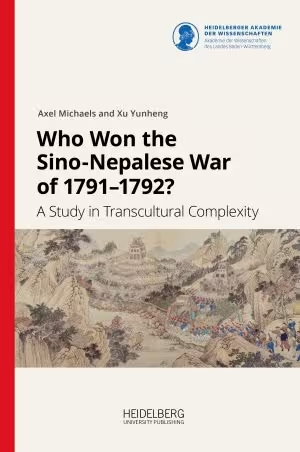
Michaels, Axel, Xu Yunheng. Who Won the Sino-Nepalese War of 1791–1792? A Study in Transcultural Complexity. Heidelberg: Heidelberg University Publishing, 2026 (Documenta Nepalica: Book Series, Vol. 8). https://doi.org/10.17885/heiup.1666
"This book examines the history of the last war between Nepal and China-Tibet in 1791–1792. Drawing on a wealth of newly discovered texts from Nepal, China, and Tibet—many of which have been published and translated for the first time—this volume serves as a handbook on the sources of this Sino-Nepalese war. The focus is on the controversial question of who won the war. In light of the new material, the central thesis is developed that both sides were able to declare themselves the victors without this being strongly contested by the other side. This rare form of ending a war was made possible primarily by the transcultural complexity and the differing interpretations of the key terms used.", 10.17885/heiup.1666.
 heiUP
heiUP
E-Publications
The digitally edited documents are published on the editions’ platform of the research unit. The data is subject to the license CC BY-SA 4.0; for more information, see Terms of Use.
Since February 2017 they have also been obtainable in open access through the Heidelberg University Library; see 'Editions published with DOI'.
Publications by Team Members
2025
Bajracharya, Manik. 2025. Slavery and Unfree Labour in Nepal: Documents from the 18th to Early 20th Century. Kathmandu: Vajra Books Südasiatische Edition.
Bajracharya, Manik, and Rajan Khatiwoda. 2025. "Legitimizing Slavery through Brahmanical Norms: The Ain of 1854." In Provincialising Dharma: Studies on Legal Issues in the Himalaya, edited by Florinda de Simini, Domenico Francavilla, and Axel Michaels, Corpus Iuris Sanscriticum, vol. 10. Turin: Asia Institute Torino.
Bajracharya, Manik. 2025. "Śrīnivāsa Malla and the Identification of Buṅgadyaḥ with Matsyendranāth." Golden Jubilee Commemorative Issue of Bauddha Vihar Sangha, 104–108.
Cubelic, Simon. 2025. "The Code of Tribute: Law and Political Economy in the Ain of 1854." In Provincialising Dharma: Studies on Legal Issues in the Himalaya, edited by Florinda de Simini, Domenico Francavilla, and Axel Michaels, Corpus Iuris Sanscriticum, vol. 10. Turin: Asia Institute Torino.
de Simini, Florinda, Domenico Francavilla, and Axel Michaels, eds. 2025. Provincialising Dharma: Studies on Legal Issues in the Himalaya. Corpus Iuris Sanscriticum, vol. 10. Turin: Asia Institute Torino.
Grujovska, Marija, and Julia Shrestha. 2025. "Conference on Nepal's Transcultural Histories and Foreign Relations at Heidelberg Academy of Sciences and Humanities and Centre for Asian and Transcultural Studies, Heidelberg University, 27–28 May 2024." European Bulletin of Himalayan Research 64.
Khatiwoda, Rajan, and Nirajan Kafle. 2025. "Nepālamā Aupacārika Śikṣā Thālanī Aghiko Śaikṣika Avasthābāre Prakāśa Pārne Pā̃ca Dastāveja." Samāja Adhyayana, no. 20: 247–271.
Khatiwoda, Rajan, and Nirajan Kafle. Forthcoming. Tīnadhārā Pākaśālā: Unnāisauṃ Śatābdīko Śikṣā, Mulukī Kāryānvayana ra Rājanītika Cetanāko Kendra. Studies in Nepali History and Society.
Michaels, Axel. 2025. "Between Love and Power: The Dharma Drama of King Raṇabahādura Śāha (1775–1806)." In Provincialising Dharma: Studies on Legal Issues in the Himalaya, edited by Florinda de Simini, Domenico Francavilla, and Axel Michaels, Corpus Iuris Sanscriticum, vol. 10. Turin: Asia Institute Torino.
Olivelle, Patrick. 2025. Ashoka: Indiens philosophischer Kaiser. Translated by Axel Michaels. Stuttgart: Kröner Verlag.
Sapkota, Devaki. Forthcoming. "Śālagrāma: The Sacred Himalayan Divyadeśam of Śrīvaiṣṇavism." In Reimagining and Reclaiming the Knowledge Traditions of Bharat: Beyond Boundaries and Definitions, conference proceedings, March 3–4, 2025, Jawaharlal Nehru University, New Delhi. New Delhi: Motilal Banarsidass.
Sarawgi, Anjali, Esteban Garces Arias, and Christof Zotter. 2025. "Digitizing Nepal's Written Heritage: A Comprehensive HTR Pipeline for Old Nepali Manuscripts." Preprint, arXiv. https://doi.org/10.48550/ARXIV.2512.17111.
Shrestha, Julia. 2025. "Mundhumi Natak: From Ritual to Resistance." The Commons (Digital Magazine of the Social Science Baha), December 29.
Timalsina, Ramhari. 2025. "The Practice of Levirate in 19th-Century Nepal and the Dharmaśāstric Discussion of Niyoga." In Provincialising Dharma: Studies on Legal Issues in the Himalaya, edited by Florinda de Simini, Domenico Francavilla, and Axel Michaels, Corpus Iuris Sanscriticum, vol. 10. Turin: Asia Institute Torino.
Zotter, Astrid. 2025. "Writing Nibandhas in Nepal." In Provincialising Dharma: Studies on Legal Issues in the Himalaya, edited by Florinda de Simini, Domenico Francavilla, and Axel Michaels, Corpus Iuris Sanscriticum, vol. 10. Turin: Asia Institute Torino.
Zotter, Christof. Forthcoming. "Die Forschungsstelle Religions- und rechtsgeschichtliche Quellen des vor-modernen Nepal." In Editionswissenschaft – Textkritik – Digital Humanities: 25 Heidelberger Editionsprojekte, edited by Isabel Langkabel, Ludger Lieb, Maximiliane Nietzschmann, and Lena Sowada, 119–126. Heidelberg: HeiUP.
2024
Bajracharya, Manik. 2024. "Unfreie Arbeit und Sklaverei in Nepal." Athene – Magazin der HAdW 1/2024: 26–27.
Khatiwoda, Rajan. 2024. Homicide Law in 19th-Century Nepal: A Study of the Mulukī Ains and Legal Documents. Documenta Nepalica: Book Series, 7. Heidelberg: Heidelberg University Publishing.
Khatiwoda, Rajan. 2024. Homicide Law in 19th-Century Nepal: A Study of the Mulukī Ains and Legal Documents. Reprint. Kathmandu: Vajra Books.
Khatiwoda, Rajan, Simon Cubelic, and Axel Michaels. 2024. The "Mulukī Ain" of 1854: Nepal's First Legal Code. Reprint. Kathmandu: Vajra Books.
Michaels, Axel. 2024. Nepal: A History from the Earliest Times to the Present. Oxford: Oxford University Press.
Shrestha, Julia. 2024. "Ein Yams zwischen zwei Felsen? Konferenz zu Nepals Außenbeziehungen am 27. und 28. Mai 2024." Athene – Magazin der HAdW 2/2024: 40–41.
2023
Bajracharya, Manik. Forthcoming. "The Cultural Experience of Newar Buddhism Today." In Buddhism: Introducing the Buddhist Experience, edited by Sarah Jacoby and Donald Mitchell. New York: Oxford University Press.
Michaels, Axel. 2023. Die Autonomie des Rituals: Eine transkulturelle Perspektive. Heidelberger Akademische Bibliothek, 12. Stuttgart: Kröner.
Michaels, Axel. 2023. Der Hinduismus – Geschichte und Gegenwart. New ed. Munich: C. H. Beck.
Wegner, Gert-Matthias. 2023. Drumming in Bhaktapur: Music of the Newar People of Nepal. Vol. 1, Text; Vol. 2, Transcriptions. Documenta Nepalica, 4. Heidelberg: Heidelberg University Publishing.
2022
Bajracharya, Manik, and Axel Michaels. "Introduction." In Slavery and Unfree Labour in Nepal: Documents from the 18th to Early 20th Century, edited by Manik Bajracharya. Heidelberg: Heidelberg University Publishing, 2022.
Cubelic, Simon, Rajan Khatiwoda, and Axel Michaels. "Introduction: Slavery and Unfree Labour in the Ain of 1854." In Slavery and Unfree Labour in Nepal: Documents from the 18th to Early 20th Century, edited by Manik Bajracharya. Heidelberg: Heidelberg University Publishing, 2022.
Timalsina, Ramhari. The Sumatipañjikā: A Commentary on the Cāndravyākaraṇavṛtti 1.1 and 1.4. Pondichéry: Institut Français de Pondichéry / École française d’Extrême-Orient, 2022.
Tittel, Sabine. "Towards an Ontology for Toponyms in Nepalese Historical Documents." In Proceedings of the Workshop on Resources and Technologies for Indigenous, Endangered and Lesser-Resourced Languages in Eurasia within the 13th Language Resources and Evaluation Conference, 7–16. Marseille: European Language Resources Association, 2022.
Zotter, Christof. "Shades of Power: The Nāth Yogīs in Nepal." In The Power of the Nāth Yogīs, edited by D. Bevilacqua and E. Stuparich, 197–226. Amsterdam: Amsterdam University Press, 2022.
2021
Cubelic, Simon. Die koloniale Restauration des Dharmaśāstra. Das Obligationenrecht in Sarvoru Śarmans Vivādasārārṇava: Edition, Kommentierte Übersetzung und Studie der Kapitel ṛṇādānanirūpaṇa und upanidhyādinirūpaṇa. Dissertation, University of Heidelberg, 2021. https://doi.org/10.11588/heidok.00029448.
Michaels, Axel, and Christoph Wulf, eds. Science and Scientification in South Asia and Europe. London and New York: Routledge, 2021.
———. "Kann weltflüchtige Askese innovative Kräfte auslösen? Drei Thesen." In Kreative Impulse und Innovationsleistungen religiöser Gemeinschaften im mittelalterlichen Europa, edited by Julia Becker and Julia Burkhardt, 151–165. Regensburg: Schnell & Steiner, 2021.
———. "The Place of Historical Nepal in the History of South Asian Religions." In Routledge Handbook of South Asian Religions, edited by Knut A. Jacobson, 139–150. London and New York: Routledge, 2021.
Michaels, Axel, et al. "Studying, Documenting, and Teaching Nepal’s Cultural Heritage." The Newsletter 90 (2021): 25–26. https://www.iias.asia/the-newsletter/newsletter-90-autumn-2021.
Zotter, Astrid. "Who Kills the Buffalo? Authority and Agency in the Ritual Logistics of the Nepalese Dasaĩ Festival." In Nine Nights of Power: Durgā, Dolls, and Darbārs, edited by U. Hüsken, V. Narayanan, and A. Zotter, 193–220. New York: State University of New York Press, 2021.
Hüsken, Ute, Vasudha Narayanan, and Astrid Zotter, eds. Nine Nights of Power: Durgā, Dolls, and Darbārs. New York: State University of New York Press, 2021.
———. "Nine Nights of Power: Durgā, Dolls, and Darbārs: An Introduction." In Nine Nights of Power: Durgā, Dolls, and Darbārs, edited by U. Hüsken, V. Narayanan, and A. Zotter, 1–13. New York: State University of New York Press, 2021.
2020
Michaels, Axel. "Mathematics and Vedic Mathematics." In Science and Scientification in South Asia and Europe, edited by Axel Michaels and Christoph Wulf, 57–68. London and New York: Routledge, 2020.
———. "South Asia and Southeast Asia." In Making Civilizations: The World before 600, edited by H.-J. Gehrke, 867–1023. Cambridge, MA: Belknap Press of Harvard University Press, 2020.
———, with Christiane Brosius. "Vernacular Heritage as Urban Place-Making: Activities and Positions in the Reconstruction of Monuments after the Gorkha Earthquake in Nepal, 2015–2020: The Case of Patan." Sustainability 12, no. 20 (2020).
———, ed., with Christoph Wulf. Science and Scientification in South Asia and Europe. London and New York: Routledge, 2020.
Zotter, Astrid. "Bells, Auspiciousness and the God of Music: Reflections on Sound in Ritual Space in Nepalese Hindu Traditions." In Worship Sound Spaces: Architecture, Acoustics and Anthropology, edited by C. Guillebaud and C. Lavandier, 122–139. London and New York: Routledge, 2020.
Zotter, Christof. "The Pragmatic End of Scholasticism: Ritualists and Their Textual Tradition." In Les scolastiques indiennes: Genèses, développements, interactions, edited by G. Colas and É. Aussant, 239–250. Paris and Pondicherry: École française d’Extrême-Orient, 2020.
2019
Cubelic, Simon. "Sarvoru Śarman’s Vivādasārārṇava (1789) and the Formation of Sanskritic Legal Knowledge in Early Colonial Bengal." In Reinterpreting Indology and Indian History: Institutions, Intentions, Sources and Issues, edited by Radha Madhav Bharadwaj, 102–119. Delhi: Pratibha Prakashan, 2019.
Michaels, Axel, ed., with Margareta Pavaloi. The Scholar’s Choice: Lieblingsstücke Heidelberger Wissenschaftler aus dem Völkerkundemuseum der J. und E. von Portheim-Stiftung. Heidelberg: heiUP, 2019.
———. "Lost in Transhimalayan Transculturality: Opium, Horses and an Englishman between China, Tibet and Nepal." In China and the World – the World and China: Essays in Honor of Rudolf G. Wagner, edited by B. Mittler et al., 79–88. Gossenberg: Ostasien Verlag, 2019.
———. "Sklaverei in Nepal." In Jahrbuch 2018, 38–40. Heidelberg: Heidelberger Akademie der Wissenschaften, 2019.
———. "Repetition and Reenactments in Rituals." In Repetition, Recurrence, Returns: How Cultural Renewal Works, edited by J. R. Resina and C. Wulf, 19–31. Lanham: Lexington Books, 2019.
———. "Cultural Hybridity and Transculturality." In Engaging Transculturality: Concepts, Key Terms, Case Studies, edited by L. Abu-Er-Rub et al., 3–14. London and New York: Routledge, 2019.
Plachta, Nadine, and Subas Tamang. "Labor Geographies: Uneven Infrastructures in Nepal’s Rana Period." Roadsides 2 (2019). https://doi.org/10.26034/roadsides-2019008.
Zotter, Astrid. "Papier ist geduldig." In Jahrbuch der Heidelberger Akademie der Wissenschaften, 95–100. Heidelberg, 2019.
———. "Rezension: Demoting Vishnu: Ritual, Politics, and the Unraveling of Nepal’s Hindu Monarchy, by Anne T. Mocko." Journal of the American Oriental Society 139, no. 3 (2019): 770–772.
2018
Bajracharya, Manik. "Munsīs in the Courts of Early Śāha and Rāṇā Rulers: The Career of Lakṣmīdāsa Pradhāna." In Studies in Historical Documents from Nepal and India, edited by Simon Cubelic, Axel Michaels, and Astrid Zotter, 377–398. Heidelberg: Heidelberg University Publishing, 2018.
Cubelic, Simon. "Governing Economic Life in Rāṇā Nepal: The Tender Process for the Gambling License at the Market Square of Asan in 1902." In Studies in Historical Documents from Nepal and India, edited by Simon Cubelic, Axel Michaels, and Astrid Zotter, 293–327. Heidelberg: Heidelberg University Publishing, 2018.
———. "Rezension zu: Otter, Felix: Die Revitalisierung von Vāstuvidyā im kolonialen und nachkolonialen Indien. Heidelberg 2016." H-Soz-Kult, July 6, 2018. <www.hsozkult.de/publicationreview/id/rezbuecher-26996>.
Cubelic, Simon, Axel Michaels, and Astrid Zotter, eds. Studies in Historical Documents from Nepal and India. Heidelberg: Heidelberg University Publishing, 2018. Nepalese edition: Kathmandu: National Archives, Nepal, 2018.
———. "Studying Documents of South Asia: An Introduction." In Studies in Historical Documents from Nepal and India, 1–33. Heidelberg: Heidelberg University Publishing, 2018.
Khatiwoda, Rajan. "Documented Evidence Relating to the Implementation of the Mulukī Ain in Mid-19th Century Nepal." In Studies in Historical Documents from Nepal and India, edited by Simon Cubelic, Axel Michaels, and Astrid Zotter, 243–269. Heidelberg: Heidelberg University Publishing, 2018.
Michaels, Axel. Kultur und Geschichte Nepals. Stuttgart: Kröner, 2018.
———. "Are Hindu Women Allowed to Establish a Śivaliṅga? A Question Asked in a Letter to Jaṅga Bahādura Rāṇā, Dated 1843 CE." In Studies in Historical Documents from Nepal and India, edited by Simon Cubelic, Axel Michaels, and Astrid Zotter. Heidelberg: Heidelberg University Publishing, 2018.
———. "Rites of Passage: Saṃskāras." In The Oxford History of Hinduism: Hindu Law, edited by Patrick Olivelle and Donald R. Davis, 86–97. New York: Oxford University Press, 2018.
———, ed., with Christoph Wulf. Images of the Body in India. London: Routledge, 2018.
Zotter, Astrid. "What Durgā, Which Navarātra? Remarks on Reconfigurations of Royal Rituals in the Kathmandu Valley." In Nine Nights of the Goddess: Navarātri in South Asia and Beyond, edited by M. Sen, C. Simmons, and H. P. Rodrigues, 39–62. New York: SUNY, 2018.
———. "Conquering Navarātra: Documents on the Reorganisation of a State Festival." In Studies in Historical Documents from Nepal and India, edited by Simon Cubelic, Axel Michaels, and Astrid Zotter, 493–531. Heidelberg: Heidelberg University Publishing, 2018.
Zotter, Christof. Asketen auf Zeit: Das brahmanische Initiationsritual der Bāhun und Chetrī im Kathmandu-Tal. Heidelberg: CrossAsia, 2018.
———. "Ascetics in Administrative Affairs: Documents on the Mahantamaṇḍalāī." In Studies in Historical Documents from Nepal and India, edited by Simon Cubelic, Axel Michaels, and Astrid Zotter, 446–491. Heidelberg: Heidelberg University Publishing, 2018.
———. "Vedisches Übungswissen: Schülerschaft und Ritual in der brahmanischen Tradition." In Übungswissen in Religion und Philosophie: Produktion, Weitergabe, Wandel, edited by Almut-Barbara Renger and Alexandra Stellmacher, 225–239. Berlin: Lit Verlag, 2018.
2017
Bajracharya, Manik, Simon Cubelic, and Rajan Khatiwoda. "Reporting across Borders in a Time of Turmoil: Eight Reports from Lokaramaṇa Upādhyāya from the Years 1837–1844." Abhilekha 34 (2017): 138–172.
Bajracharya, Manik, and Axel Michaels. "Religious Approaches to Heritage Restoration in Post-Earthquake Kathmandu." Material Religion 13, no. 3 (2017): 379–381. https://doi.org/10.1080/17432200.2017.1335085.
Cubelic, Simon, and Rajan Khatiwoda. "Nepalese Monarchy in an Age of Codification: Kingship, Patriotism, and Legality in the Nepalese Code of 1854." In Transnational Histories of the ‘Royal Nation’, edited by Milinda Banerjee, Charlotte Backerra, and Cathleen Sarti, 67–86. Cham: Palgrave Macmillan, 2017.
Michaels, Axel. "Rituals." In Hinduism in India: The Early Period, edited by Greg Bailey, 27–59. Los Angeles: Sage, 2017.
———. "Macht und Autorität in der hinduistischen Priestersukzession: Das Beispiel des Pasupatinatha-Tempels in Nepal." In Sukzession in Religionen: Autorisierung, Legitimierung, Wissenstransfer, edited by Almut-Barbara Renger and Markus Witte, 535–549. Berlin and Boston: De Gruyter, 2017.
———. Paśupatikṣetra: A Historical Inventory. With Govinda Tandon. Kathmandu: Himal Books, 2017.
Zotter, Astrid. "Königliche Rituale ohne König: Zur Selbstrepräsentation des nepalischen Staates zwischen Monarchie und Demokratie." Religionen unterwegs 23, no. 1 (2017): 4–9, 16.
———. "Review of Roots of Wisdom, Branches of Devotion: Plant Life in South Asian Traditions, edited by Fabrizio M. Ferrari and Thomas Dähnhardt." South Asia: Journal of South Asian Studies (2017). https://doi.org/10.1080/00856401.2017.1379235.
2016
Bajracharya, Manik, Simon Cubelic, and Rajan Khatiwoda. "Reporting across Borders: Four Reports of Lokaramaṇa Upādhyāya from the Years 1831–1837." Abhilekha 33 (2016): 120–133.
Bajracharya, Manik, and Axel Michaels. Nepālikabhūpa-Vaṃśāvalī / History of the Kings of Nepal: A Buddhist Chronicle. 3 vols. Kathmandu: Himal Books, 2016.
Cubelic, Simon, and Astrid Zotter. "Report on the International Conference ‘Studying Documents in Pre-modern South Asia and Beyond: Problems and Perspectives’." European Bulletin of Himalayan Research 47 (2016): 96–98.
Michaels, Axel. Homo ritualis: Hindu Rituals and Its Significance for Ritual Theory. Oxford: Oxford University Press, 2016.
———. "Blood Sacrifice in Nepal: Transformations and Criticism." In Religion, Secularism, and Ethnicity in Contemporary Nepal, edited by David N. Gellner, Sondra Hausner, and Chiara Letizia, 192–225. Delhi: Oxford University Press, 2016.
———. "Kulturelles Erbe in Katastrophen: Nepal und seine Erdbeben." In Jahrbuch 2015, 78–80. Heidelberg: Heidelberger Akademie der Wissenschaften, 2016.
Michaels, Axel, et al. "Nepalese History in a European Experience: A Case Study in Transcultural Historiography." History and Theory 55, no. 2 (2016): 210–232.
Zotter, Astrid. "The Making and Unmaking of Rulers: On Denial of Ritual in Nepal." In The Ambivalence of Denial: Danger and Appeal of Rituals, edited by Ute Hüsken and Udo Simon, 221–255. Wiesbaden: Harrassowitz, 2016.
———. "State Rituals in a Secular State? Replacing the Nepalese King in the Pacali Bhairava Sword Procession and Other Rituals." In Religion, Secularism, and Ethnicity in Contemporary Nepal, edited by David N. Gellner, Sondra Hausner, and Chiara Letizia, 265–301. Delhi: Oxford University Press, 2016.
———. "Sag mir, wo die Blumen sind: Zur Identifikation von Pflanzennamen in nepalischen Ritualtexten." Zeitschrift der Deutschen Morgenländischen Gesellschaft 166, no. 2 (2016): 397–424.
Zotter, Christof. "The Cremation Ground and the Denial of Ritual: The Case of the Aghorīs and Their Forerunner." In The Ambivalence of Denial: Danger and Appeal of Rituals, edited by Ute Hüsken and Udo Simon, 43–79. Wiesbaden: Harrassowitz, 2016.
———. "The Bonds of the Liberated: On Community among Hindu Ascetics." In Potency of the Common: Intercultural Perspectives about Community and Individuality, edited by Gert Melville and Carlos Ruta, 239–254. Boston and Berlin: De Gruyter, 2016.
2015
Bajracharya, Manik, Rajan Khatiwoda, and Axel Michaels. "Six 19th–20th Century Documents on Elephants from the National Archives of Nepal." Abhilekha 32 (2015): 96–105.
Bajracharya, Manik, Niels Gutschow, and Axel Michaels. Nepālikabhūpa-Vaṃśāvalī: History of the Kings of Nepal: A Buddhist Chronicle. Kathmandu: Himal Books, 2015/16.
Michaels, Axel. "Perspektiven und Probleme der deutschsprachigen Indologie." In Geisteswissenschaften heute: Die Sicht der Fächer, edited by D. Lamping, 282–306. Stuttgart: Kröner, 2015.
Zotter, Christof. "Ritual Text in Hindu Initiation." In Musical Text as Ritual Object, edited by H. Schulze, 25–37. Brussels: Brepols, 2015.
2014
Michaels, Axel, ed., with Christoph Wulf. Exploring the Senses. London, New York, and New Delhi: Routledge, 2014.
———. "Untouchability and Tactility in Hindu Death Rituals." In Exploring the Senses, edited by Axel Michaels and Christoph Wulf, 206–220. London, New York, and New Delhi: Routledge, 2014.
———. "Heilige Ehefrauen und gefährliche Witwen: Der Status von Frauen im vormodernen Hindu-Recht." In Religionsfreiheit und Gleichberechtigung der Geschlechter: Spannungen und Konflikte, edited by Juliane Kokott and Ute Mager, 91–102. Tübingen: Mohr Siebeck, 2014.
Zotter, Astrid, with Lars Bednorz. Hinduismus: Arbeitsheft mit CD-ROM. Stuttgart: Klett, 2014.
———. "Scent of a Flower: Notes on Olfaction in Hindu Worship." In Exploring the Senses, edited by Axel Michaels and Christoph Wulf, 187–205. London, New York, and New Delhi: Routledge, 2014.
The database development and the publication of the documents are realized in cooperation with the National Archives of Nepal (Rashtriya Abhilekhalaya, Kathmandu). Cataloguing and digitization are carried out in coordination and close cooperation with the German Oriental Society (Deutsche Morgenländische Gesellschaft, DMG) and the Oriental Department of the Berlin State Library (Orientabteilung der Staatsbibliothek zu Berlin, SBB).
The project's cooperation partners also include the Heidelberg South Asia Institute, which ensures the administrative and spatial integration of the workplaces in Heidelberg and Patan (Nepal); furthermore, the Heidelberg University Library provides the platform Heidelberg Historic Literature Digitized (DWork) used for the publication of the project's digital editions. This platform can also be used for the necessary dissemination of the project’s results within the scientific community, in particular with respect to digital resources (e.g. CrossAsia).
The research project cooperates with the Nepal Heritage Documentation Project (NHDP, Heidelberg) and takes part in the initiative Heidelberger Forum Edition.



Deutsche Morgenländische Gesellschaft

Nepal Heritage Documentation Project


Universitätsbibliothek Heidelberg
Weitere Web Resources
Centre for Asian and Transcultural Studies (CATS), Heidelberg
Department of Archaeology Nepal
Heidelberg University - Digital Editions
Kathmandu Valley Preservation Trust (KVPT)
Nepal-German Manuscript Cataloguing Project (NGMCP), Hamburg
Nepalese Manuscripts Return Home After Conservation in Heidelberg
More than 800 rare documents from Nepal—some dating back to the 13th century—have been formally returned to the country after years of conservation and research work in Germany.
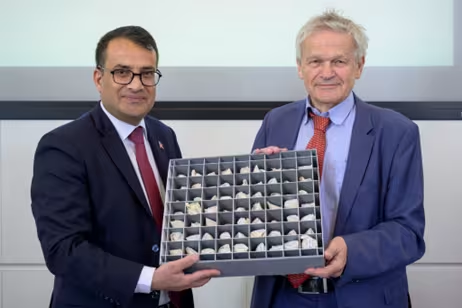
The collection, assembled by Bavarian collector Josef Peter Walter Rindfleisch between 1980 and 2000, had been entrusted to the Indologist Prof. Dr. Axel Michaels of Heidelberg University with the explicit aim of eventual repatriation. On 24 April 2026, representatives of the Nepali government officially received the materials at a ceremony in Heidelberg. The agreement was signed by Sagar Phuyal, chargé d’affaires a.i. of Nepal’s embassy in Berlin and Prof. Dr. Axel Michaels.
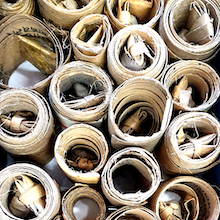
Scholars say the holdings are likely one of the largest collections of Nepalese palmleaf rolls outside Nepal. At its core are 465 Newari palm-leaf rolls, most of them bearing clay seals and dating to the medieval Malla period (c. 1200–1800). The archive also includes royal decrees, court records, Sanskrit manuscripts, and a wide range of historical materials—from legal documents and ritual texts to photographs, maps, and personal writings. Fifteen bound volumes in the collection document palace life, state expeditions, and official correspondence from the 19th and early 20th centuries.
“This collection offers a unique window into Nepal’s political, legal, and religious history across several centuries,” said Michaels, who heads the project “Documents on the History of Religion and Law of Pre-modern Nepal” at the Heidelberg Academy of Sciences and Humanities.
When the manuscripts first arrived in Heidelberg, their provenance was only partially documented, and many items were in poor condition. Mold, insect damage, and earlier repair attempts had left visible traces. Conservation specialists carried out extensive restoration work: fragile palm-leaf scrolls were humidified, carefully opened, cleaned, repaired, and digitized before being rolled again and placed in acid-free archival storage.
The project received support in 2022 from the Flagship Initiative “Transforming Cultural Heritage” (FI TCH), enabling systematic cataloguing and digitization. Today, the collection is accessible online via Heidelberg University Library and integrated into the Documenta Nepalica research database. An open access cataogue of metadata of the collection will soon be released from Heidelberg University Publishing.
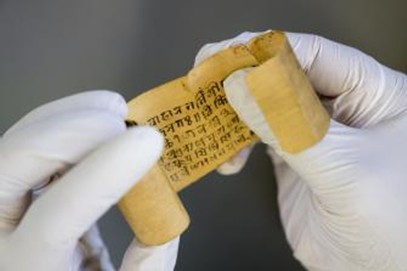
As part of the handover event, Dr. Manik Bajracharya and Dr. Rajan Khatiwoda offered insights into the collection. Both are leading scholars in the research project “Documents on the History of Religion and Law of Pre-modern Nepal,” based at the Heidelberg Academy of Sciences and Humanities. Prof. Dr. Christiane Brosius, a researcher at the Heidelberg Center for Transcultural Studies, presented the “Nepal Heritage Documentation Project”, which systematically records endangered cultural assets in Nepal—such as temples, monasteries, palaces, and inscriptions—and makes them digitally accessible. Welcoming remarks were delivered by Prof. Dr. Marc-Philippe Weller, Vice-Rector for International Affairs and Diversity, and Prof. Dr. Hans Harder, Director of the South Asia Institute.
Receiving the manuscripts, CDA a.i. Mr. Phuyal expressed sincere appreciation to Professor Dr. Michaels and all individuals involved in the preservation and repatriation process. He highlighted that this gesture reflects a deep respect for Nepal’s cultural heritage and contributes significantly to the country’s ongoing efforts to recover and safeguard its historical assets.
For Michaels, the dual approach—digital access and physical return—was essential. “Making the materials available worldwide is one goal,” he said. “But returning them to Nepal is equally important. It acknowledges their cultural significance and our responsibility toward their history.”
With the handover, a substantial body of Nepal’s written heritage will be returned home – preserved for future generations, yet accessible to researchers around the world.
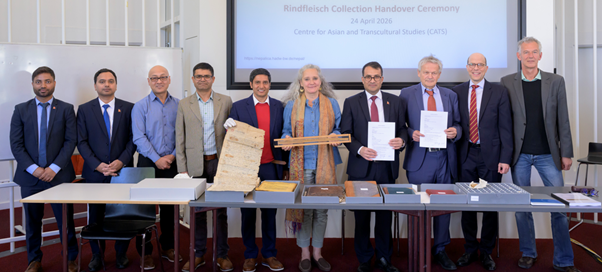
Ranjan Yadav (1st Secretary), Dipendra Sah (3rd Secretary),* Dr. Mani Bajracharya, *Dr. Ramhari Timalsina, *Dr. Rajan Khatiwoda, Prof. Christiane Brosius (Director Nepal Heritage Documentation Project), Chargé d’Affaires a.i. Sagar Phuyal, *Prof. Axel Michaels, Prorektor Marc-Philippe Weller, Prof. Hans Harder (Director South Asia Institute) – Ⓒ Philipp Rothe
* Members of the Nepal Research Unit at Heidelberg Academy of Sciences and Humanities
 Philipp Rothe
New Volume in the Series "Documenta Nepalica"
DOCUMENTA NEPALICA VOL. 8
Michaels, Axel, Xu Yunheng. Who Won the Sino-Nepalese War of 1791–1792? A Study in Transcultural Complexity. Heidelberg: Heidelberg University Publishing, 2026 (Documenta Nepalica: Book Series, Vol. 8). https://doi.org/10.17885/heiup.1666
heiUP
Exhibition “Buṅgadyaḥ: The Rain-Making God”
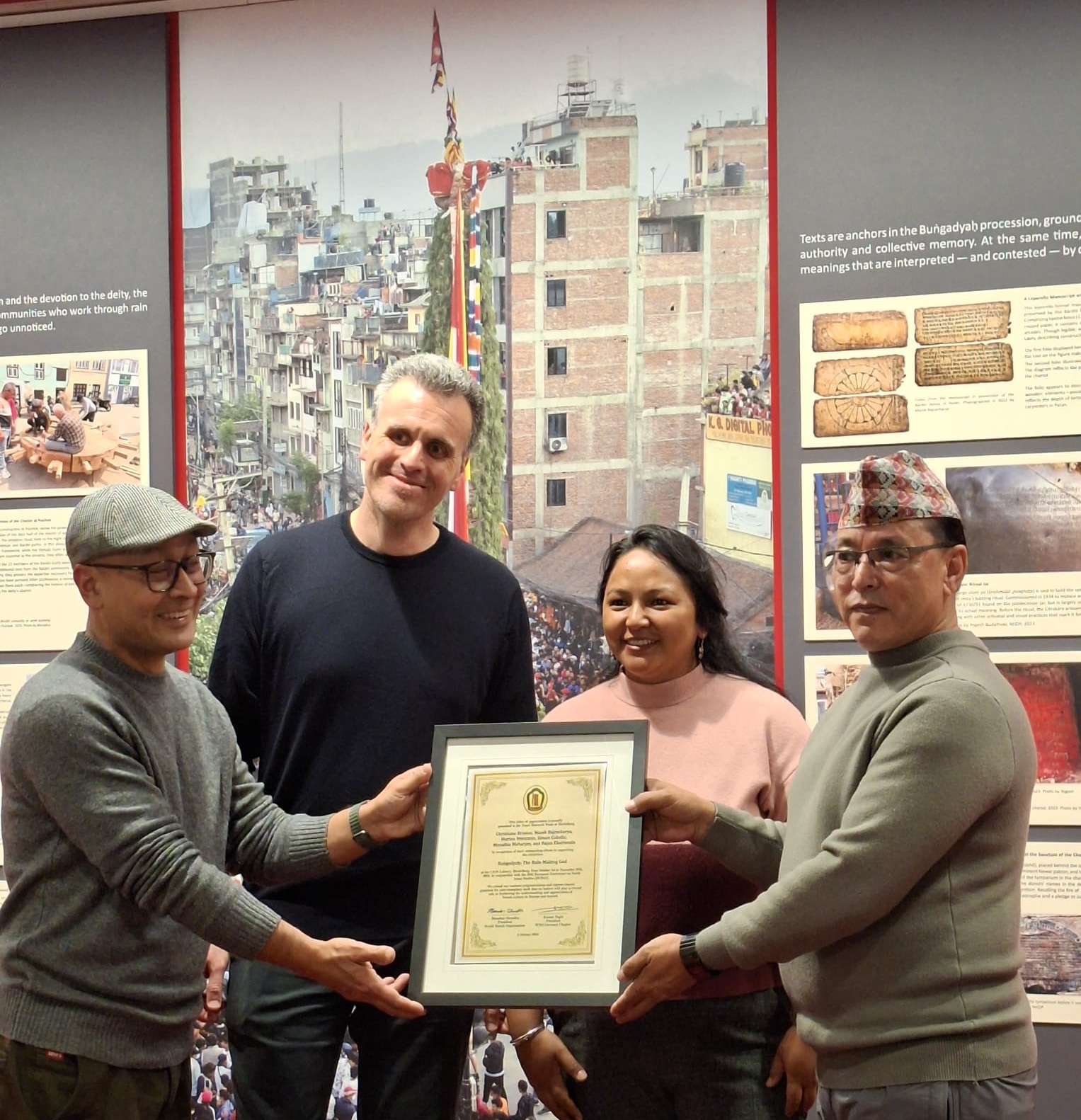
On October 4, 2025, the World Newah Organization—a diaspora organization of the Newar people from Nepal registered in Baltimore, USA—presented the Nepal Research Group team with an award in recognition of the exhibition co-curated by the research center “Buṅgadyaḥ: The Rain-Making God” in the CATS Library.
Kumar Napit, President of the German section of the World Newah Organization, and Bishnu Malla, a renowned artist from Nepal, presented the certificate on behalf of the World Newah Organization. In doing so, he expressed their gratitude to the curatorial team—comprising Prof. Christiane Brosius, Dr. Manik Bajracharya, Dr. Marion Wettstein, Prof. Simon Cubelic, Dr. Monalisa Maharjan, and Dr. Rajan Khatiwoda—for promoting understanding and appreciation of Newar culture in Germany and throughout Europe. He also reaffirmed the diaspora community’s commitment to supporting the research group’s activities.
The exhibition focuses on the procession of Buṅgadyaḥ (Rāto Matsyendranātha), one of the largest and most elaborate ritual events in the Kathmandu Valley and a defining element of Newar culture. It explores the procession through four interwoven themes: places, people, texts, and performances, each of which offers insights into the cultural and ritual vitality of this tangible and intangible heritage. The exhibition opened in conjunction with the 28th European Conference on South Asian Studies (ECSAS) and will run through November 25, 2025.
PPresentations at the European Conference for South Asian Studies, Heidelberg
The 28th European Conference for South Asian Studies (ECSAS) took place in Heidelberg from October 1 to 4, 2025. Staff members from the research project contributed to the conference with a panel discussion and presentations. Manik Bajracharya, Nirajan Kafle, and Rajan Khatiwoda chaired the panel “Hinduisation and Sanskritisation in the Himalayas,” which featured presentations by Alessandro Giudice, Arik Moran, Astrid Zotter, Devaki Sapkota, Pradip Ghimire, Nirajan Kafle, Manik Bajracharya & Rajan Khatiwoda, and Monalisa Maharjan.
In addition, Christof Zotter and Julia Shrestha presented papers in other panels. For her paper (“Mundhumi Natak – The Limbu Oral Tradition in Contemporary Nepali Theatre”), Julia Shrestha received this year’s EASAS Research Student Award, which is given to outstanding doctoral student papers presented at the conference.
The research project also showcased its publications at a book booth at the conference.
Presentations at the Newah Academic Conference on Culture and Heritage, SOAS University of London
On September 13, 2025, Shobhit Shakya, Manik Bajracharya, and Rajan Khatiwoda presented at the Newah Academic Conference on Culture and Heritage (NACCH) at SOAS University of London. Their presentations were titled “Newars and Their Heritage: From Heritage Mentality to Ecological Approach to Heritage?” (Shakya) and “Challenges and Opportunities in Documenting the Tangible and Intangible Heritage of the Kathmandu Valley” (Bajracharya and Khatiwoda).
Welcome Dr. Shobhit Shakya
The Research Project welcomes Dr. Shobhit Shakya as a new member of the team. As part of the Research Project, he is conducting a postdoctoral project on traditional institutions in Nepal, their role in historical governance, and their development over the course of history. Shobhit holds a PhD in Public Administration from the Ragnar Nurkse Department of Innovation and Governance at Tallinn University of Technology in Estonia. His research focuses on perspectives from non-Western governance, with a particular emphasis on the Himalayan region, and explores topics such as Buddhist governance principles, digitality, and civic engagement. He has conducted extensive research on the Guthi institution in Nepal from the perspective of local governance. Shobhit is also an Honorary Research Fellow at the Institute for Innovation and Public Purpose at University College London, UK, and Editor-in-Chief of the journal Halduskultuur – The Estonian Journal of Administrative Culture and Digital Governance.

Dr. Shobhit Shakya
Presentations at the 14th International Indology Graduate Research Symposium, Toyo University, Japan
On December 7, 2024, Marija Grujovska and Julia Shrestha presented their research findings on documents from the Documenta Nepalica corpus at the 14th International Indology Graduate Research Symposium (IIGRS) at Toyo University in Tokyo, Japan. Their presentations were titled: “The Daily and Occasional Worship Trust of Tripureśvara Temple” (Marija Grujovska) and “‘May We Obtain nagarās?’—Insights into the Socio-Political Roles of nagarā Kettledrums among the Limbu Indigenous Group from 19th-Century Nepalese Documents” (Julia Shrestha).
Book Presentation: *Homicide Law in 19th-Century Nepal* by Dr. Rajan Khatiwoda, Kathmandu
On November 10, 2024, Dr. Rajan Khatiwoda presented his book Homicide Law in 19th-Century Nepal: A Study of the Muluki Ains and Legal Documents (Heidelberg University Publishing, Documenta Nepalica: Book Series, Vol. 7, 2024) at the Martin Chautari Institute in Kathmandu. The occasion marked the publication of the South Asian edition of the book by Vajra Books. This edition is intended to make the work accessible to a wider audience in Nepal and South Asia.
Prof. Triratna Manandhar of Tribhuvan University (Kathmandu) and Shubhanga Pandey, a doctoral candidate at the University of California (Los Angeles), enriched the event with their contributions.
SAI Kathmandu
Joint Lecture Series, Yala Maya Kendra, Patan
On October 21, 2024, the Research Department, in collaboration with the Martin Chautari Institute, the South Asia Institute Kathmandu Branch, and the Nepal Heritage Documentation Project, organized a joint lecture series to discuss and exchange information on ongoing research projects and infrastructure. The program took place at the Yala Maya Kendra in Patan, Nepal, and included a session led by Dr. Manik Bajracharya titled “Documenta Nepalica: A Digital Research Environment for the Study of Nepal’s Historical Documents,” in which Dr. Bajracharya presented the research unit’s digital infrastructure and its applications for the study of Nepal’s historical documents. Dr. Rajan Khatiwoda presented on: Digital Preservation of Tangible and Intangible Cultural Heritage in the Kathmandu Valley. Pratyoush Onta and Devendra Uprety gave a presentation on: History of Public School Education in Nepal during the Long 20th Century: Non-State-Centered Perspectives and Examples.
Book Presentation: The Mulukī Ain of 1854 – Nepal's First Legal Code, Kathmandu
On August 16, 2024, The Mulukī Ain of 1854 – Nepal's First Legal Code by Simon Cubelic, Rajan Khatiwoda, and Axel Michaels was presented at an event organized by the Kathmandu branch of the Institute of South Asian Studies at Heidelberg University. Originally published in 2021 by Heidelberg University Publishing as part of the Documenta Nepalica book series, the book has now been reissued by Vajra Publications to make it accessible to a wider audience in Nepal and South Asia.
The event began with a presentation of the book by Dr. Rajan Khatiwoda, followed by remarks from Prof. Prayag Raj Sharma and a lively discussion among the participants.
https://kathmandupost.com/books/2024/07/27/english-translation-of-muluki-ain-1854-published
Prof. Axel Michaels' New Book
On July 20, 2024, Prof. Axel Michaels published *Nepal: A History from the Earliest Times to the Present* (Oxford University Press, 2024).
This book traces the history of Nepal’s cultural, religious, and sociopolitical diversity as a landlocked nation between India and China (Tibet)—a country with 125 recognized ethnic groups, 123 languages, and a wealth of religions, textual and art-historical traditions, and diverse political power centers.
The focus is on a transcultural history of the region that takes into account diverse political claims and forms of organization, multiple and fluid identities, as well as cross-border transcultural, transreligious, and economic interconnections.
A central theme running through the book is the question of how the country’s major challenges—including social conflicts, nationalization, infrastructure, education, migration, divided forms of governance, and political instability—can be addressed without jeopardizing its impressive ethnic and cultural diversity.
Michaels, Axel. 2024. Nepal: A History from the Earliest Times to the Present. New York: Oxford University Press https://academic.oup.com/book/56088
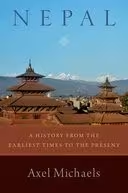
History from the Earliest Times to the Present (Oxford University Press, 2024)
Presentations at the 3rd German South Asia Day in Leipzig
On June 29, 2024, Marija Grujovska and Julia Shrestha gave presentations as part of the 3rd German South Asia Day (June 28–29) at the University of Leipzig. Their presentations were titled “Royal Land Endowments in 19th-Century Nepal” (Marija Grujovska) and “The Yuma Mundhum: An Oral Text about the Limbu Grandmother Goddess from Eastern Nepal” (Julia Shrestha).
Welcome Julia Shrestha
The Research Project warmly welcomes Julia Shrestha as its new research associate. Julia holds a master’s degree in South Asian Studies with a focus on anthropology from Heidelberg University. She is currently working on her doctoral dissertation at the University of Vienna on the topic of Yuma Mundhum—an ethnographic study of the oral textual traditions surrounding the Limbu grandmother deity Yuma. Her research interests lie in the anthropology of written and oral texts, religion and ritual, and critical studies of ethnicity in the context of Nepal. At the Research Project, she is editing documents on the history of eastern Nepal and documents that shed light on the construction of ethnicity and the relationships between the local population and the state.

Julia Shrestha
Farewell to Dr. Simon Cubelic
The Research Project warmly bids farewell to Dr. Simon Cubelic, who was appointed Deputy Head of the South Asia Department at the Library of the Centre for Asian and Transcultural Studies (CATS) in June 2024. Simon Cubelic has been a valued colleague of ours as a research associate since the Research Project was founded in 2014. In addition, he has served as a research librarian at the CATS Library since 2020. Simon will remain connected to the Research Project as an associate member in his new role. We sincerely thank Simon for his many years of service, congratulate him on his new position, and wish him all the best for his future career.

Dr. Simon Cubelic
Conference: “A Yam between Two Rocks”: Transcultural Histories of Nepal’s Relations with India, China, and Tibet.
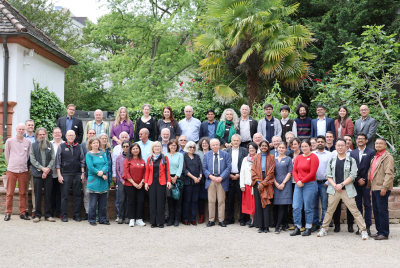
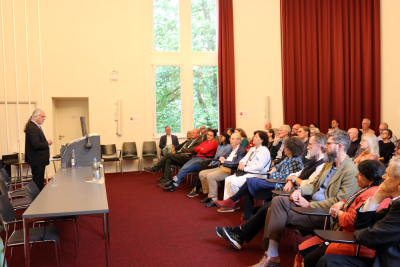
On May 27 and 28, 2024, the Research Project, in collaboration with the Nepal Heritage Documentation Project (Heidelberg Center for Transcultural Studies, Heidelberg Academy of Sciences), organized a conference that examined Nepal’s transcultural relations with its neighbors India, China, and Tibet, while also honoring Axel Michaels on the occasion of his 75th birthday. By addressing the theme of transculturality in the Nepalese context, the conference shed light on a central theme in Prof. Michaels’ scholarly work.
Four panels brought together presentations on topics that examined historical and contemporary transregional relationships and dynamics, global interconnections, and the crossing of boundaries in the realms of material culture, religion, and social relations. The keynote address, “A yam or a sausage? Elastic boundaries, internal exotica, and other features in the slow coagulation of a nation,” by Prof. Charles Ramble, critically examined King Pṛthvīnārāyaṇa Śāha’s image of Nepal as a “yam root between two rocks” and provocatively contrasted it with the sausage as an alternative metaphor for Nepal’s nation-building.
The conference concluded with a presentation of Prof. Michaels’ newly published book, *Nepal: A History from the Earliest Times to the Present* (Oxford University Press, 2024), which was introduced by Prof. David Gellner.


New Volume in the Series "Documenta Nepalica"
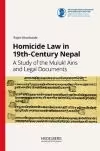
DOCUMENTA NEPALICA VOL. 7
Khatiwoda, Rajan. Homicide Law in 19th-Century Nepal: A Study of the Mulukī Ains and Legal Documents. Heidelberg: Heidelberg University Publishing, 2024 (Documenta Nepalica: Book Series, Vol. 7). https://doi.org/10.17885/heiup.1276
 heiUP
heiUP
Lecture by Dr. Manik Bajracharya, University of California, Berkeley
On March 9, 2024, Dr. Manik Bajracharya gave a lecture as part of a conference on the origins and development of Newar Buddhism at the University of California, Berkeley. The title of his lecture was: “Royal Patronage of the Cult of Bungama-Lokeshvara under King Srinivasa Malla.”
On March 10, 2024, Dr. Bajracharya led a workshop during the same conference on the digital infrastructures of Documenta Nepalica and the NHDP.
Lecture by Dr. Manik Bajracharya, University of Bonn
On February 19, 2024, Dr. Manik Bajracharya delivered a lecture as part of the Joseph C. Miller Memorial Lecture Series at the Bonn Center for Dependency and Slavery Studies at the University of Bonn. The title of his lecture was: “Slavery in Eighteenth- and Nineteenth-Century Nepal.”
The lecture addressed slavery and other forms of bonded labor in 18th- and 19th-century Nepal, examining their typology, the role of slaves in the social order, and the processes of enslavement and emancipation.
Lecture by Prof. Axel Michaels, Museum of Ethnology, Heidelberg
On February 9, 2024, Prof. Axel Michaels gave a lecture at the Heidelberg Museum of Ethnology on the topic “The Wars Between Nepal and China/Tibet: Who Won Them?”
In his lecture, Prof. Michaels untangled the complex web of political dynamics and twists and turns of the wars to shed light on their unexpected conclusion, marked by both sides’ paradoxical claims to victory.
Research Project at the 2023 Academies' Day
At the 2023 Academies' Day, held on November 7, 2023, and dedicated to the theme “What Is Justice? – Concepts of Justice in a Global Comparison,” the Research Center had a booth on the history of slavery and the caste system in Nepal. For more information about the event, click here.
New Volume in the Series "Documenta Nepalica"
Documenta Nepalica Vol. 4
Wegner, Gert-Matthias, Drumming in Bhaktapur: Music of the Newar People of Nepal, Volume I: Text, Volume II: Transcriptions, Heidelberg: Heidelberg University Publishing, 2023 (Documenta Nepalica – Book Series, Vol. 4), DOI: https://doi.org/10.17885/heiup.1246.
 heiUP
heiUP
Conservation of Palm-Leaf Manuscripts
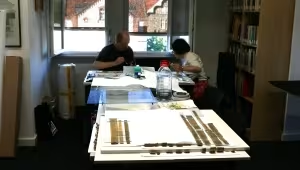
As part of the project “Postcolonial Restitution in the Digital Age: Archiving and Contextualizing a Private Collection of Nepalese Manuscripts,” conservators Mark Barnard and Kumiko Matsuoka visited the research project in September 2023 to work on the conservation of medieval palm-leaf scrolls from a private collection. The previous year, Kumiko Matsuoka and Naoko Takagi had come to Heidelberg for a pilot study. During both visits, a total of 465 palm-leaf scrolls were opened, scanned, and conserved.
 Documenta Nepalica
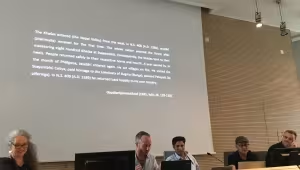
Panel at ECSAS 2023 in Turin
Members of the research project, in collaboration with the Nepal Heritage Documentation Project, organized the panel “Stasis and Motion in the Processional Culture of the Kathmandu Valley: The Buṅgadyaḥ Yātrā Revisited” at the 27th European Conference for South Asian Studies (ECSAS) in Turin in July 2023. The panel, chaired by Manik Bajracharya, Christiane Brosius, and Rajan Khatiwoda, featured presentations by David Andolfatto, Simon Cubelic, Rajan Khatiwoda, Manik Bajracharya, Bruce Owens, Christiane Brosius, Monalisa Maharjan, and Bibek Basukala.
 Monalisa Maharjan
Astrid Zotter Takes Up a Position at Heidelberg University
Effective April 1, 2023, Dr. Astrid Zotter will assume a permanent position as a research assistant in the “History of Culture and Religion in South Asia” department at the Institute for South Asian Studies at Heidelberg University. We would like to express our sincere gratitude to Astrid for her many years of tireless dedication as deputy director of the research project and wish her all the best for her future career.

Panel at the 2022 German Oriental Studies Conference
Project members Simon Cubelic and Astrid Zotter, together with Nina Mirnig (Austrian Academy of Sciences), organized the panel “Inscriptions as Social Artefacts: Revisiting South Asian Epigraphic Cultures” at the 34th German Oriental Studies Conference (September 12–17, 2022) at Freie Universität Berlin. The panel examined the diverse functions that inscriptions played in the construction of spaces, social identities, and political authority in South Asia. The panelists were Diwakar Acharya, Georg Berkemer, Simon Cubelic, Valerie Gillet, Timothy Lubin, Nina Mirnig, and Ingo Strauch.
In addition, Simon Cubelic and Astrid Zotter gave a joint presentation on the relationship between the state and foundations in 19th-century Nepal as part of the panel “Endowments Through the Millennia,” organized by Prof. Joachim Friedrich Quack.
 NHDP
NHDP
New Collaborative Project “Modeling Text Editions as Linked Data (edition2LD)”
The project “Modeling Text Editions as Linked Data (edition2LD)” at the Heidelberg Academy of Sciences and Humanities, led by Dieta Svoboda-Baas and Sabine Tittel, is funded as part of the NFDI Text+ consortium. The project aims to use existing project data from the research center “Religious and Legal Historical Sources of Pre-Modern Nepal” to develop a workflow that maps editions as RDF triples using maximally automated processes and can be transferred to other projects.
 Sabine Tittel
The Research Project welcomes Marija Grujovska as a new member of staff
The Research Project welcomes Marija Grujovska as a new member of staff, who will be pursuing her doctoral research as part of the project. Marija earned a B.A. in Ethnology from the University of Vienna and an M.A. in the Cultural and Religious History of South Asia from the University of Heidelberg. In her dissertation project, Marija examines the administrative history of the Tripureśvara Mahādeva Temple in Kathmandu from its founding in the early 19th century to the present, combining archival and field research methods.

Marija Grujovska
Video Profile of the Research Project Now Online
A short profile of the Research Project is available here on the Heidelberg Academy of Sciences and Humanities’ YouTube channel.
DE Kurzporträt | Vorstellung „Religions- und rechtsgeschichtliche Quellen des vormodernen Nepal“
New Volumes in the Series "Documenta Nepalica"
Documenta Nepalica Band 3
Bajracharya, Manik (Hrsg.), Slavery and Unfree Labour in Nepal: Documents from the 18th to Early 20th Century, Heidelberg: Heidelberg University Publishing, 2022 (Documenta Nepalica – Book Series, Vol. 3), DOI: 10.17885/heiup.1003.
Documenta Nepalica Band 5
Bijay Basukala, Niels Gutschow, Nutandhar Sharma, Patan-Vãbāhā : History and Inventory of a Newar Buddhist Monastery, Heidelberg: Heidelberg University Publishing, 2022 (Documenta Nepalica – Book Series, Vol. 5), DOI: 10.17885/heiup.1116.
Nepal Day at Heidelberg University
The Institute of South Asian Studies (SAI) hosted a Nepal Day on July 21 and 22, 2022, to celebrate the 35th anniversary of the SAI’s branch office in Nepal and the 60th anniversary of the SAI.
The event began with the signing of a Memorandum of Understanding between Heidelberg University and Tribhuvan University, represented by their respective rectors, Prof. Bernhard Eitel and Prof. Shiva Lal Bhusal. This was followed by welcoming remarks from Prof. Rahul Mukherji, Director of the SAI, Rector Prof. Bhusal, and Prof. Christiane Brosius. During the panel discussion “What Have We Learned from Nepal?”, Prof. Niels Gutschow and Prof. Axel Michaels reflected on their many years of research in Nepal.
Nepal Day also provided an opportunity to present ongoing research projects. These included the Nepal Heritage Documentation Project (presented by Rajan Khatiwoda and Bharat Maharjan), the research project “Religious and Legal Historical Sources of Pre-modern Nepal” at the Heidelberg Academy of Sciences (presented by Dr. Manik Bajracharya and Dr. Astrid Zotter), “Urban Transformation and Placemaking” (presented by Prof. Christiane Brosius and Sujan Chitrakar), and “Himalyan Socio-Hydrology: Evidence from Nepal” (presented by Prof. Marcus Nüsser and Dr. Susanne Schmidt).
This was followed by presentations by Prof. Sagar Raj Sharma (Kathmandu University), titled “Dilemmas of a Nation in Transition,” which addressed Nepal’s socioeconomic and environmental challenges, and by Prof. Martin Gaenszle (University of Vienna) on “Ethnic Traditions and Global Archives: Changing Research Conditions in Nepal.” Prof. Gaenszle’s lecture highlighted the potential of digital archiving methods for ethnographic documentation and reflected on the associated challenges.
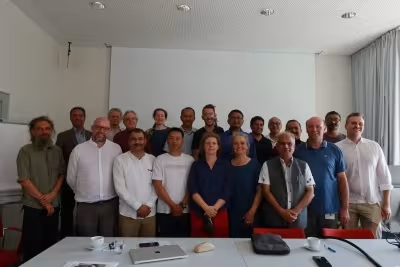 Astrid Zotter
Gruppenfoto der Teilnehmer des Round-Table-Gesprächs
Nepal as a Focus of Asian Studies at Heidelberg University
The Institute of South Asian Studies at Heidelberg University has maintained a branch office in Kathmandu for 35 years. As the Executive Director of the South Asia Institute, Prof. Dr. Rahul Mukherji, emphasizes, Nepal has become a focal point of Asian studies at Heidelberg University. “Nowhere else in the world is there such a concentration of disciplinary and region-specific expertise, research, and projects.”
New Publications
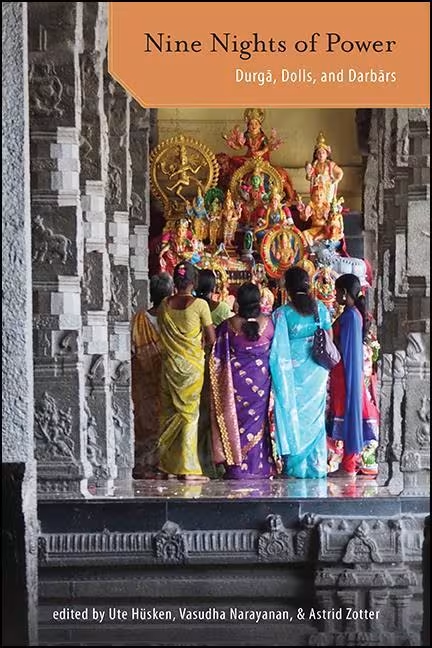
Ute Hüsken, Vasudha Narayanan, Astrid Zotter (Hrsg.), Nine Nights of Power. Durgā, Dolls, and Darbārs, SUNY series in Hindu Studies, 2021, ISBN13: 978-1-4384-8407-5 (Available as a hardcover, Google eBook, and Kindle edition, see here).
New Volume in the Series "Documenta Nepalica"
Documenta Nepalica Band 2
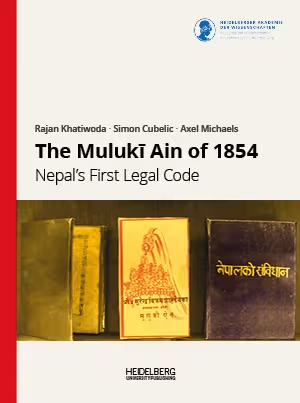
Rajan Khatowoda, Simon Cubelic, Axel Michaels (Hrsg.), The Mulukī Ain of 1854. Nepal's First Legal Code, Heidelberg: Heidelberg University Publishing, 2021 (Documenta Nepalica – Book Series, Vol. 2), DOI: 10.17885/heiup.769.
Conference: “Workshop on Resources and Technologies for Indigenous, Endangered, and Lesser-Resourced Languages in Eurasia (EURALI)”
As part of LREC 2022, the “Workshop on Resources and Technologies for Indigenous, Endangered, and Lesser-Resourced Languages in Eurasia (EURALI)” took place on June 20, 2022, in Marseille. Sabine Tittel presented her work on a place-name ontology for the Documenta Nepalica in the form of a poster and a talk titled “Towards an Ontology for Toponyms in Nepalese Historical Documents.”
Lecture Series
As part of the lecture series “Asian Religions and the Politics of Heritage,” organized by the Institute of South Asian Studies & the Heidelberg Centre for Transcultural Studies, the following lectures took place in June and July:
“Heritage Politics at the Paśupatinātha Temple in Nepal”,
Prof. Dr. Axel Michaels,
Thursday, June 24, 2021, 11:15 a.m., see here.
“Places of Value: Inscriptions as Valorisation Practices at Cultural Heritage Sites in the Kathmandu Valley,”
Dr. Simon Cubelic,
Thursday, July 8, 2021, 11:15 a.m., see here.
Integration of the first 137 inscriptions from DANAM into Documenta Nepalica
As part of the pilot project “Anthropology of Inscriptions: Memory and Cultural Heritage in the Public Sphere” (HCTS/Flagship Initiative “Transforming Cultural Heritage”), the first catalog entries of inscriptions from the Digital Archive of Nepalese Arts and Monuments (DANAM) have been successfully integrated into the Documenta Nepalica database. The dataset containing 137 inscriptions from approximately 60 monuments (marked with the identifier “NHDP”) can now be searched within the Documenta Nepalica catalog, which contains more than 60,000 entries from public and private archives in Nepal. In the future, new entries from the DANAM inscription catalog will be regularly transferred to the database. The transfer is part of efforts to link the databases of both projects and enables further interdisciplinary research on Nepal’s textual, art-historical, and intangible cultural heritage. The Documenta Nepalica catalog search can be accessed here.
Symposium “The Digital Preservation of Asian Manuscripts and Documents” (February 26, 2021)
On February 26, 2021, from 10:00 a.m. to 12:00 p.m. CET, the virtual international symposium “The Digital Preservation of Asian Manuscripts and Documents” took place. The symposium was organized in collaboration with the Department of Digital Archiving and Research at Otani University in Kyoto. The program can be found via the link below.